Canadian Museum of Health Care
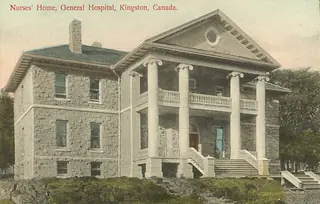
Canada’s museum of health and medicine history in Kingston’s Ann Baillie Building, a 1904 nursing residence and National Historic Site.
Show individual sections
About the museum
The museum’s origins go back to the late 1980s, when local physicians, nurses, museum professionals and Queen’s University scholars set out to save the disappearing artifacts and stories of Canada’s medical past. With support from Kingston General Hospital and Queen’s Faculty of Health Sciences, the decommissioned Ann Baillie Building was turned into a museum, and the Museum of Health Care was founded in 1991.
The Ann Baillie Building, a Beaux-Arts structure of 1904, was built as a residence for nursing students at Kingston General Hospital and was designated a National Historic Site in 1998. The museum opened to the public there in 1995 as the country’s first museum devoted exclusively to the history of health and medicine. A new tower with an elevator was added in 2007, a permanent nursing gallery opened in restored rooms in 2008 and a children’s gallery followed in 2011.
The collection has grown to more than 40,000 artifacts, documents and images, including material acquired in 2002 from the University Health Network’s Canadian Museum of Health and Medicine and the Ralph and Olga Crawford Dental Collection. To reflect its national mission, the museum changed its name from Museum of Health Care at Kingston to Canadian Museum of Health Care in 2026.
Highlights
- Ann Baillie Building, a 1904 nursing residence and National Historic Site
- For Service to Humanity: nursing education at Kingston General Hospital
- Trench Menders: health care in the First World War
- Recreated 1930s doctor’s treatment room with an early electrostatic generator
- Tooth Be Told, with the museum’s deer tooth dentures
- Hands-on Janet & Walter Rosser Children’s Gallery
Permanent exhibitions
- For Service to Humanity – The story of nursing education at Kingston General Hospital from 1886 to 1974, with student life, uniforms and the work of graduates.
- Trench Menders – Nurses, physicians, stretcher-bearers and dentists of the Canadian Army Medical Corps in the First World War and the medical innovations of the time.
- Electricity & The Invisible Ray – A recreated 1930s doctor’s treatment room from Gananoque showing early electrotherapy and X-ray technology.
- Founded
- 1991
- Operated by
- Canadian Museum of Health Care (registered charity)
Admission & discounts
| Adults | CA$10 |
|---|---|
| Reduced | CA$5Seniors 60+, youth 5–16 and full-time students with valid ID |
| Children & teens | CA$5free up to age 4 · Under 5 free; youth 5–16: $5. |
| Seniors | CA$5Seniors 60+. |
| Visitors with disabilities | –Support persons welcome. |
| Students & apprentices | CA$5Full-time students with valid ID. |
| Groups | –Custom group tours for up to 25 people by appointment; 50% fee for cancellations within 48 hours. |
Museum members free. Cash, debit and credit cards accepted.
Booking: not required – tickets at the desk · No pre-registration needed for groups under 10.
Accessibility
- Partially wheelchair accessible
- Elevator
- Accessible restroom: not available
- Accessible parking: no information
- Service dogs welcome
- Tactile models & exhibits: no information
- Sign language tours: no information
- Easy-to-read materials: no information
- Audio description: no information
Barrier-free entrance on George Street (manual door, staff assist) and an elevator to the exhibit floor (2nd floor). The two washrooms on the exhibit floor are not wheelchair accessible; accessible washrooms nearby on the KGH campus. Seating throughout, portable seating on request. Chill Out space in the Children’s Gallery; galleries are generally quiet, but hospital intercom announcements may occur, so sound-dampening headphones are recommended for noise-sensitive visitors. Adult venue guide and kids relaxed guide (social narratives) in English and French. Sensory-friendly visits can be arranged.
Kids & families
Great for kids & families
| Kids’ admission | free up to age 4 |
|---|
- Family tours & workshops
- Hands-on stations
The Janet & Walter Rosser Children’s Gallery has hands-on activity stations and arts and crafts for children of all ages, included with admission.
Getting there & parking
By public transit
Kingston Transit stops within walking distance in downtown Kingston.
By car
No on-site parking at the museum.
The lot next to the museum is reserved for the KGH Cancer Clinic; public street parking on King Street or Barrie Street. Limited accessible parking on the KGH campus.
On the grounds of Kingston General Hospital and Queen’s University, a short walk from City Park and Lake Ontario.
Get directionsAddress & contact
Canadian Museum of Health Care32 George Street
K7L 2V7 Kingston
Ontario, Canada
Amenities & dining
- Café: not available
- Restaurant: not available
Events & venue rental
The museum hasn’t published any information on this.
Plan your visit
| Guided tours | yes |
|---|---|
| School programs | yes |
| Good to know | Drop-in guided tours are included with admission, based on staff availability (ask at the front desk). Groups over 10 should contact the museum in advance. Several exhibits are bilingual (English and French). |
Visitor experiences
Loading experiences …