Canadian Museum for Human Rights
National museum at The Forks in Winnipeg devoted entirely to human rights, with ten core galleries on seven levels and the Tower of Hope lookout.
Show individual sections
About the museum
The idea for a national museum about human rights came from the Winnipeg media entrepreneur Israel Asper, who began working on the project in 2000. In 2003 he set up the Friends of the Canadian Museum for Human Rights and announced the plan at The Forks, as a partnership between the Asper Foundation, the federal and provincial governments, the City of Winnipeg and the owners of the site. Asper died later that year, and his family carried the project forward.
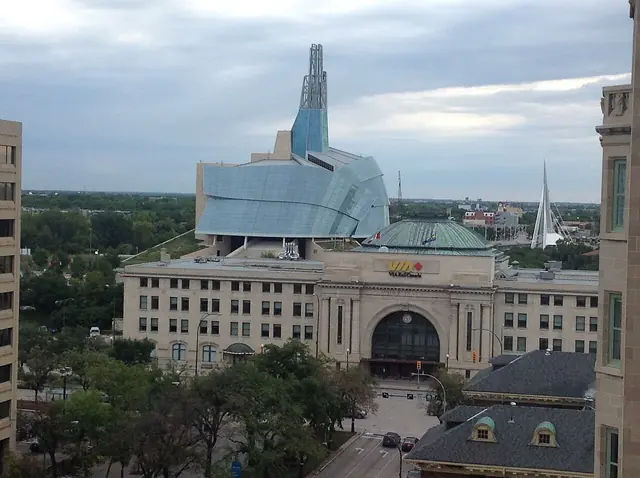
In 2008 Parliament amended the Museums Act and created the museum as a Crown corporation. It was the first new national museum in Canada since 1967 and the first located outside the National Capital Region. The building by the American architect Antoine Predock rises from roots in the earth to a glass cloud and the Israel Asper Tower of Hope; glowing alabaster ramps lead visitors from darkness into light. The museum opened in September 2014.
Rather than a classic collection of objects, the museum tells human rights stories from Canada and around the world through more than 7,000 hours of content, including film, oral histories, interactive exhibits and artifacts. Ten core galleries cover Indigenous perspectives, Canadian journeys, the Holocaust and other genocides, rights today and inspiring change. The museum is also widely known for its inclusive design for visitors with disabilities.
Highlights
- Glowing alabaster ramps through seven levels
- Israel Asper Tower of Hope with 360-degree views of Winnipeg
- Indigenous Perspectives gallery with its circular theatre
- Canadian Journeys gallery with the story of Viola Desmond
- Building by Antoine Predock (2014)
- Inclusive design with Universal Access Points, ASL/LSQ and descriptive audio
- Founded
- 2008
- Operated by
- Canadian Museum for Human Rights (Crown corporation)
- Director
- Isha Khan
Admission & discounts
| Adults | CA$23 |
|---|---|
| Reduced | CA$18Seniors (65+) and post-secondary students with ID |
| Children & teens | CA$11free up to age 6 · Children 6 and under free; youth 7–17 pay $11. |
| Seniors | CA$1865+ with ID |
| Visitors with disabilities | –companion free · People accompanying a person with a disability (support persons) are admitted free; tickets by phone or at the main ticketing desk. |
| Students & apprentices | CA$18Post-secondary students with ID |
| Groups (10+ people) | –Group reservations for 10 or more, with or without a guided tour, in English or French. |
Free admission: Free admission on the first Sunday of every month, on Canada Day (1 July), on the National Day for Truth and Reconciliation (30 September) and on Human Rights Day (10 December).
General admission gives unlimited same-day access to the galleries. Indigenous Peoples (First Nations, Inuit and Métis) are admitted free by self-declaration; this does not apply to special programs or tours. Community organizations can request free admission for small groups. The museum takes part in Canoo.
Booking: not required – tickets at the desk · Tickets are sold at the ticketing desk on site; buying online lets you skip the line.
Accessibility
- Wheelchair accessible
- Elevator
- Accessible restroom
- Accessible parking
- Service dogs welcome
- Tactile models & exhibits
- Sign language tours: no information
- Easy-to-read materials: no information
- Audio description
All entrances are accessible; an Accessible Drop-off Entrance north of the main entrance has four accessible parking stalls, with more along Israel Asper Way. Inclined ramps with resting spots reach every gallery; the main elevator serves levels 1–7 and the Tower Elevator levels 3–8. Accessible single-room washrooms on levels 1, 2, 3, 5, 6 and 7, including an adult-sized change table and transfer lift on Level 1. Manual wheelchairs, scooters, power mobility devices and cane seats can be borrowed at Coat Check (photo ID or credit card as deposit). Universal Access Points with Braille and tactile numbers, cane-stop floor strips, Universal Keypads at touch screens, Braille Gallery Guide on request and free Aira service for blind and low-vision visitors. All videos with spoken words have closed captions in English and French and on-screen ASL and LSQ; the mobile app is also available in ASL and LSQ, with transcripts of the audio guide. Videos include descriptive audio. TTY-capable pay phone near Coat Check. Support persons are admitted free.
Kids & families
Great for kids & families
| Kids’ admission | free up to age 6 |
|---|
- Activity booklet, scavenger hunt or kids’ audio guide
- Hands-on stations
- Stroller-friendly
- Baby changing facilities
Some content is challenging, but many stories suit all ages. The museum publishes age-based guides with suggested pathways for children under 7 (about 45 minutes), children 7 to 12 (about one hour) and teens. Strollers can be borrowed at Coat Check; baby change tables in the single-room washrooms.
Getting there & parking
By public transit
Winnipeg Transit serves The Forks and the museum with many routes; VIA Rail’s Union Station is a short walk away.
By car
No on-site parking at the museum.
No designated museum parking. Paid metered parking (FNP Parking) on Israel Asper Way, William Stephenson Way and Waterfront Drive, in surface lots and The Forks parkade. Accessible stalls at the Accessible Drop-off Entrance.
- Accessible parking
Main entrance at 85 Israel Asper Way. Winnipeg is reached by the Trans-Canada Highway; the airport is about 9 km away (about 20 minutes by car).
Get directionsAddress & contact
Canadian Museum for Human Rights85 Israel Asper Way
R3C 0L5 Winnipeg
Manitoba, Canada
Amenities & dining
- Café
- Restaurant
- Coat check
- Wi-Fi
Free Wi-Fi for visitors (for example to download the mobile app). Bistro Boréal on Level 1 serves meals, snacks and drinks (reservations by phone); Cloud Coffee on Level 5 offers drinks and baked goods. Free coat check staffed by volunteers; backpacks, large bags and umbrellas must be checked. Nut-free and scent-free environment.
Events & venue rental
- Spaces for rent
- Private parties
- Corporate events
- Weddings / ceremonies
Up to 750 guests.
Spaces include Bonnie & John Buhler Hall (up to 750 for a reception), classrooms, the Stuart Clark Garden of Contemplation, a boardroom, two terraces, Bistro Boréal and the Israel Asper Tower of Hope. Catering exclusively by WOW Catering; wedding packages available.
Inquiries & detailsPlan your visit
| Guided tours | yes · approx. 60 min |
|---|---|
| Audio guide | yes (EN, FR) |
| School programs | yes |
| Photography | Photography for non-commercial use is welcome in the galleries; no flash and no bulky equipment. |
| Dogs | not allowed (assistance dogs excepted) · Pets are not permitted; service animals are welcome. |
| Good to know | Ten core galleries on seven levels plus the Tower of Hope viewing platform on Level 8. Guided tours Explore the Galleries in 60 or 90 minutes, offered six days a week, plus themed tours and virtual tours; book online or via tours@humanrights.ca. Free mobile app with a self-guided audio tour in English and French. Galleries are kept at 19–20 °C. Food and drink are not allowed in the galleries or on the ramps. |
Visitor experiences
Loading experiences …