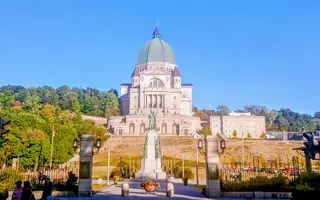
Oratoire Saint-Joseph du Mont-Royal
The largest shrine in the world dedicated to Saint Joseph, on Mount Royal, with a museum of sacred art known for its collection of nativity scenes from around the world.
Show individual sections
About the museum
The Oratory grew out of the devotion of Brother André (Alfred Bessette), doorkeeper of the Collège Notre-Dame of the Congregation of Holy Cross, who was renowned for his healing gifts. In 1904 he had a small wooden chapel built on the side of Mount Royal, facing the college. The influx of pilgrims led to several extensions, followed by the construction of a crypt church completed in 1917.
Work on the basilica began in the 1920s and extended over several decades; its dome, one of the largest in the world, now dominates the Montreal skyline. The building was completed in the 1960s. Brother André, who died in 1937, rests in a tomb in the shrine; he was canonized in 2010.
The Oratory’s museum presents the art and heritage of the shrine. It is best known for its collection of nativity scenes from about a hundred countries, comprising more than 125 works. A permanent exhibition on level 6 traces the life of Brother André, with three period interiors partly reconstructed using authentic elements. The site also includes the original chapel, the votive chapel, the crypt, the basilica with its large organ, a carillon and the Stations of the Cross garden.
Highlights
- Collection of nativity scenes from around the world (more than 125 works)
- Exhibition on the life of Brother André and his period interiors
- Dioramas by Joseph Guardo on the life of Saint Joseph
- Basilica and its dome on Mount Royal
- Original 1904 chapel and the tomb of Saint Brother André
- Stations of the Cross garden
- Founded
- 1967
- Operated by
- Congregation of the Holy Cross
Admission & discounts
| Adults | CA$3 |
|---|---|
| Children & teens | CA$1free up to age 6 · $1 for ages 7 to 17; free for children aged 6 and under. |
| Groups | CA$6 per personChartered bus groups: $6 per person for self-guided visits, $8 for guided visits (by reservation); bus parking free of charge. |
Access to the shrine is free; the admission fee applies to the museum.
Accessibility
- Wheelchair accessible
- Elevator
- Accessible restroom: no information
- Accessible parking
- Service dogs welcome
- Tactile models & exhibits: no information
- Sign language tours: no information
- Easy-to-read materials: no information
- Audio description: no information
Certified accessible by Kéroul (2012). The museum, the exhibition on Saint Brother André and the places of worship are wheelchair-accessible; elevators from the main entrance up to the basilica. Free loan of wheelchairs at the reception desk in exchange for an identity document. Parking spaces reserved for permit holders.
Kids & families
Great for kids & families
| Kids’ admission | free up to age 6 |
|---|
Free access to the shrine for the whole family; free museum admission for children aged 6 and under.
Getting there & parking
By public transit
Accessible by metro and by bus of the Société de transport de Montréal (STM).
By car
Paid parking
Paid parking on site (free for less than 30 minutes, then from $3.75); 120 minutes free for Sunday mass; spaces reserved for group buses.
- Accessible parking
Address & contact
Oratoire Saint-Joseph du Mont-Royal3800, chemin Queen-Mary
H3V 1H6 Montréal
Quebec, Canada
Amenities & dining
- Café
- Museum shop
Food service every day from 8:30 to 19:00; shop Monday to Saturday from 8:30 to 19:00, Sunday from 8:00 to 20:00. The small guide and a site map are offered at the reception desk of the Marcel-Lalonde Pavilion (level 1).
Events & venue rental
- Spaces for rent
Rooms available for hire through the Oratory.
Plan your visit
| Guided tours | yes |
|---|---|
| Dogs | not allowed (assistance dogs excepted) · Only assistance dogs and guide dogs are admitted. |
| Good to know | Guided tours in summer every day at 13:30, online reservation; group visits all year by reservation. Dress code: shoulders covered, no see-through clothing, skirts and trousers at least to mid-thigh. During works, the dioramas are not accessible. |
Visitor experiences
Loading experiences …