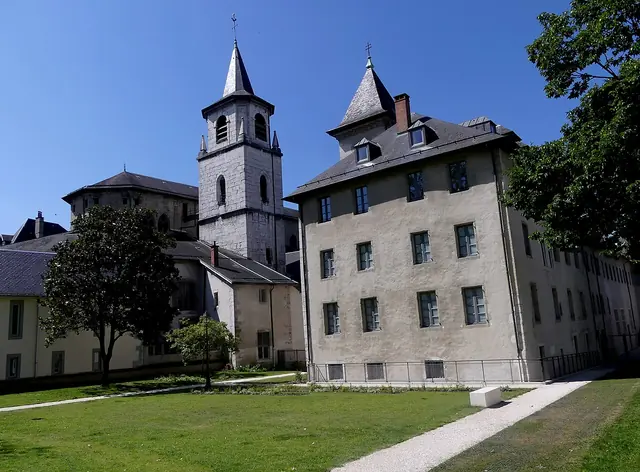
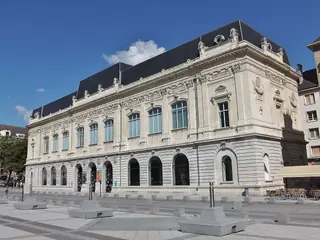
Painting museum in the former Grenette (grain hall) of Chambéry, with about a hundred paintings from the late Middle Ages to the early 20th century, mostly Italian.
Zeina Abirached’s comic panels offer a fully drawn version of Khalil Gibran’s “Le Prophète”. The display is part of the cooperation between Chambéry and Bcharré, in Lebanon.
About the museum
The museum’s first core appeared in 1783 in a room of the Chambéry town hall: a cabinet of curiosities and 5,000 books given to the town by the abbé Philibert de Mellarède. In the 19th century the collections moved several times before settling in 1889 in the former grain hall, together with the library.
This neoclassical grenette was built between 1839 and 1846 to designs by Ferdinando Caronesi. From 1883 the architect François Pelaz enlarged it: he removed the upper storey, kept the stone first floor (ground level) and added two levels with a metal frame. The building was inaugurated on July 14, 1889. Major gifts supported the project, notably those of King Victor-Emmanuel II in 1850 and of Baron Hector Garriod, who bequeathed his entire collection on his death in 1883.
The museum holds about a hundred paintings from the late Middle Ages to the early 20th century, with a strong representation of Italian art from the 14th to the 18th century. The chronological hang runs from the Primitives to Neoclassicism. A major renovation took place from 2009 to 2012: the first floor now houses reception and a café-shop, the second floor the temporary exhibitions, and the third floor the permanent collections and the Artothèque.
Highlights
About a hundred paintings from the late Middle Ages to the early 20th century
Important collection of Italian paintings from the 14th to the 18th century
Neoclassical grenette, enlarged at the end of the 19th century
Audio-tactile route with images to touch
Café-restaurant and shop accessible without a ticket
Permanent exhibition
Collections permanentes de peinture – The third floor presents a chronological route from the Primitives to Neoclassicism, with a strong emphasis on Italian painting.
Operated by
Ville de Chambéry
Visitors per year
approx. 44,474
Admission & discounts
Admission is free.
The permanent collections are free. One or two paid temporary exhibitions are held each year; their prices are not published on the visit page.
Accessibility
Wheelchair accessible
Elevator: no information
Accessible restroom: no information
Accessible parking: no information
Service dogs welcome: no information
Tactile models & exhibits
Sign language tours
Easy-to-read materials: no information
Audio description
The building is fully accessible to visitors with reduced mobility. An audio-tactile route with seven images to touch and an audio description can be requested at reception. Four videos in French Sign Language (LSF) present major works, and each temporary exhibition offers a tour in sign language.
Kids & families
Great for kids & families
Family tours & workshops
Activity booklet, scavenger hunt or kids’ audio guide
Visits and workshops for children aged 2–3, 4–6 and 7–12, plus activity booklets for the temporary exhibitions.
Getting there & parking
The museum is located on Place du Palais de Justice – Robert Badinter in Chambéry.
Hector café-restaurant in the alcoves of the first floor (breakfast, lunch, afternoon snack, Sunday brunch), accessible without a ticket. Museum shop with bookshop and children’s section, also accessible without a ticket.
Events & venue rental
The museum hasn’t published any information on this.
Plan your visit
Guided tours
yes
School programs
yes
Good to know
Guided tours, lectures, concerts and performances for individual visitors. “Coup d’œil” QR codes give a two-minute overview of about twenty paintings, or a tablet can be requested at reception. Groups book in advance.