From the folding screen to painted shelves and later distorted images, the exhibition traces the birth of Korean trompe-l’œil, nourished by Jesuit art and European perspective.
Seulgi Lee installs, from the façade to the museum’s belvedere, a work made of painted wooden semicircles and more than 700 metres of ribbons with bells, inspired by a Korean tradition.
About the museum
The museum owes its origins to Lyon industrialist Émile Guimet, a passionate student of the world’s religions, who gathered a collection of objects brought back from his travels. He first founded a museum in Lyon, then had a new building constructed on the Chaillot hill in Paris, which opened in 1889. Guimet donated it to the State and directed it himself.
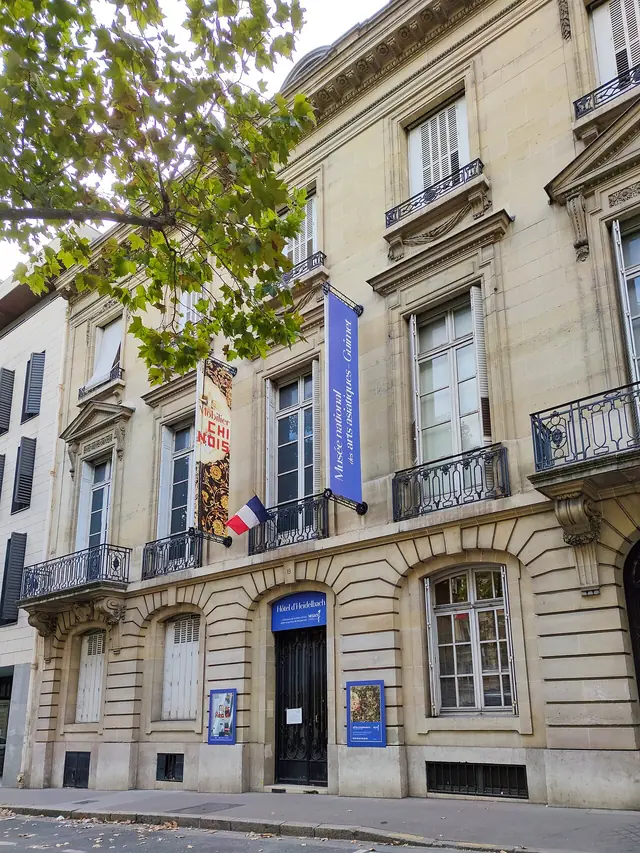
In the 20th century, expeditions and the work of archaeologists such as Joseph Hackin and Philippe Stern enriched the holdings. In 1945, the museum received part of the Louvre’s Asian collections, including the Grandidier collection, and has since been devoted exclusively to the arts of Asia. The Musée d’Ennery, an annex on the avenue Foch, had been attached to it since 1908, and the Hôtel d’Heidelbach on the avenue d’Iéna was added in 1991.
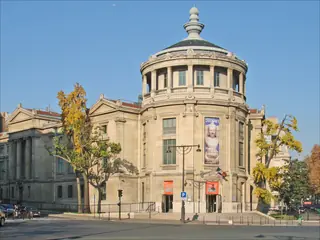
A major renovation, led by architects Henri and Bruno Gaudin, began in 1996 and was inaugurated in 2001. The route now presents works from India, Southeast Asia, China, Japan, Korea, Central Asia, Tibet and Nepal, around the Khmer courtyard (cour khmère) and the rotunda.
Highlights
Khmer sculptures from Cambodia
Art from India and the Himalayas
Ceramics and bronzes from China
Art from Japan and Korea
Library rotunda and dome on the fifth floor
Maison Guimet (Hôtel d’Heidelbach), visitable on a guided tour
Permanent exhibition
Collections permanentes – Art from India, Southeast Asia, China, Japan, Korea, the Himalayas and Central Asia, spread over several floors around the Khmer courtyard.
Founded
1889
Operated by
État – ministère de la Culture (musée national)
Visitors per year
approx. 253,223
Admission & discounts
Adults
€15
Reduced
€12Members of friends’ associations of national museums, visitors paying with holiday vouchers, holders of the large-family card and members of the AFAO; the museum does not offer age-based reduced rates.
Children & teens
freefree up to age 17 · Free admission for visitors under 18.
Seniors
–No reduced rate for seniors.
Visitors with disabilities
freecompanion free · Free and priority admission for the person with a disability and one companion, upon proof.
Students & apprentices
–Visitors aged 18 to 25 who are EU nationals, job seekers and recipients of social minimum benefits receive free or reduced admission upon proof, available only at the ticket desk.
Groups
–Booking is required for groups with a talk; up to 25 people per group in the permanent collections. Lecture-tours cost €160 (adults) or €100 (students) for 1 or 1.5 hours; workshops cost €350; school visits cost €80.
Free admission:First Sunday of the month, for the permanent collections and temporary exhibitions at the Iéna site, without online booking; some events, such as the Nuit des musées, are also free.
The ticket gives access to the permanent collections and the temporary exhibitions. The Paris Museum Pass is accepted for the permanent collections (one entry per site). The Société des amis du musée Guimet offers a membership card with free access.
An external ramp to the left of the entrance steps, two lifts serving the garden level and the three collection floors, and a separate lift to the rotunda on the fifth floor. Accessible toilets are at garden level and on the fourth floor. Three wheelchairs are lent at reception against ID (no booking needed); folding seats are at the entrance to the collections. Induction loops at reception, at the shop checkouts and in the auditorium. Reserved parking spaces on the service lane of the avenue d’Iéna. The third-floor terrace is not accessible to visitors with reduced mobility. The Maison Guimet is not wheelchair-accessible.
Kids & families
Time needed
approx. 1.5 hrs
Kids’ admission
free up to age 17
Activity booklet, scavenger hunt or kids’ audio guide
Baby changing facilities
The museum offers online content for children: youth podcasts (a mystery and storytelling Asian recipes), articles and audio series. Baby-changing table on the fourth floor.
Getting there & parking
By public transit
Iéna
Metro: Iéna (line 9) and Boissière (line 6); RER C: Pont de l’Alma. Bus: Iéna (lines 63, 82, 32), Kléber-Boissière (lines 22, 30), Albert de Mun (line 32). Vélib’ stations: Longchamp – place d’Iéna and Galilée – Kléber.
By car
Paid parking
Covered paid car park Kléber-Longchamp, 65 avenue Kléber, 75016 Paris.
Accessible parking
The metro stations listed have no lifts; all Paris bus lines are accessible.
Maison Guimet (hôtel d’Heidelbach) 19 avenue d’Iéna, 75116 Paris Visits only with a guided tour booked online; the ticket also grants access to the museum’s collections. Not wheelchair-accessible.
The map will load once you have made your cookie choice.
Hanok restaurant, open all year from Wednesday to Monday, 10:00 to 17:30. The Han Rooftop terrace is open from June to September and is currently closed until spring 2027. Bookshop of the Réunion des musées nationaux, accessible without a ticket. Free self-service cloakroom for small bags; wheeled suitcases and cabin bags are not allowed. The museum asks visitors not to eat or drink in the galleries.
Events & venue rental
Spaces for rent
Private parties
Corporate events
Up to 450 guests.
Spaces of the museum and the Maison Guimet for cocktails and breakfasts (up to 450 guests), seated lunches and dinners (up to 100 guests), seminars and conferences (up to 276 people). Catering, guided visits and entertainment are not included. Requests by email to privatisations@guimet.fr.
Photos and films are allowed for private use unless otherwise indicated; flash and additional lighting are prohibited. Drawing is permitted in pencil and coloured pencil only.
Dogs
not allowed (assistance dogs excepted)
Good to know
Suggested visit length: about 1.5 hours for the permanent collections, plus about 45 minutes for a temporary exhibition. The museum does not offer an audio guide; maps in French and English are available at reception. Free presentations take place in the collections on the first Sunday of each month, without booking. A ticket is valid all day, but leaving the museum ends the visit.