Special exhibition on cephalopods such as octopuses and squid and their fossil relatives: evolution, body structure, lifestyle and diversity, shown mainly through ammonites from the Keupp collection.
About the museum
The Paläontologisches Museum is the public part of the Bayerische Staatssammlung für Paläontologie und Geologie (Bavarian State Collection of Paleontology and Geology), which belongs to the Staatliche Naturwissenschaftliche Sammlungen Bayerns (SNSB) and is closely linked with Ludwig-Maximilians-Universität. In the 19th century, researchers such as Johann Andreas Wagner, Albert Oppel, and Karl Alfred von Zittel shaped the collection and made Munich a center of paleontology.
The collection suffered heavy losses in World War II: an air raid in April 1944 destroyed, among other things, the dinosaur fossils discovered in Egypt by Ernst Stromer, including the type specimen of Spinosaurus.
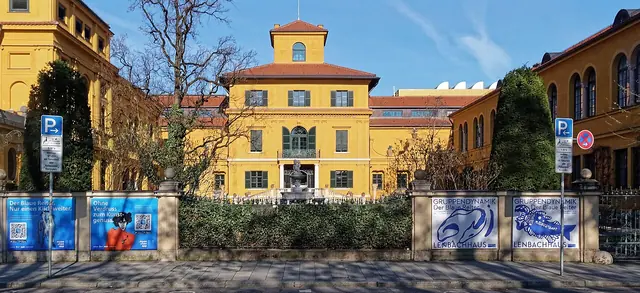
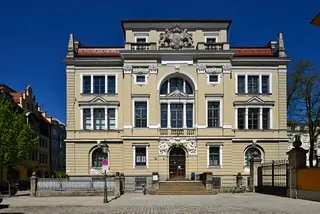
Today the museum is housed in the former municipal school of applied arts on Richard-Wagner-Straße, an eclectic building by Leonhard Romeis from around 1900. The glass-roofed atrium holds large fossils from around the world, from Plateosaurus, Allosaurus, and Triceratops to the giant deer and the primeval elephant Gomphotherium. The third floor leads chronologically through the geological eras and their typical life forms, while the second floor is currently being redesigned. Among the most famous pieces is the only known specimen of Archaeopteryx bavarica from the Solnhofen limestone.
Highlights
Archaeopteryx bavarica from the Solnhofen limestone
Atrium with large fossils such as Plateosaurus, Allosaurus, and Triceratops
Skeleton of the primeval elephant Gomphotherium from Mühldorf
Ice Age mammals such as the giant deer, cave bear, and saber-toothed cat
Free admission
Permanent exhibitions
Großfossilien aus aller Welt – The atrium displays skeletons and casts of dinosaurs, pterosaurs, ichthyosaurs, and large Ice Age mammals.
Vom Stromatolith zum Hamster – A chronological walk through all the geological eras and their typical life forms, on the third floor.
According to the SNSB, wheelchair-accessible with an elevator and accessible restroom.
Kids & families
Great for kids & families
Family tours & workshops
Activity booklet, scavenger hunt or kids’ audio guide
During school holidays, free family tours with scientists on Wednesdays at 14:00, no registration required. On Sundays, a children's quiz on the current exhibition with a small reward. Tours for daycare groups and schools through the MPZ. Free admission.
Getting there & parking
By public transit
Königsplatz
U2/U8 Königsplatz, U1 Stiglmaierplatz, buses 68 and 100 Königsplatz; about a 10-minute walk from the main train station
By car
No on-site parking at the museum.
No museum parking; according to the museum, arriving by car is not advisable.
The museum hasn’t published any information on this.
Plan your visit
Guided tours
yes
School programs
yes
Photography
Photography permitted.
Good to know
Group tours by arrangement (palmuseum@snsb.de); school tours through the Museumspädagogisches Zentrum (buchung@mpz-bayern.de). Changing "Fossil des Monats" (Fossil of the Month) display.