September 19, 2026 – January 2, 2027
Blauw Wit
The exhibition asks why the colour combination of blue and white looks timeless despite changing fashions, and what it has always stood for as a sign of order, purity and reliability.

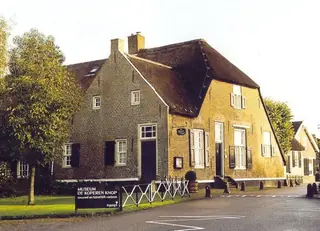
Cultural history museum in a 17th-century farmhouse in Hardinxveld-Giessendam on the history and everyday life of the Alblasserwaard.
September 19, 2026 – January 2, 2027
The exhibition asks why the colour combination of blue and white looks timeless despite changing fashions, and what it has always stood for as a sign of order, purity and reliability.
The Koperen Knop is a stately farm in the Alblasserwaard that was built in the last quarter of the 17th century: the front house of brick, the rear house initially of wood, which was replaced by masonry over the centuries. A wealthy gentleman farmer lived here who held many administrative offices in the region and left the daily work largely to farmhands and maids. In the 1930s a large barn was added behind the house, which a storm destroyed in 1973; on its remains a terrace with a tea house was built, which became the tea garden in 2016.
Until about 1970 the farm was used for agriculture, then the last farmer moved to Groningen as part of land consolidation. The De Kok-de Vos family bought the dilapidated farm, had it restored and used it as a home with an animal feed business and an antiques shop. In 1988 eight entrepreneurs acquired the property and turned it into a museum; it was officially opened in September 1989 by the then Minister of Culture, Eelco Brinkman. It is run by the Stichting Museum De Koperen Knop foundation.
The collection comprises thousands of objects on the history of the Alblasserwaard and is spread throughout the house: the Prunkstube (best parlour), Opkamer with a special wall painting, Rentenierskamer, kitchen and vaulted cellar show the life of farmers of earlier times, and in the Rijgebint there is a tile collection. In the Betuwe pavilion, a wax figure commemorates Trijntje, the oldest buried woman in the Netherlands, whose grave was excavated a few kilometres away. The museum farm also includes a smithy, a hoop-maker's workshop, a cart shed, a Stookhuisje and a garden.
| Adults | €6 |
|---|---|
| Children & teens | €2.50free up to age 3 · Children aged 4 to 14 pay €2.50; under 4 free. |
From age 15 €6. Free with the Museumkaart (adult, youth and child cards) and with the cards of donors and sponsors of the museum. Bankgiro Loterij cards and the Rembrandtpas are not valid.
The exhibition room, part of the middle area and the museum café are accessible. The upper floor can be reached by a stairlift (maximum 100 kg). The front house is accessible by wheelchair via ramps if reserved two opening days in advance. The tea garden has a lowered area; the museum garden has grass paths.
Great for kids & families
| Kids’ admission | free up to age 3 |
|---|
For the exhibitions there are children's search games and often colouring sheets; in the museum and garden children can discover the old way of life, and when the blacksmith is there, they may help out.
Free parking
Free parking on the museum grounds.
Museum café with terrace (drinks, wine and beer, cake, tosti) and in summer a tea garden. Small museum shop with books, postcards, jewellery and textiles; also a library on regional history.
Up to 60 guests.
The upper floor has room for a good 60 people (meetings, presentations, courses; 36 seats for lunch or workshops) and can also be booked for wedding ceremonies. The museum is not suitable for wedding parties and receptions. Enquiries to reserveringen@koperenknop.nl.
Inquiries & details| Guided tours | yes |
|---|---|
| School programs | yes |
| Good to know | Group tours must be reserved in advance (reserveringen@koperenknop.nl). School classes can book museum lessons (September to April, outside school holidays; €70 plus €1 per pupil, supervisors free; enquiries to educatie@koperenknop.nl). |
Loading experiences …