Special exhibition
Astronomisch kabinet van Jean Paulus
Temporarily in the meridian hall: an astronomical clockwork more than three meters wide with globes and planetariums, begun in 1771.
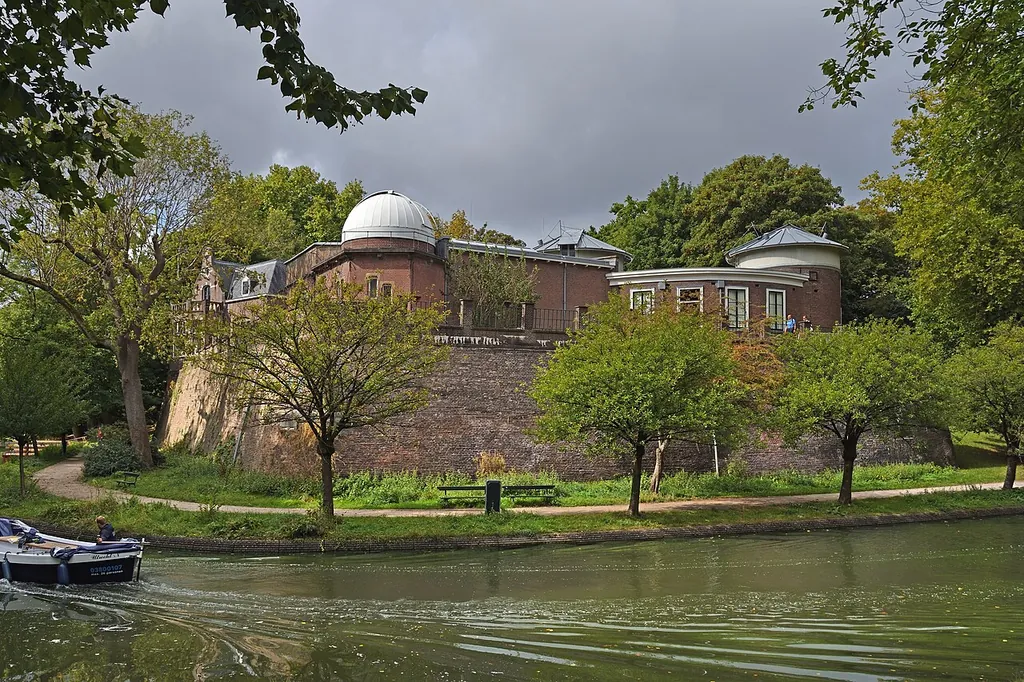
Museum and public observatory on a bastion from 1552: historic telescopes, meteorology and astronomy, stargazing in winter.
Special exhibition
Temporarily in the meridian hall: an astronomical clockwork more than three meters wide with globes and planetariums, begun in 1771.
Sonnenborgh brings together two eras. The bastion was built in the mid-16th century on the orders of Emperor Charles V, who had Utrecht fortified with four bastions against the new artillery; Sonnenborgh is the only one of them to survive almost intact. In the 17th century the university laid out its first botanical garden here, and around 1700 the chemist Johann Conrad Barchusen set up one of the earliest chemical laboratories in the casemates.
In the mid-19th century, the new university observatory was built on the bastion; King Willem III laid the foundation stone in 1853. The core building was designed by the physicist Buys Ballot, who also founded the meteorological institute KNMI here in 1854 – it did not move to De Bilt until 1897. Around 1930, the solar research of Marcel Minnaert and Kees de Jager made the observatory internationally known.
After the astronomical institute moved out in 1987, Sonnenborgh became a museum and public observatory. Between 1998 and 2003, archaeologists uncovered the buried bastion again. In 2018 the renewed exhibition "Ver weg komt dichterbij" opened, and in 2020 the site was recognized as national chemical heritage.
Today the museum presents astronomy and meteorology in largely original rooms: the meridian hall, the solar laboratory, and domes with the 1863 Merz refractor and a large solar telescope. Stargazing evenings are held during the winter half of the year.
| Adults | €13 |
|---|---|
| Reduced | €10Students |
| Children & teens | €8.50free up to age 3 · Children up to age 3 free, ages 4–17 €8.50. |
| Visitors with disabilities | –companion free · Companions of wheelchair users free. |
| Students & apprentices | €10 |
| Groups | –Group tour of 1.5 hrs. for €100 per group (max. 15 people), plus admission. |
| Planetarium surcharge | €5 |
| Stargazing evening (October–March) | €18.50online only; children's evening: price covers the child and an accompanying adult; Museumkaart and discount cards not valid |
Free with the Museumkaart (not sold on site); also free with the VriendenLoterij VIP-KAART (cardholder only), NVON membership card and Voedselbank Cultuurpas. U-pas: adults €8.50, children €5.50. Museum tickets only on the day of the visit at the ticket desk, card payment only. Prices as of January 1, 2026.
Listed historic buildings with thresholds and heavy doors, no elevators; telescopes and bastion reachable only by stairs, no wheelchair-accessible restrooms. Accompaniment recommended. Public accessible parking spaces at Lange Nieuwstraat 106 and Servaasbolwerk 2-3. Every two months on a Sunday (or by arrangement), "Sterren kijken met handen en oren" tours for visually impaired adults; handrails and tactile markings. Quieter days: Tue–Thu.
Great for kids & families
| Kids’ admission | free up to age 3 |
|---|
The permanent exhibition is designed for children aged 8 and up; for ages 3–6 there is the "Voetzoekertjes" search game. Children's observation evenings on Saturdays (ages 6–12, October–March), "Kosmische kindercolleges" (cosmic lectures for kids) for ages 8–12 on the last Wednesday of the month, youth astronomy courses. The "Op Aarde" exhibition is suitable only for ages 16 and up.
Utrecht Vaartsche Rijn · 10-min walk
About a 10-minute walk from Utrecht Vaartsche Rijn station, about 20 minutes on foot from Utrecht Centraal (via the Domtoren, Lange Nieuwstraat and Agnietenstraat).
No on-site parking at the museum.
No dedicated parking; street parking (e.g., Nieuwegracht) is limited and paid. Recommended: Springweg or Station Vaartsche Rijn parking garages (approx. 10-minute walk each).
Entrance on the edge of the Zocherplantsoen in the white building at the top of the hill.
Get directionsNo café or restaurant; food brought along may be eaten in the garden. Museum shop (including eclipse glasses) also accessible without a ticket.
Terreplein (with glass roof), library, Collegezaal (lecture hall) and garden via the caterer Qeet (info@qeet.nl, +31 30 696 6121) for parties, weddings, conferences and dinners.
Inquiries & details| Guided tours | yes · approx. 1.5 hrs |
|---|---|
| Audio guide | yes |
| School programs | yes |
| Good to know | In the "Ver weg komt dichterbij" exhibition, a tablet serves as a guide with questions and experiments. Group tours on request. If it is cloudy, stargazing takes place in the planetarium. |
Cookies help you use this website. We only load the map and statistics with your consent.