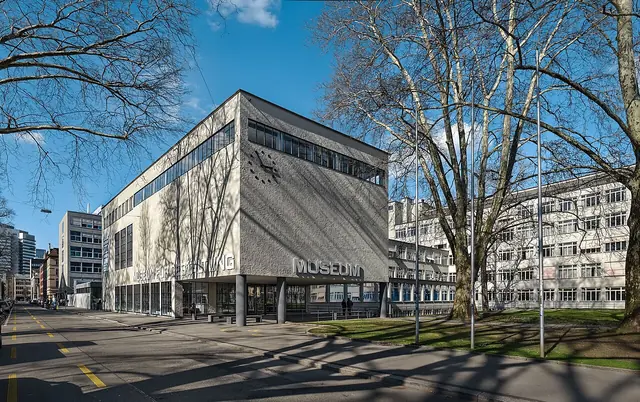
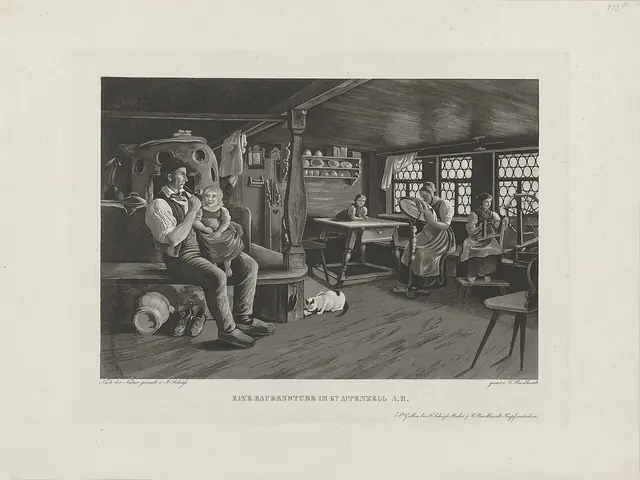
Historical posters and objects from the graphic collection show how design awakens desires and shapes role models and national identities; a second part shows how posters, logos, typography and postage stamps are made.
Shows how wars since the late Middle Ages have shaped Switzerland's politics, economy and society, from the Rütli Oath and the Sonderbund War to the Second World War, and questions the self-image of a neutral country.
About the museum
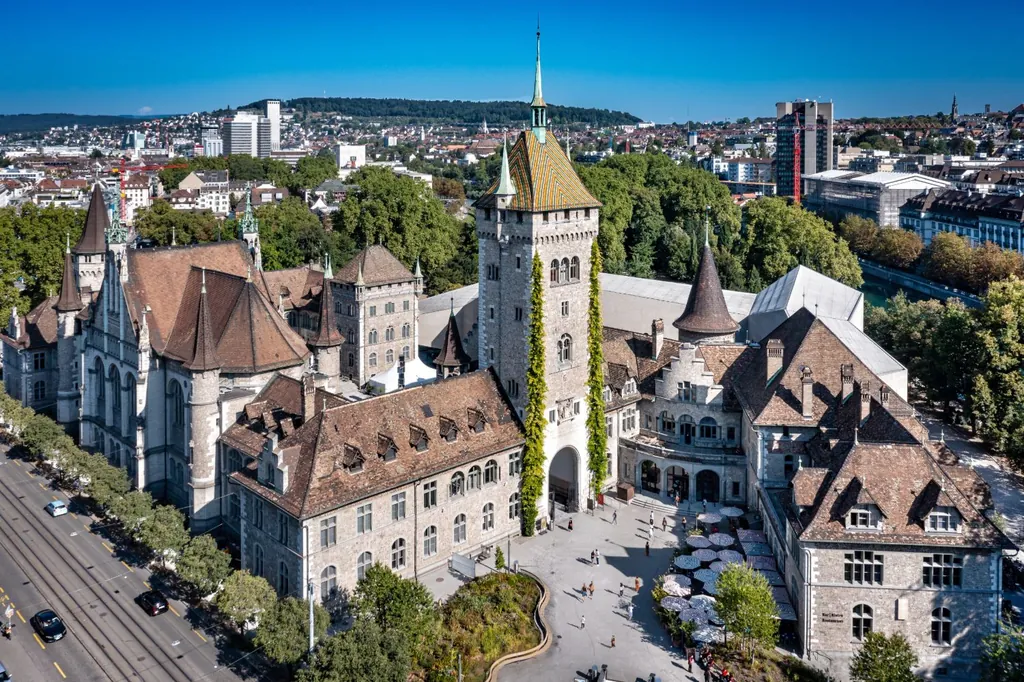
The Landesmuseum Zürich is the most visited cultural-history museum in Switzerland. It presents history from its beginnings to the present, explores Swiss identities and the historical and cultural diversity of the country. It is one of Zurich's most popular sights and lies centrally, right next to the main railway station.
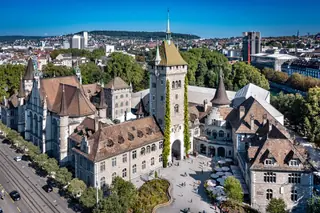
The idea of a national museum came late to Switzerland. The debate was launched in 1883 by the Zurich National Councillor Salomon Vögelin, after the national exhibition on the Platzspitz had been a great success. In 1891 Parliament, after a fierce competition between sites, decided in favor of Zurich and against Bern, Basel and Lucerne. The commission for the building went to the young architect Gustav Gull.
Gull designed a complex in the historicist style with elements from the late Middle Ages and the modern era, in which building, collection and exhibition were meant to form one unit; at the same time the museum was linked with the School of Applied Arts. After six years of construction, the Federal Council opened the Landesmuseum on June 24, 1898 with a large costumed parade. For the Ruhmeshalle (Hall of Fame), Ferdinand Hodler painted his frescoes on the retreat from Marignano in 1900, which had been the subject of earlier dispute.
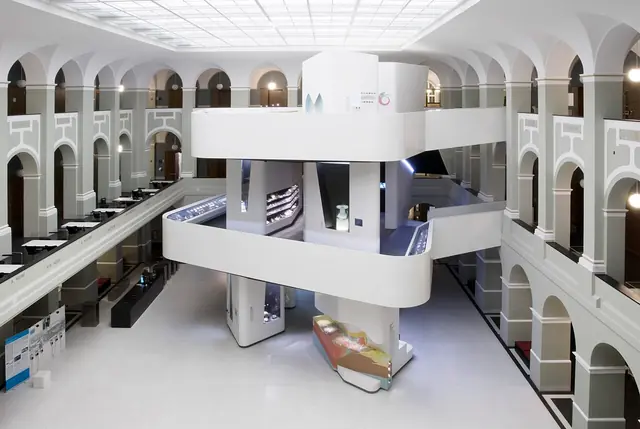
The house is part of the Swiss National Museum, which also includes the Château de Prangins, the Forum Schweizer Geschichte Schwyz and the collection center in Affoltern. The building is an ensemble of a finely detailed historicist original from 1898 and a sculptural wing completed in 2016, with large exhibition halls, a library and an auditorium, which adjoins the existing complex and allows a route through old and new. In 2020 the extensive renovation and extension work, led by the architects Christ & Gantenbein, was completed. At the same time the Landesmuseum was nominated for the renowned "Europäisches Museum des Jahres" (European Museum of the Year) award.
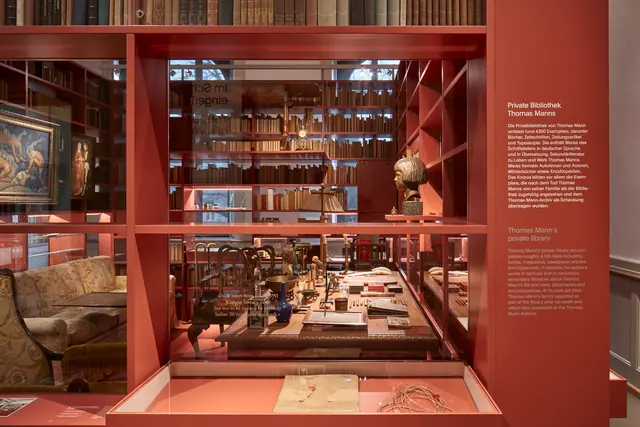
The house on Museumstrasse shows six permanent exhibitions and around eight temporary exhibitions per year. These take up historical, cultural and socially relevant themes, complemented by debates, lectures, readings and workshops. The permanent exhibitions include the history of Switzerland from the 15th century to the present, the archaeology of the country, and historic rooms and cultural-history collections.
Highlights
Permanent exhibition "Geschichte Schweiz" covering 550 years on 1,000 square meters
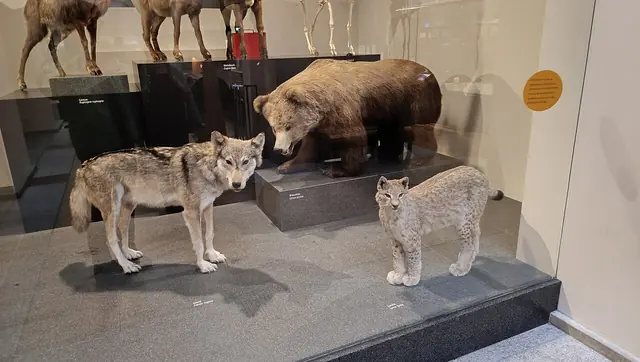
Permanent exhibition "Archäologie Schweiz" with animated projections
Historic Gull building of 1898 with the Ruhmeshalle and Hodler frescoes
Historic rooms and the Trachtenturm (costume tower)
New wing by Christ & Gantenbein (2016)
Family exhibition "Mit fliegendem Teppich durch die Geschichte"
Permanent exhibitions
Geschichte Schweiz – A tour through around 550 years of Swiss history, from the end of the Middle Ages to the present, from a confederation of states to the modern federal state.
Archäologie Schweiz – The most important stages of human history on the territory of today's Switzerland, with animated projections and interactive research stations.
Mit fliegendem Teppich durch die Geschichte – Family exhibition in which children solve puzzles, dress up and listen to stories in three theme rooms on the Orient, shipping and railways.
Founded
1898
Operated by
Schweizerisches Nationalmuseum
Visitors per year
approx. 389,101 (2025)
Admission & discounts
Adults
CHF 13
Reduced
CHF 10AHV (old-age pension), IV (disability insurance) and RAV (unemployment insurance) recipients, pupils and students
Children & teens
freefree up to age 16 · Children and young people up to age 16 have free admission.
Seniors
CHF 10AHV recipients
Visitors with disabilities
CHF 10IV recipients; individual exhibition guidance for people with disabilities is included in the admission.
Students & apprentices
CHF 10Pupils and students
Groups
–Private guided tour for groups of up to 25 people: CHF 180 per tour (60 minutes) plus CHF 10 reduced admission per person; Swiss school classes have free admission with advance registration.
Annual pass (valid for all houses of the Swiss National Museum)
CHF 35
Free admission is granted, among others, to holders of the Swiss Museum Pass, the Raiffeisen MemberPlus card and the ZürichCARD, as well as to members of ICOM, ICOMOS and VMS, Friends of the Landesmuseum, persons with Ausweis N, S or F, military personnel in uniform and media professionals with a press card. The exhibition "Einfach Zürich" is free of charge.
The museum and bistro are accessible via a ramp; the main entrance has an electric door opener, all floors can be reached by elevator, and accessible toilets are available in several places. Not accessible by wheelchair are the family exhibition "Mit fliegendem Teppich durch die Geschichte", the costume tower, the upper chapel and some historic rooms. Two wheelchairs and a stair-climbing wheelchair (SCEWO BRO) can be booked free of charge upon registration; portable folding seats are available. A parking space for holders of the blue badge can be reserved (info@nationalmuseum.ch). Tactile model in front of the museum, tactile tours for people with visual impairments, public tours with interpretation in German-Swiss Sign Language, guide dogs welcome. Individual exhibition guidance 14 days in advance via the reservation desk (+41 44 218 66 00).
Kids & families
Great for kids & families
Kids’ admission
free up to age 16
Family tours & workshops
Activity booklet, scavenger hunt or kids’ audio guide
Hands-on stations
Children and young people up to age 16 have free admission. Family exhibition "Mit fliegendem Teppich durch die Geschichte" (three theme rooms on the Orient, shipping and railways, with puzzles and dressing up), interactive stations in "Archäologie Schweiz", a story window (Wednesday and Saturday afternoons), discovery suitcases, a Globi tour, an annual family day and family workshops. Private strollers are only permitted to a limited extent; buggies and baby carriers can be borrowed.
Getting there & parking
By public transit
Zürich HB
Train to Zürich HB; the museum is right next to it. Tram and bus to "Central", "Bahnhofstrasse/HB" or "Sihlquai/HB".
By car
No own parking for all visitors; car parks at the main station (Sihlquai 41) and Urania (Uraniastrasse 3). One parking space for holders of the blue badge can be reserved.
Accessible parking
The tram stop "Bahnhofquai/HB" is closed until the end of 2026 due to renovation work. The museum is next to the main station at Platzspitz, Museumstrasse 2. Large luggage can be deposited in the SBB lockers at the main station.
Bistro in the foyer (snacks and baked goods) and Restaurant Spitz (evening bar from 17:00); boutique. Lockers in the cloakroom (token from the welcome desk, only for the duration of your visit); small bags up to A3 may be taken into the exhibitions.
Events & venue rental
Spaces for rent
Available to rent are the Willy G. S. Hirzel Auditorium, the Pixel Auditorium, the museum foyer with bistro, a meeting room on the second floor, and the museum courtyard and garden courtyard. Catering through Restaurant Spitz.
Photography is welcome, except in exhibitions and at objects marked with a no-photography sign; photo and film recordings for commercial purposes require a permit.
Good to know
Free "Landesmuseum" app with audio guides and route guidance for your own smartphone. Public tours according to the agenda, with online reservation; private group tours (60 minutes, up to 25 people, in German, French, Italian or English) via the reservation desk, at least two weeks in advance.