Amerind Museum
Anthropology museum and art gallery in Texas Canyon in southeastern Arizona with Indigenous art and archaeology of the US Southwest and northern Mexico.
Show individual sections
About the museum
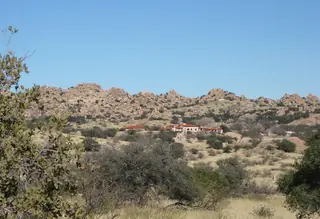
William Shirley Fulton, a Connecticut native drawn to the archaeology and living Native cultures of the Southwest, bought land in Texas Canyon in 1930 for his FF Ranch and built a home among the granite boulders in 1931. He began excavating sites on the property, and in 1937 he incorporated the Amerind Foundation as a private, nonprofit archaeological research institution. Over the following years the museum, library, art gallery, laboratories and staff housing were added; the art gallery was largely the contribution of his wife, Rose Hayden Fulton, who also raised quarter horses on the ranch.
In 1948 Fulton hired Charles C. Di Peso as the foundation’s first professional director. During his three decades at Amerind, Di Peso led excavations at sites in southern Arizona, southwestern New Mexico and northern Mexico, above all at Paquimé in Chihuahua, excavated with Mexico’s INAH between 1959 and 1962 and published in an eight-volume report in 1974. His work helped researchers view the region across the international border as one cultural area.
Amerind no longer excavates but hosts several advanced seminars each year, published in the series Amerind Studies in Anthropology. The museum shows ethnographic and archaeological collections from the Southwest Borderlands, including Zuni and Navajo jewelry, pottery, baskets and textiles, while the Fulton-Hayden Memorial Art Gallery presents art. The surrounding Texas Canyon Nature Preserve has hiking trails.
Highlights
- Without Borders: The Deep History of Paquimé, a bilingual walk-through exhibit
- A century of A:shiwi (Zuni) and Diné (Navajo) jewelry
- Painted elk-hide story robe by the Eastern Shoshone artist Katsikodi
- Fulton-Hayden Memorial Art Gallery
- Trails of the Texas Canyon Nature Preserve among granite boulders
Permanent exhibitions
- Without Borders: The Deep History of Paquimé – Bilingual walk-through exhibit modeled on the architecture of Paquimé in Chihuahua, presenting sixty years of research on this major town of the late 1200s to 1400s.
- American Art Form: A Century of A:shiwi (Zuni) and Diné (Navajo) Jewelry – History and development of Zuni and Navajo jewelry, drawn from a collection assembled over three generations.
- Indigenous Water/Ways – Pottery, baskets, jewelry, weavings and carvings with water motifs, and the ways Indigenous farmers managed water for their crops.
- Founded
- 1937
- Operated by
- Amerind Foundation, Inc.
Admission & discounts
| Adults | $12 |
|---|---|
| Reduced | $10Seniors 62+, college students with ID and youth 10–17 |
| Children & teens | $10free up to age 9 · Children under 10 free; youth 10–17 $10. |
| Seniors | $10Age 62 and over. |
| Students & apprentices | $10College students with ID. |
| Groups (10+ people) | $8 per personBy reservation, for groups of 10 or more. |
| Dual pass museum and trails, adults | $20Seniors and students $15; children under 10 free. |
Museum and trails are ticketed separately. Free for Native Americans with tribal enrollment and through the Blue Star Museums program. Library cardholders in the Tucson area can use the Culture Pass for free admission.
Accessibility
- Partially wheelchair accessible
- Elevator
- Accessible restroom
- Accessible parking
- Service dogs welcome
- Tactile models & exhibits: no information
- Sign language tours: no information
- Easy-to-read materials: no information
- Audio description: no information
The main museum and art gallery have entrance ramps, and all first-floor exhibits in the main building are reached by ramps; the second floor of the main building can be reached through a ground-level outdoor entrance at the back (ask at the admissions desk). The main building has no accessible restroom; accessible restrooms are in the Fulton-Hayden Memorial Art Gallery, which has an elevator, and at the picnic area. One wheelchair available first come, first served. The designated accessible parking space in front of the art gallery is on an unpaved lot. The Fulton Seminar House is not wheelchair accessible.
Kids & families
The museum hasn’t published any information on this.
Getting there & parking
By car
Parking available
Unpaved parking lot.
- Accessible parking
One mile south of I-10 between Benson and Willcox, about an hour east of Tucson: take Exit 318 (Dragoon Road); the entrance is on the left just past mile marker 1.
Get directionsAddress & contact
Amerind Museum2100 N. Amerind Road
85609 Dragoon
Arizona, United States
Amenities & dining
- Café: not available
- Restaurant: not available
- Museum shop
Museum store; picnic area. Wi-Fi is offered to overnight guests of the Fulton Seminar House.
Events & venue rental
- Spaces for rent
- Private parties
- Corporate events
- Weddings / ceremonies
Up to 75 guests.
The historic Fulton Seminar House (about 1930) can be rented for meetings (up to 50 seated), weddings and events (up to 75) and overnight retreats; the Spanish courtyard for daytime outdoor events; the library for private meetings.
Inquiries & detailsPlan your visit
| Guided tours | yes |
|---|---|
| School programs | yes |
| Photography | No photography in the galleries with any device. |
| Dogs | not allowed (assistance dogs excepted) · No pets on the grounds or trails; service dogs are allowed. |
| Good to know | Docent-guided group tours and school visits for groups of 10 or more with at least three weeks’ notice. Curator talks and events throughout the year. Smoking is not allowed on the property. |
Visitor experiences
Loading experiences …