Arizona-Sonora Desert Museum
Living museum of the Sonoran Desert west of Tucson, combining native animals and gardens with a cave and mineral gallery, an aquarium and art galleries.
Show individual sections
About the museum
The Arizona-Sonora Desert Museum was founded in 1952 by William H. Carr with financial backing from the conservationist Arthur Newton Pack. Its aim was to explain the natural history of the Sonoran Desert through combined displays of native plants and animals. Buildings put up on the site in the 1930s by the Civilian Conservation Corps were adapted as exhibit spaces, offices and a shop.
The museum expanded step by step: the Cave and Earth Sciences exhibits opened in 1973, presenting cave habitats and the mineral wealth of the region, followed by the Mountain Woodland habitat in 1986, the Hummingbird Aviary in 1988 and the Desert Grassland in 1992. In 1994 the museum excavated Sonorasaurus, a dinosaur later named Arizona's state dinosaur, and opened the Ironwood Gallery; the Art Institute followed in 2001.
Today about 85 percent of the 98-acre campus lies outdoors. Around two miles of paths lead past more than 230 animal species and about 1,200 kinds of plants, an aquarium, four aviaries, the Earth Sciences Center with its mineral collection and art galleries. The museum is also active in research and conservation across southern Arizona and Sonora.
Highlights
- Earth Sciences Center with a replica limestone cave and mineral gallery
- Ancient Arizona with fossil digging and the state dinosaur Sonorasaurus
- Warden Aquarium with species from the Gulf of California
- Raptor Free Flight demonstrations
- Art Institute and Ironwood Gallery
Permanent exhibitions
- Earth Sciences Center – Replica limestone cave on the geology of the region, leading to a mineral gallery with specimens from the museum's collection.
- Ancient Arizona – Exhibit on prehistoric Arizona with fossil digging and the dinosaur Sonorasaurus, excavated by the museum.
- Warden Aquarium – Two galleries on freshwater and marine life of the region, including species from the Gulf of California.
- Founded
- 1952
Admission & discounts
| Adults | $29.95 |
|---|---|
| Children & teens | $24.95free up to age 2 · Youth 3–12 $24.95; children 2 and under free. |
| Seniors | –$2 discount for ages 65 and over with ID. |
General admission applies to ages 13–64. Native Americans with tribal ID or CIB enter free. Arizona and Sonora residents receive a $5 discount (seasonal); active and retired military with ID $2 off. Community Access Program: $20 off general and $17 off youth tickets for holders of EBT, WIC or SNAP documentation with photo ID plus up to three additional people. Discounts are given at the front gate with proof of eligibility.
Accessibility
- Partially wheelchair accessible
- Elevator: no information
- Accessible restroom: no information
- Accessible parking
- Service dogs welcome
- Tactile models & exhibits: no information
- Sign language tours: no information
- Easy-to-read materials: no information
- Audio description: no information
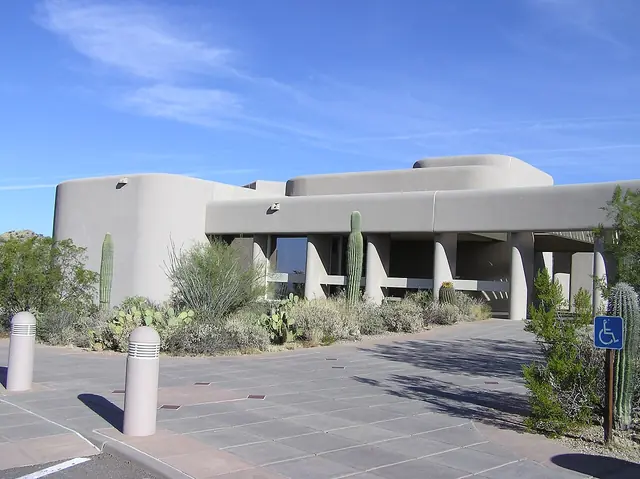
All buildings and most restrooms are wheelchair accessible, with ramps wherever there are stairs; about half of the paths are paved and some sections are hilly, and about 96 percent of exhibits can be viewed from a wheelchair. The Earth Sciences cave entrance is dark with changes in floor and ceiling level. Manual wheelchairs ($8), strollers ($9) and electric scooters ($29) can be rented at the front ticket window. Accessible parking in Lot 1, rows 1A and 1B; drop-off zone about 98 feet from the main entrance. Assistive listening devices free of charge in the Warden Oasis Theater. ASL interpretation and tours for visitors with visual impairments on request at least three weeks in advance. Service animals are welcome but should check in at Guest Services; access to some animal areas may be limited.
Kids & families
Great for kids & families
| Time needed | approx. 2 hrs |
|---|---|
| Kids’ admission | free up to age 2 |
- Family tours & workshops
- Hands-on stations
- Playground / play area
Packrat Playhouse is an indoor, air-conditioned climbing area; Spadefoot Splash offers water play for children up to five; Ancient Arizona lets visitors dig for fossils; Stingray Touch. Strollers for rent; kids' meals at Ironwood Terraces. Camps and family programs.
Getting there & parking
By car
Parking available
Accessible parking in Lot 1.
- Accessible parking
No public transportation to the museum. Rideshare drop-off is possible, but cell phone service is limited, so a taxi may be easier for the return trip.
Get directionsAddress & contact
Arizona-Sonora Desert Museum2021 N. Kinney Rd.
85743 Tucson
Arizona, United States
Amenities & dining
- Café
- Restaurant
- Museum shop
Ironwood Terraces food court (lunch 11:00–14:00), Ocotillo Café with regional Southwest cuisine, and Phoebe's Coffee Bar. Mountain House Gift Shop (8:30–17:00) and Ironwood Gift Shop (10:00–16:00). No outside food; small picnic area just outside the entrance. Refill stations for water bottles on the grounds.
Events & venue rental
- Spaces for rent
Plan your visit
| Guided tours | yes |
|---|---|
| School programs | yes |
| Photography | Non-professional photos for personal use are allowed; professional photographers must follow the photography policy. |
| Dogs | not allowed (assistance dogs excepted) · No pets on the grounds; only service animals are permitted. |
| Good to know | About 85 percent of the museum is outdoors on walking paths; most visitors stay two to three hours, and arriving before mid-afternoon is recommended. Docents give tours and interpretive demonstrations; live animal presentations of 25–30 minutes in the Warden Oasis Theater and seasonal Raptor Free Flight. Bring water, sun protection and comfortable shoes. |
Visitor experiences
Loading experiences …