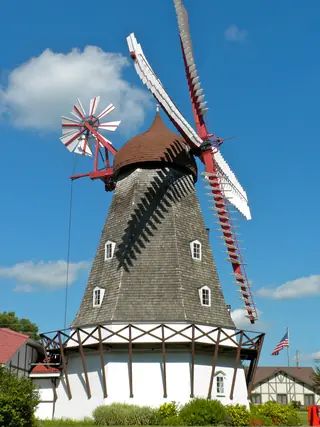
Danish Windmill
Working 1848 windmill from Denmark, rebuilt in Elk Horn in 1976, with tours inside the mill and Danish-American exhibits on the grounds.
Show individual sections
About the museum
The Danish Windmill in Elk Horn was built in 1848 by Jens Olesen just north of Nørre Snede in Jutland, where it ground flour for a fast-growing rural population. Over more than a century it survived a relocation, at least three fires and many owners and millers. By the time representatives from Elk Horn first saw it in 1975, it had been idle for at least ten years.
The idea of bringing a real Danish mill to Iowa came from Harvey Sornson after a trip to Denmark in 1975. The community raised the money, and the Danish Mill Corporation was set up in November 1975 to buy, move and maintain the mill. It was taken apart, shipped across the Atlantic and reached Elk Horn in February 1976, where more than 300 volunteers reassembled it piece by piece. Elk Horn and the neighboring towns were settled by Danish immigrants, part of the roughly 300,000 Danes who came to the United States between 1850 and 1914. The organization describes the windmill as the only working Danish windmill in the United States; Denmark banned the export of windmills in 1977.
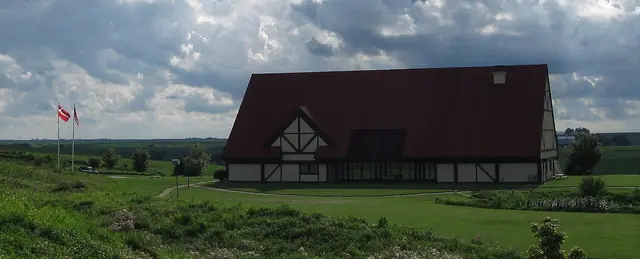
The mill is about 60 feet tall with sails 66 feet across and can grind more than two tons of flour a day. Tours start with a short documentary on its reconstruction, followed by an introduction inside and a self-guided visit of the lower three floors, a second-floor gallery and a viewing deck on the fourth floor that looks into the cap. The grounds also hold the Vikinghjem, a replica home from around 900 CE built by Viking interpreters, the Morning Star Chapel built in 1951, and Richard Storkfelt's miniature model of the Danish town of Ebeltoft.
Highlights
- Working Danish windmill built in 1848 and rebuilt in Elk Horn in 1976
- Original millstones, gears and axles inside the mill
- Viewing deck on the fourth floor looking into the mill's cap
- Vikinghjem replica of a home from around 900 CE
- Miniature Ebeltoft Village and the Morning Star Chapel
Permanent exhibitions
- Inside the 1848 Windmill – Exhibits inside the working mill explain its history and engineering, with the original millstones, gears and axles and local heritage objects.
- Danish-American Heritage Grounds – Outdoor exhibits include a Viking-era home replica, the Morning Star Chapel of 1951 and a hand-built miniature of the Danish town of Ebeltoft.
- Founded
- 1976
- Operated by
- Danish Mill Corporation
Admission & discounts
| Adults | $5 |
|---|---|
| Children & teens | freefree up to age 12 · Children 12 and under free. |
A virtual tour of the windmill and grounds is available online for a suggested donation of $5 per household.
Accessibility
- Partially wheelchair accessible
- Elevator: not available
- Accessible restroom: no information
- Accessible parking: no information
- Service dogs welcome: no information
- Tactile models & exhibits: no information
- Sign language tours: no information
- Easy-to-read materials: no information
- Audio description: no information
Access beyond the ground floor of the windmill requires stairs and ladders. A free virtual tour can be viewed on site instead.
Kids & families
Great for kids & families
| Kids’ admission | free up to age 12 |
|---|
The windmill invites families to bring children and spend the day exploring the mill and the grounds with the Vikinghjem, chapel and miniature village.
Getting there & parking
About 5 minutes from Interstate 80: take Exit 54 and head north to Elk Horn.
Get directionsAddress & contact
Danish Windmill4038 Main Street
51531 Elk Horn
Iowa, United States
Amenities & dining
- Museum shop
The Heritage Market gift shop sells Danish and Scandinavian gifts, Christmas items and heritage goods; selected items are also sold online.
Events & venue rental
The museum hasn’t published any information on this.
Plan your visit
| Guided tours | yes |
|---|---|
| Good to know | Tours of the windmill run daily: a short documentary on the reconstruction and a brief introduction inside the mill, then a self-guided visit of the lower three floors, the second-floor gallery and the fourth-floor viewing deck. On windy days the sails may be turning; an on-site weather station shows current conditions online. |
Visitor experiences
Loading experiences …