Mill Hill Historic Park
Group of historic buildings above Norwalk Harbor, kept by the Norwalk Historical Society, with a town house, schoolhouse and colonial law office.
Show individual sections
About the museum
Mill Hill rises above the head of Norwalk Harbor, where the town's first commercial wharves and much of its early trade were located. Norwalk built its first town house on the hill in 1746; it was burned along with much of the town by British troops under General Tryon in July 1779. A second town house followed in the 1790s, and in 1835 the present brick Town House was put up on the same site by Lewis Raymond Jr., reportedly using bricks that had arrived in Norwalk as ship ballast.
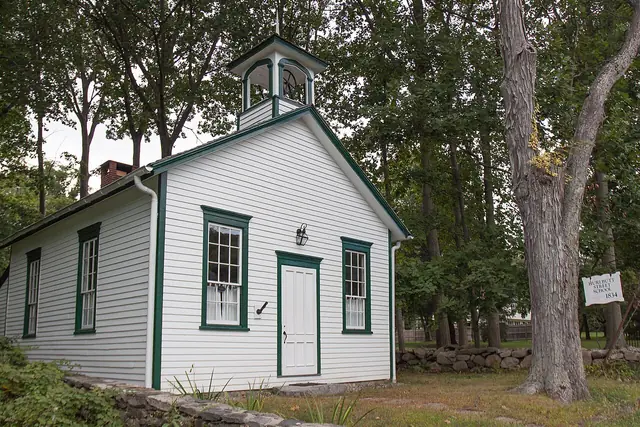
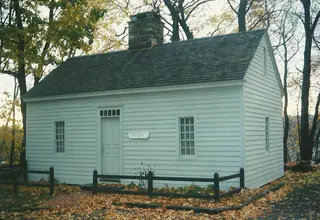
From the 1960s onward the Norwalk Historical Society gathered further buildings around the Town House. The Downtown District Schoolhouse, a one-room school in use by 1826 and later a private home, was moved to Mill Hill in 1971 and restored. The same year the kitchen wing of the house of Thomas Fitch, colonial governor of Connecticut from 1754 to 1766, was saved from the construction of Interstate 95, moved to the hill and rebuilt as a colonial law office.
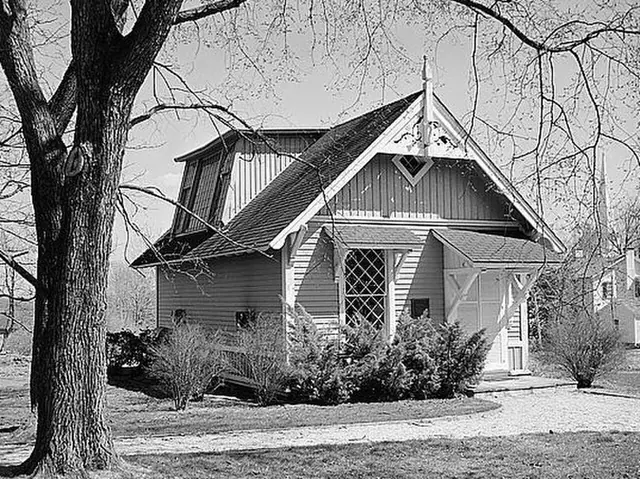
The park also takes in the Mill Hill Burying Ground, established in 1767 and one of the oldest cemeteries in Norwalk, a colonial herb garden, and a lockup and barn on Smith Street that once belonged to the A. E. Smith pottery works. Exhibits in the buildings cover Norwalk from the end of the Ice Age to 1835, the history of one-room schools in the town and the life of Governor Fitch.
Highlights
- 1835 brick Norwalk Town House on the site of the town's earlier meeting houses
- 1826 Downtown District Schoolhouse, a restored one-room school
- Reconstructed c. 1740 law office of Governor Thomas Fitch
- 1767 Mill Hill Burying Ground and colonial herb garden
- Hands-on exhibit on Norwalk communities from 13,000 BC to 1835
Permanent exhibitions
- Norwalk’s Changing Communities: 13,000 BC–1835 – Interactive exhibit tracing Norwalk from the first Indigenous inhabitants after the Ice Age through European settlement to the early industrial era, with hands-on activities.
- One Room Schoolhouses: a History of Education in Norwalk 1650–1870 – Exhibit in the 1826 schoolhouse on how children in Norwalk were taught before public graded schools.
- The Fitch Law Office: A Colonial Governor’s Legacy – The reconstructed law office presents the life and career of Thomas Fitch, colonial governor of Connecticut.
- Operated by
- Norwalk Historical Society
Admission & discounts
| Groups | –Guided tours of the buildings for non-school groups are available May–November; contact the Norwalk Historical Society to arrange a tour. |
|---|
The park grounds are open to the public at all times during daylight hours.
Accessibility
The museum hasn’t published any information on this.
Kids & families
Great for kids & families
- Hands-on stations
The exhibit on Norwalk communities from 13,000 BC to 1835 is designed for families, with hands-on activities and games.
Getting there & parking
By car
Parking available
A small lot next to the Town House has room for a limited number of cars.
At the top of Mill Hill, overlooking the head of Norwalk Harbor.
Get directionsAddress & contact
Mill Hill Historic Park2 East Wall Street
06851 Norwalk
Connecticut, United States
Amenities & dining
The museum hasn’t published any information on this.
Events & venue rental
The museum hasn’t published any information on this.
Plan your visit
| Guided tours | yes |
|---|---|
| School programs | yes |
| Good to know | Group tours of the buildings by appointment, May–November. School groups can book the Little Red Schoolhouse Program in the 1826 schoolhouse. |
Visitor experiences
Loading experiences …