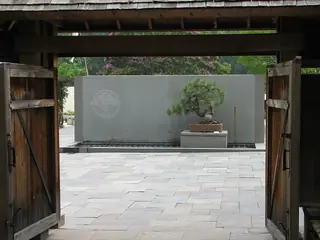
National Bonsai and Penjing Museum
Museum of living bonsai and penjing trees at the U.S. National Arboretum, with Japanese, Chinese and North American collections in several pavilions.
Show individual sections
About the museum
The museum traces its beginnings to the American Bicentennial: in July 1976 the Nippon Bonsai Association presented fifty-three bonsai trees from Japan to the U.S. National Arboretum as a gift to the people of the United States. Small potted trees had already reached the Arboretum in 1972, when penjing from China were given to President Richard Nixon.
In the 1980s the museum accepted a large collection of Chinese penjing from Dr. Yee-sun Wu of Hong Kong, so that it could show both main traditions of the art. A North American collection followed, made up of trees donated by artists from across the continent, and further donors added specimens to all collections.
The museum is arranged around the Maria Vanzant Upper Courtyard. Visitors move from the Mary E. Mrose International Pavilion to the Yee-sun Wu Chinese Pavilion, the Japanese Pavilion (renovated and reopened in 2017), the John Y. Naka North American Pavilion and the Kaneshiro Tropical Conservatory; the Yuji Yoshimura Center provides space for demonstrations and staff. The National Bonsai Foundation supported the museum for more than forty years until it ended operations at the end of 2025; Friends of the National Arboretum is now the Arboretum’s nonprofit partner.
Highlights
- Bonsai presented by Japan for the 1976 Bicentennial
- Yee-sun Wu collection of Chinese penjing
- North American bonsai by artists from across the continent
- Japanese Pavilion renovated in 2017
- Tropical conservatory and collection of viewing stones
Permanent exhibitions
- Japanese Collection – Bonsai in the Japanese Pavilion, beginning with the trees given by Japan in 1976.
- Chinese Collection – Penjing, the older Chinese form of the art, centered on the trees donated by Dr. Yee-sun Wu.
- North American Collection – Bonsai created and donated by artists from across North America, many from native species.
- Founded
- 1976
- Operated by
- U.S. National Arboretum (U.S. Department of Agriculture)
Admission & discounts
Admission is free.
Admission to the museum and the National Arboretum is free.
Accessibility
- Wheelchair accessible
- Elevator: no information
- Accessible restroom: no information
- Accessible parking: no information
- Service dogs welcome: no information
- Tactile models & exhibits: no information
- Sign language tours: no information
- Easy-to-read materials: no information
- Audio description: no information
The museum is wheelchair accessible.
Kids & families
The museum hasn’t published any information on this.
Getting there & parking
By public transit
No rail line serves the Arboretum directly; Metrobus stops are nearby. Union Station (Amtrak, MARC, Metrorail) is the closest major hub, with a bus or ride share from there. Capital Bikeshare station outside the R Street entrance.
By car
Free parking
Free parking in several marked lots on the Arboretum grounds; parking along roads or on the grass is not allowed.
Arboretum entrances: 3501 New York Avenue NE and 2400 R Street NE (recommended for GPS and ride shares). The museum lies inside the grounds.
Get directionsAddress & contact
National Bonsai and Penjing Museum3501 New York Avenue NE
20002 Washington
Washington, D.C., United States
Amenities & dining
Restrooms, water fountains and vending machines at the Arboretum Visitor Center and at Arbor House.
Events & venue rental
The museum hasn’t published any information on this.
Plan your visit
| Photography | Special-occasion, portrait and commercial photography on the Arboretum grounds may require a USNA photography permit. |
|---|
Visitor experiences
Loading experiences …
Museums nearby
All 64 museums in Washington All museums in Washington, D.C.