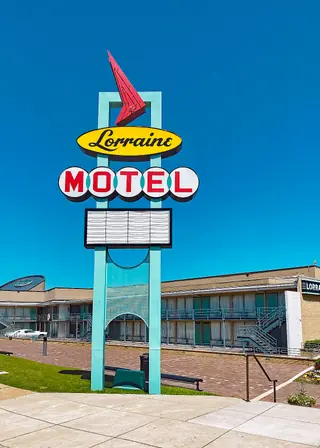
National Civil Rights Museum
Museum at the former Lorraine Motel in Memphis, where Martin Luther King Jr. was killed in 1968, tracing the American civil rights movement from slavery to today.
Show individual sections
About the museum
The building began as the Windsor Hotel around 1925 and was bought in 1945 by Walter Bailey, who renamed it the Lorraine. In the era of segregation it was one of the few places in Memphis where African American travelers could stay; musicians from Stax Records and touring stars were regular guests, and a two-story motel wing was added in 1955. Martin Luther King Jr. stayed there several times and was shot on the balcony outside Room 306 on April 4, 1968, while in Memphis to support striking sanitation workers.
The National Civil Rights Museum opened there in 1991. The State of Tennessee owns the motel structure, while the museum is run by the nonprofit Lorraine Civil Rights Museum Foundation. A renovation costing $27.5 million in 2013 and 2014 added more than 40 films, oral histories and interactive media.
The permanent galleries follow African American resistance and the struggle for civil rights from slavery in the colonial era through the Montgomery Bus Boycott, the student sit-ins and the Freedom Rides to the Poor People's Campaign and movements since 1968. Further galleries cover the assassination and its aftermath, the Freedom Award honorees and Room 306, which visitors view from the corridor. The museum is accredited by the American Alliance of Museums and is a founding member of the International Coalition of Sites of Conscience.
Highlights
- Room 306 and the balcony of the Lorraine Motel
- A Culture of Resistance: Slavery in America 1619–1861
- The Year They Walked: Montgomery Bus Boycott 1955–1956
- We Are Prepared to Die: The Freedom Rides 1961
- Assassination & Aftermath exhibit on the investigation of King's killing
Permanent exhibitions
- A Culture of Resistance: Slavery in America 1619–1861 – The opening gallery shows how enslaved Africans and their descendants resisted bondage in America over more than two centuries.
- The Year They Walked: Montgomery Bus Boycott 1955–1956 – The gallery recalls the yearlong boycott of segregated city buses in Montgomery, Alabama.
- Standing Up by Sitting Down: Student Sit-Ins 1960 – The exhibit presents the lunch counter sit-ins led by students across the South in 1960.
- Founded
- 1991
- Operated by
- Lorraine Civil Rights Museum Foundation
Admission & discounts
| Adults | $25 |
|---|---|
| Reduced | $23Seniors 65 and over and college students |
| Children & teens | $22free up to age 4 · Children 5–17 pay $22; children 4 and under free. |
| Seniors | $23Ages 65 and over |
| Students & apprentices | $23College students |
| Groups (20+ people) | $23 per personGroups of 20 or more booked at least two weeks ahead: adults $23, children 5–17 $20, seniors and college students $21; bus drivers and active-duty military free, one free chaperone per eight children. |
Free admission: Free Period Mondays: free admission for Tennessee residents with state-issued ID on Mondays from 15:00 until closing (one adult and up to five children; not on holidays, special events or for groups).
Online tickets are non-refundable.
Booking: booking online recommended · timed-entry tickets · Timed-entry tickets are sold online; arrive 15 minutes early. Walk-up visitors are admitted as availability allows.
Accessibility
- Wheelchair accessible: no information
- Elevator: no information
- Accessible restroom: no information
- Accessible parking: no information
- Service dogs welcome
- Tactile models & exhibits: no information
- Sign language tours: no information
- Easy-to-read materials: no information
- Audio description: no information
Free sign-language interpretation and tour guides for deaf and hard-of-hearing guests with at least two weeks' notice (ASL interpretation); free tour guides for blind and low-vision guests with 48 hours' notice; up to ten people per guide. Assistive listening devices for the two main theaters and transcripts of the audio elements are available at the admissions desk. All films have open captions. Trained service animals are welcome.
Kids & families
Only partly suitable for kids
| Time needed | approx. 1.75 hrs |
|---|---|
| Kids’ admission | free up to age 4 |
The museum contains sensitive material that may be frightening for children and adolescents; a family guide with suggestions for discussing difficult topics is available.
Getting there & parking
By car
Free parking
Free visitor lot; enter by turning north on Mulberry Street from G.E. Patterson Avenue.
In the South Main District of downtown Memphis.
Get directionsAddress & contact
National Civil Rights Museum450 Mulberry Street
38103 Memphis
Tennessee, United States
Amenities & dining
- Museum shop
Museum store with items on the civil rights movement. Oversize bags must be checked with security; all guests go through a security screening.
Events & venue rental
- Spaces for rent
- Private parties
- Corporate events
Event spaces for conferences, receptions, dinners, meetings and reunions; events must fit the museum's mission.
Inquiries & detailsPlan your visit
| School programs | yes |
|---|---|
| Photography | Photos without flash are allowed in the exhibitions; video only with prior authorization; no photos inside the Room 306 enclosure. |
| Dogs | not allowed (assistance dogs excepted) · Only service animals are allowed. |
| Good to know | A typical visit takes 1.5 to 2 hours; guests starting in the last hour may have a shortened experience. |
Visitor experiences
Loading experiences …