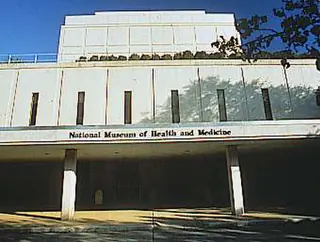
National Museum of Health and Medicine
Free Department of Defense museum in Silver Spring on the history of military medicine, anatomy and pathology, founded in 1862 as the Army Medical Museum.
Show individual sections
About the museum
Surgeon General William Hammond founded the Army Medical Museum in 1862, during the Civil War, as a collection of specimens for research into military medicine and surgery. Medical officers in the field sent in anatomical specimens along with bullets and other foreign bodies, and the first curator, John Brinton, gathered material on the battlefields of the mid-Atlantic. Photographs of wounded soldiers and surgical results fed into the six-volume Medical and Surgical History of the War of the Rebellion, published from 1870 to 1883.
In the decades that followed, museum staff pioneered photomicrography and took part in research on infectious diseases, including the work that proved the cause of yellow fever and studies on typhoid vaccination. From the 1940s the museum was tied to the Army's pathology institute, later the Armed Forces Institute of Pathology, and its name changed several times before it became the National Museum of Health and Medicine in 1989. In the early 1990s it acquired a large neuroanatomy collection and the embryology collection of the Carnegie Institution.
After decades on the campus of the former Walter Reed Army Medical Center, the museum moved to Silver Spring, Maryland, in 2011. Since 2015 it has been part of the Defense Health Agency. Its exhibitions cover combat casualty care, traumatic brain injury, the history of vaccines, forensic identification and human anatomy and pathology.
Highlights
- Civil War medical collections
- Military Medicine: Challenges and Innovations exhibition
- The Human Body: Anatomy and Pathology with real specimens
- Hands-on Discovery Carts with plastinated organs
- Founded
- 1862
- Operated by
- Defense Health Agency
- Visitors per year
- approx. 50,000
Admission & discounts
Admission is free.
| Groups (10+ people) | –Free guided tours for groups of 10 or more; book at least four weeks in advance. |
|---|
Admission, tours and parking are free.
Accessibility
- Wheelchair accessible
- Elevator: no information
- Accessible restroom
- Accessible parking
- Service dogs welcome
- Tactile models & exhibits
- Sign language tours: no information
- Easy-to-read materials: no information
- Audio description: no information
Building, grounds and parking were designed to ADA requirements; the entrance is some distance from the two accessible parking spaces near the fence line. Wheelchairs can be requested in advance and brought to the car (call 301-319-3300); wheelchairs and lightweight stools are also lent free at the Information Desk. All restrooms have accessible stalls. A Braille and Tactile Anatomy Atlas can be borrowed. Closed captions on all exhibition videos; ASL interpretation for tours and programs on request at least two weeks ahead.
Kids & families
Great for kids & families
- Family tours & workshops
- Activity booklet, scavenger hunt or kids’ audio guide
- Hands-on stations
Free Mini Medic Bags with puzzles and activities for children aged 3–7 can be borrowed at reception. Discovery Carts let families handle real plastinated organs, subject to guide availability.
Getting there & parking
By public transit
Forest Glen (Metrorail)
WMATA Metrorail: Forest Glen station (1.2 miles) or Silver Spring station (1.9 miles); on weekdays a Montgomery County Ride On commuter bus runs from Silver Spring station to the museum.
By car
Free parking
Free parking at the museum, including spaces for visitors with disabilities and oversized vehicles.
- Accessible parking
The museum is just outside the U.S. Army Garrison Forest Glen. Use the visitor entrance on Linden Lane; the Brookfield Road entrance requires military ID.
Get directionsAddress & contact
National Museum of Health and Medicine2500 Linden Lane
20910 Silver Spring
Maryland, United States
- +1 301 319 3300
- USArmy.Detrick.MEDCOM-USAMRMC.List.Medical-Museum@health.mil
- medicalmuseum.health.mil
Amenities & dining
The museum hasn’t published any information on this.
Events & venue rental
The museum hasn’t published any information on this.
Plan your visit
| Guided tours | yes · approx. 1.5 hrs |
|---|---|
| School programs | yes |
| Dogs | not allowed (assistance dogs excepted) · Pets are not allowed; service animals are welcome. |
| Good to know | Exhibits are designed for self-guided visits. Free guided tours for groups of 10 or more from pre-K on, including a 90-minute general tour, a forensics workshop and a human body program; groups should also register self-guided visits. A mobile web app offers exhibit guides. |
Visitor experiences
Loading experiences …