New York Transit Museum
Museum of urban public transportation in a decommissioned 1936 subway station in Downtown Brooklyn, with vintage subway cars on the platform.
Show individual sections
About the museum
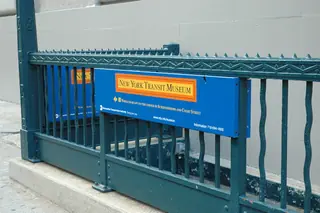
The New York Transit Museum was founded in 1976 and is housed in a subway station in Downtown Brooklyn that opened in 1936 and was later taken out of regular service. Visitors walk down from the street to the mezzanine and the platform level, where historic trains stand on the original tracks.
The museum is a self-supporting division of the Metropolitan Transportation Authority. Its collection documents the development of the city's subway, elevated, trolley and bus networks and the people who built and ran them. About twenty vintage subway and elevated cars rotate on the platform, the oldest from the first years of the subway; there are also historic buses, turnstiles and fare boxes, signals, signage and a large archive of photographs and documents.
Exhibits explain how the first subway lines were dug and built, how surface transit developed from horse-drawn cars to modern buses, and how fares have been collected over more than a century. Besides the museum in Brooklyn, the Transit Museum runs a free gallery and store in Grand Central Terminal and organizes nostalgia rides on historic trains.
Highlights
- About twenty vintage subway and elevated cars on the platform of a 1936 station
- Working signal tower in Moving the Millions
- Steel, Stone & Backbone on the construction of the first subway
- City bus whose driver's seat visitors can sit in
- A century of turnstiles and fare collection
- More than 50 scale models of trolleys and work cars
Permanent exhibitions
- Moving the Millions – The evolution of the subway, told with vintage cars and a working signal tower.
- Steel, Stone & Backbone: Building New York's Subways – How the first subway line was built, from construction methods to the workers who dug it.
- On the Streets: New York's Trolleys and Buses – Two centuries of surface transit, with a bus to board and interactive street furniture.
- Founded
- 1976
- Operated by
- Metropolitan Transportation Authority (MTA)
Admission & discounts
| Adults | $15 |
|---|---|
| Reduced | $10Children 2–17, seniors 62 and older, visitors with disabilities |
| Children & teens | $10Ages 2–17 $10; children 15 and under must be accompanied by an adult. |
| Seniors | $10Ages 62 and older. |
| Visitors with disabilities | $10companion free · Not valid for groups of 5 or more; personal care attendants are admitted free. |
| Groups (8+ people) | –Groups of 8 or more must book a staff-led group tour. |
Free for MTA employees. EBT cards are not accepted for free or discounted admission. Tickets are non-refundable; rescheduling is possible up to 24 hours before the time slot. The Gallery & Store in Grand Central Terminal is free.
Booking: booking online recommended · timed-entry tickets · Advance online reservations are strongly encouraged; tickets are released three weeks ahead. A limited number of same-day tickets are sold on site.
Accessibility
- Partially wheelchair accessible
- Elevator: not available
- Accessible restroom: no information
- Accessible parking: no information
- Service dogs welcome
- Tactile models & exhibits
- Sign language tours: no information
- Easy-to-read materials: no information
- Audio description
The main entrance is down two flights of stairs and there is no elevator. A staff-operated wheelchair lift is at the entrance at Schermerhorn and Court Streets (weight limit 450 pounds; some motorized wheelchairs may not fit; allow 10–20 extra minutes); some vintage cars on the platform are not wheelchair accessible. Most exhibits, including the train cars, can be touched; braille and raised-line tactile guides and smart pens with audio descriptions can be borrowed, and guided tours for blind and low-vision visitors are offered with two weeks' notice. ASL interpretation for scheduled programs with two weeks' notice; FM assistive listening devices on request for tours. Free sensory toolkits (headphones, fidget, visual schedule), a social narrative, and a quiet room during special access programs. Most of the museum, including the platform level, is not climate-controlled.
Kids & families
Great for kids & families
- Family tours & workshops
- Hands-on stations
- Stroller-friendly: not available
- Kids’ birthday parties
Children can climb aboard vintage subway cars and sit behind the wheel of a bus. Heavy strollers are best left at home because there is no elevator; unattended stroller parking at the back of the museum. Family programs and birthday experiences are offered.
Getting there & parking
By public transit
More than 20 subway and bus lines stop near the museum in Downtown Brooklyn
The main entrance on Schermerhorn Street leads down two flights of stairs; wheelchair-accessible entrance at Schermerhorn and Court Streets.
Get directionsAddress & contact
New York Transit Museum99 Schermerhorn Street
11201 New York
New York, United States
Amenities & dining
- Café: not available
- Museum shop
- Coat check: not available
- Wi-Fi
Wi-Fi is available (login information at the admission booth); there is no cell phone service inside. Large museum store. No food may be eaten or brought into the museum. No bag or coat check; large bags are discouraged.
Events & venue rental
Location shoots can be arranged through the museum.
Plan your visit
| Guided tours | yes |
|---|---|
| School programs | yes |
| Photography | Photography for personal use is allowed; personal and professional photo shoots are not permitted. |
| Good to know | Museum highlights tours, adult group tours and school and youth tours; self-guided school, camp and birthday groups are not admitted without a reservation. The museum also offers nostalgia rides on vintage trains. |
Visitor experiences
Loading experiences …