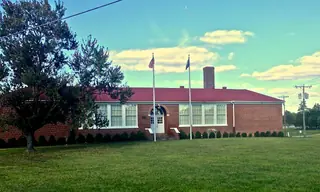
Robert Russa Moton Museum
Free civil rights museum in Farmville’s former Moton High School, where the 1951 student strike led to a case within Brown v. Board of Education.
Show individual sections
About the museum
Robert Russa Moton High School opened in 1939 as the segregated public high school for Black students in Prince Edward County. The one-story brick building, with six classrooms and an office around a central auditorium, was planned for 180 students but held about 450 by the 1940s; the county answered with temporary buildings covered in roofing material that became known as the tar paper shacks.
In April 1951, 16-year-old Barbara Johns led her classmates in a walkout to protest the conditions. NAACP attorneys took up the case, Davis v. Prince Edward, which became the only student-initiated suit among the cases decided together as Brown v. Board of Education in 1954. When integration was ordered, the county closed all its public schools from 1959 to 1964 rather than desegregate, until the Supreme Court ruled in Griffin v. Prince Edward that they had to reopen.
The building was designated a National Historic Landmark in 1998 and now houses a museum about these events. Since 2015 the museum has been formally affiliated with Longwood University, and in 2022 it became an affiliated area of Brown v. Board of Education National Historical Park. Six galleries lead from the 1951 strike through segregated schooling, the court case, Virginia’s resistance and the school closings to the Free Schools of 1963–64.
Key themes
- Restored 1939 auditorium where the 1951 student walkout began
- Recreated tar paper shack classroom with an original pot-belly stove
- Six galleries from the Moton strike to Griffin v. Prince Edward
- Story of the 1959–1964 school closings in Prince Edward County
- Starting point of the Farmville Civil Rights Walking Tour
Permanent exhibition
- Galleries I–VI – Six galleries follow the 1951 student strike, segregated schooling, the Davis v. Prince Edward case, Virginia’s Massive Resistance, the 1959–1964 school closings and the Free Schools year.
- Operated by
- Moton Museum in partnership with Longwood University
Admission & discounts
Admission is free.
| Groups | –Guided tours for groups (preferably 5 or more) should be requested by email or phone at least ten business days in advance. |
|---|
Admission is free for the general public.
Accessibility
- Wheelchair accessible: no information
- Elevator: no information
- Accessible restroom: no information
- Accessible parking: no information
- Service dogs welcome
- Tactile models & exhibits: no information
- Sign language tours: no information
- Easy-to-read materials: no information
- Audio description: no information
Service animals and approved therapy animals (with documentation) are welcome.
Kids & families
Only partly suitable for kids
Field trips and digital programs for K–12 school groups are offered.
Getting there & parking
By car
Parking available
Limited parking on site; overflow parking across the street at the Southgate Shopping Center, using the spaces parallel to Griffin Boulevard.
Farmville is about 25 miles from Appomattox and within 60 miles of Charlottesville, Lynchburg and Richmond.
Get directionsAddress & contact
Robert Russa Moton Museum900 Griffin Boulevard
23901 Farmville
Virginia, United States
Amenities & dining
- Museum shop
The Moton Bookstore is in the museum.
Events & venue rental
- Spaces for rent
- Private parties
- Corporate events
Up to 100 guests.
The restored auditorium (up to 100 theater style, 70 banquet style) and the Tar Paper Shack conference room and pavilion can be rented for private, public and nonprofit events, on weekdays from 16:00 and on Saturdays.
Inquiries & detailsPlan your visit
| Guided tours | yes |
|---|---|
| School programs | yes |
| Photography | Personal photography is encouraged; selfie sticks and tripods are not allowed, and professional photography needs prior approval. |
| Dogs | not allowed (assistance dogs excepted) · Only service animals and approved therapy animals are allowed. |
| Good to know | Group tours by advance arrangement. A two-mile Farmville Civil Rights Walking Tour to 17 sites begins and ends at the museum; the museum is also a stop on the U.S. Civil Rights Trail and the Civil Rights in Education Heritage Trail. |
Visitor experiences
Loading experiences …