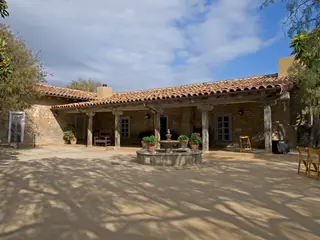
Santa Barbara Historical Museum
Free history museum in downtown Santa Barbara with the exhibition The Story of Santa Barbara, historic adobes and the Gledhill Research Library.
Show individual sections
About the museum
The Santa Barbara Historical Society was formed in 1932 by representatives of local organizations who wanted to research, collect and exhibit the history of the city and county of Santa Barbara. Its first exhibition space was the tower room of the Santa Barbara County Courthouse. The society was incorporated as a nonprofit in 1943, published its first book in 1947 and for a time had its headquarters in the Trussell-Winchester Adobe, which was given to it by Katherine Bagg Hastings.
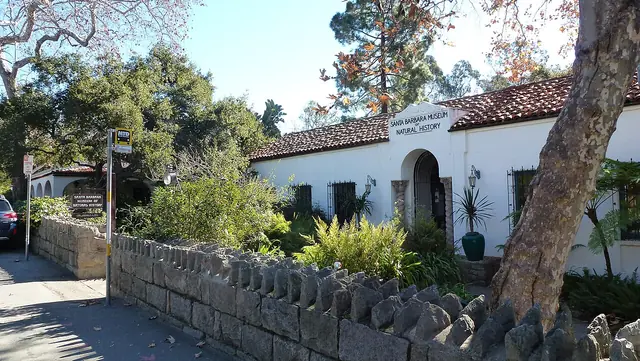
In 1965 the society opened its own museum building at 136 East De la Guerra Street in the historic downtown. The structure of reinforced concrete and adobe was built in the adobe style with bricks made on the site, on land once used by the Santa Barbara Gas and Electric Company. Two historic adobes stand in the lower courtyard: Casa Covarrubias, built in 1817 by Domingo Carrillo with Native American labor, and the Historic Adobe of about 1831, which was moved here from Anacapa Street in 1924.
The collections cover more than 500 years of regional history, with paintings, furniture, saddles, decorative arts, textiles and costumes from Chumash, Spanish, Mexican, American and Chinese communities. The signature exhibition The Story of Santa Barbara traces the region from its first inhabitants through the Spanish settlement and Mexican rule to the art colony, the silent film era and the founding of Fiesta. The Gledhill Library holds the museum’s archives for research.
Highlights
- Signature exhibition The Story of Santa Barbara
- Casa Covarrubias of 1817 and the Historic Adobe of about 1831
- Collections on Chumash, Spanish, Mexican and American history
- Material on the De la Guerra family and Santa Barbara’s Chinatown
- Gledhill Research Library
Permanent exhibition
- The Story of Santa Barbara – Signature exhibition on the history of the region from the Chumash to the 20th century, with objects from the museum’s collections.
- Founded
- 1932
- Operated by
- Santa Barbara Historical Museum (nonprofit)
- Visitors per year
- approx. 40,000
Admission & discounts
Admission is free.
Admission is free.
Booking: not required – tickets at the desk
Accessibility
- Wheelchair accessible
- Elevator: no information
- Accessible restroom: no information
- Accessible parking
- Service dogs welcome: no information
- Tactile models & exhibits: no information
- Sign language tours: no information
- Easy-to-read materials: no information
- Audio description: no information
Ramps lead up to the museum entrance and down to the historic adobes. All galleries are on the first level with no stairs inside. Accessible parking spaces in the on-site lot.
Kids & families
Great for kids & families
- Family tours & workshops
- Hands-on stations
Interactive docent-led school programs for grades K–4, including hands-on activities on Chumash life and the Spanish arrival; a combined tour with the nearby El Presidio is offered for school groups.
Getting there & parking
By car
Parking available
On-site parking lot.
- Accessible parking
The museum is in the historic downtown district (El Pueblo Viejo), two blocks from State Street.
Get directionsAddress & contact
Santa Barbara Historical Museum136 East De la Guerra Street
93101 Santa Barbara
California, United States
Amenities & dining
- Museum shop
Museum shop; the Gledhill Library is available for research.
Events & venue rental
- Spaces for rent
- Private parties
- Corporate events
- Weddings / ceremonies
Three connected private courtyards and a Spanish-era adobe can be rented for weddings, rehearsal dinners, parties, fundraisers, company meetings and corporate dinners.
Inquiries & detailsPlan your visit
| Guided tours | yes |
|---|---|
| School programs | yes |
| Photography | Photography for personal use is allowed; commercial and wedding photo shoots must be arranged with the venue coordinator. |
| Good to know | Tours for groups of all kinds, from preschool classes to after-hours adult groups, are arranged through the education department. |
Visitor experiences
Loading experiences …