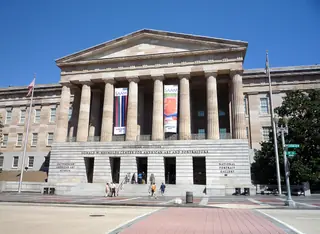
Smithsonian American Art Museum
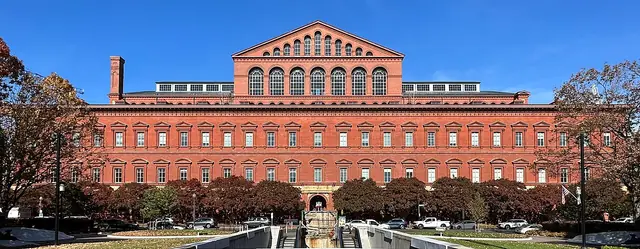
Free Smithsonian museum of American art from the 18th century to today in the historic Old Patent Office Building, shared with the National Portrait Gallery.
Show individual sections
About the museum
The museum traces its roots to the founding of the Smithsonian Institution in 1846, whose charter called for a gallery of art. For a long time the collection had no home of its own: it was shown in the Smithsonian Castle, damaged by a fire in 1865, partly lent to other institutions and later housed in the Natural History Building. Known as the National Gallery of Art from 1906, it was renamed the National Collection of Fine Arts in 1937, when that name went to Andrew Mellon’s new museum.
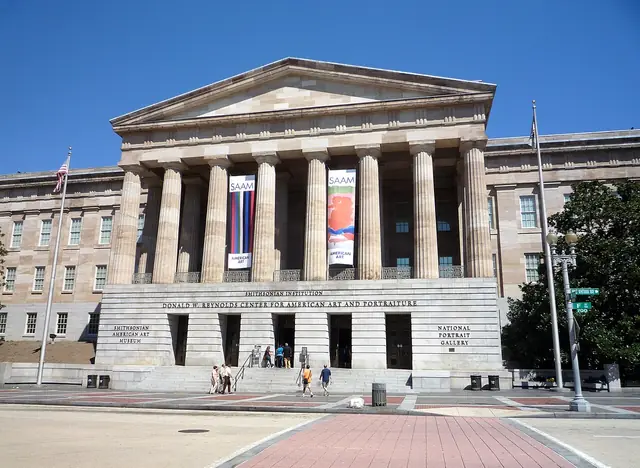
In 1958 Congress gave the collection the Old Patent Office Building, a neoclassical landmark in downtown Washington that it shares with the National Portrait Gallery. After renovation it opened there in 1968. The museum was later renamed the National Museum of American Art and finally the Smithsonian American Art Museum.
From 2000 the building closed for an extensive renovation that restored porticos, a curving double staircase, vaulted galleries and long skylights. It added the Luce Foundation Center, a visible storage and study center, the Lunder Conservation Center with glass-walled laboratories, the McEvoy Auditorium and the glass-roofed Kogod Courtyard. With its branch, the Renwick Gallery near the White House, the museum holds one of the largest collections of American art, with works by more than 7,000 artists.
Highlights
- Galleries of American art from the 18th to the 20th century
- Luce Foundation Center with thousands of artworks on view in visible storage
- Lunder Conservation Center with glass walls onto the conservation labs
- Robert and Arlene Kogod Courtyard under a glass canopy
- Works by artists such as Georgia O’Keeffe, John Singer Sargent and Nam June Paik
Permanent exhibitions
- Galleries for 18th to 20th Century Art – Collection galleries that follow American art and creativity from the colonial era through the 20th century.
- Luce Foundation Center for American Art – Visible storage center where visitors can browse thousands of paintings, sculptures, crafts and folk art objects from the collection.
- Founded
- 1846
- Operated by
- Smithsonian Institution
- Director
- Lynda Roscoe Hartigan
Admission & discounts
Admission is free.
Admission is always free; no tickets are required.
Booking: not required – tickets at the desk · No tickets required.
Accessibility
- Wheelchair accessible
- Elevator
- Accessible restroom
- Accessible parking: no information
- Service dogs welcome
- Tactile models & exhibits
- Sign language tours
- Easy-to-read materials: no information
- Audio description
Ramps on both sides of the 8th and G Streets NW entrance; MetroAccess address 800 G Street NW. Elevators serve all areas and accessible restrooms are on all floors. Free manual wheelchairs in the G Street and F Street lobbies (ask a security guard). The McEvoy Auditorium has wheelchair spaces, a hearing loop (induction loop) and a T-coil infrared assistive listening system. Art Signs: gallery talks in ASL led by Deaf gallery guides twice a month on Sunday afternoons and Thursday evenings, with voice interpretation; captioned ASL video series online. Audio guides include ASL and descriptive audio. America InSight verbal description tours for blind and low-vision visitors, sometimes with touch components; Aira Access description service via the museum’s free Wi-Fi. See Me at SAAM programs for people with dementia and their care partners (registration required). Social narratives in English and Spanish.
Kids & families
Great for kids & families
- Family tours & workshops
- Activity booklet, scavenger hunt or kids’ audio guide
- Hands-on stations
- Stroller-friendly
Art Detectives family audio tour through the building shared with the National Portrait Gallery, for families with elementary school children (map at the G or F Street information desks); scavenger hunts in the Luce Center, family days and pop-up art carts. Strollers are permitted in the galleries.
Getting there & parking
By public transit
Gallery Place–Chinatown
Metrorail Gallery Place–Chinatown (Red, Green and Yellow lines), directly beneath the museum.
By car
No on-site parking at the museum.
Limited metered street parking; several paid parking garages in the neighborhood.
The museum is about a 15-minute walk north of the Smithsonian Castle along 9th Street NW and a 25-minute walk from the Renwick Gallery.
Get directionsAddress & contact
Smithsonian American Art Museum8th and G Streets NW
20004 Washington
Washington, D.C., United States
Amenities & dining
- Café
- Museum shop
- Coat check: not available
- Lockers: not available
- Wi-Fi
Free Wi-Fi. Courtyard Café in the Kogod Courtyard with baked goods, sandwiches, salads and drinks; SAAM Store. No coat check or bag storage, and the small lobby lockers are not available at present; suitcases, large umbrellas and large backpacks are not allowed in the galleries. Metal-detector screening at the entrance.
Events & venue rental
- Spaces for rent
- Private parties
Event spaces can be rented at the museum and the Renwick Gallery.
Inquiries & detailsPlan your visit
| Guided tours | yes · approx. 60 min |
|---|---|
| Audio guide | yes (EN, ES, ASE) |
| School programs | yes |
| Photography | Noncommercial still and video photography is allowed unless posted otherwise; tripods, monopods and selfie sticks are not permitted. |
| Dogs | not allowed (assistance dogs excepted) · Pets are not allowed; service animals are welcome. |
| Good to know | Free docent-led walk-in tours daily at 12:00, 14:00 and 16:00 (about an hour; check at the Information Desk). Free group tours for adult groups of eight or more on request three to four weeks ahead; school tours four to six weeks ahead. Free audio guides through the Smartify app. Pop-up Art à la Cart stations with hands-on activities. |
Visitor experiences
Loading experiences …
Museums nearby
All 64 museums in Washington All museums in Washington, D.C.