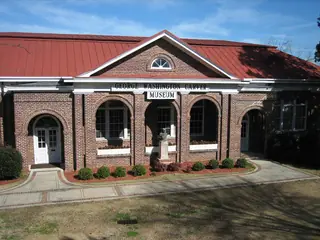
George Washington Carver Museum
Free National Park Service museum on the Tuskegee University campus about the scientist George Washington Carver, with The Oaks, Booker T. Washington’s home, nearby.
Show individual sections
About the museum
George Washington Carver, born into slavery in Missouri, came to Tuskegee Institute in 1896 at the invitation of its founding principal Booker T. Washington and taught and did research there for 47 years. He headed the agricultural department, built up extension services for Black farmers and homemakers and became known for finding hundreds of uses for peanuts and sweet potatoes and for promoting crop rotation in the South.
The trustees of Tuskegee Institute authorized a museum for Carver in 1938, and it opened in a remodeled campus building in 1941, with support from his admirer, the industrialist Henry Ford. It displayed his geological and fungus specimens, his paintings and crafts, mounted birds and the preserved vegetables he used at farm demonstrations; Carver’s last laboratory was also housed in the building, and he died in 1943.
In 1977 the university gave the museum and The Oaks, Booker T. Washington’s home, to the National Park Service, followed by much of the Carver collection in 1979. Both are part of Tuskegee Institute National Historic Site, which also covers the historic campus with buildings designed by Robert R. Taylor and built by students. The museum today serves as the site’s visitor center, with interactive exhibits and a short film on Carver’s life.
Highlights
- Interactive exhibits on Carver’s work with peanuts and sweet potatoes
- Short film on Carver’s life and legacy
- Carver’s contributions to sustainable agriculture and crop rotation
- Free ranger-led tours of The Oaks, home of Booker T. Washington
- Historic Tuskegee campus with buildings by architect Robert R. Taylor
Permanent exhibition
- George Washington Carver Museum exhibits – Interactive displays on Carver’s research with peanuts and sweet potatoes, sustainable agriculture and his influence on education, with a short film.
- Founded
- 1941
- Operated by
- National Park Service
Admission & discounts
Admission is free.
No admission fee for the museum or for tours of The Oaks.
Booking: Tours of The Oaks require a reservation and are limited to 25 visitors (15 adults and 10 youth) per tour.
Accessibility
- Wheelchair accessible
- Elevator
- Accessible restroom: no information
- Accessible parking: no information
- Service dogs welcome
- Tactile models & exhibits
- Sign language tours: no information
- Easy-to-read materials: no information
- Audio description: no information
Accessible entrances on the ground level and at the rear of the museum; restrooms on the lower level are reached by elevator. Wheelchairs can be borrowed free of charge at the museum and The Oaks, first come, first served. Films and videos have open captions. The front entrance and restrooms are labeled with tactile images and Braille. The Oaks is wheelchair accessible on the first floor only, via a chair lift.
Kids & families
Great for kids & families
Interactive exhibits on Carver’s science.
Getting there & parking
By car
Parking available
Parking deck behind the Kellogg Conference Center: park on the second level, take the breezeway to the rear of the museum, then the stairs on the right and the path around to the front entrance. Parking for The Oaks at its rear.
The museum is directly behind the Kellogg Conference Center on the Tuskegee University campus. From Montgomery take I-85 north to exit 32; from Atlanta take I-85 south to exit 38. There is no bus or train service in the area; local taxi service is limited.
Get directionsAddress & contact
George Washington Carver Museum1212 West Montgomery Road
36088 Tuskegee Institute
Alabama, United States
Amenities & dining
- Museum shop
Book sales area in the museum.
Events & venue rental
The museum hasn’t published any information on this.
Plan your visit
| Guided tours | yes |
|---|---|
| Dogs | not allowed (assistance dogs excepted) · Only trained service dogs may enter the museum and The Oaks; pets must be leashed on the grounds. |
| Good to know | The museum is self-guided and serves as the visitor center of Tuskegee Institute National Historic Site. Ranger-led tours of The Oaks start on its front porch. Group reservations by phone. |
Visitor experiences
Loading experiences …