KU Natural History Museum
Natural history museum of the University of Kansas in historic Dyche Hall, known for its 1893 wildlife Panorama, Kansas fossils and the Bunker mosasaur.
Show individual sections
About the museum
When the University of Kansas was chartered in 1864, the Kansas legislature required it to assemble a natural history cabinet. Under the naturalist Francis Huntington Snow the collections grew for four decades. The naturalist and explorer Lewis Lindsay Dyche created a wildlife Panorama for the Kansas Pavilion at the 1893 World's Columbian Exposition in Chicago, one of the first displays to show mounted groups of North American mammals in their natural setting, and it drew wide attention to Kansas.
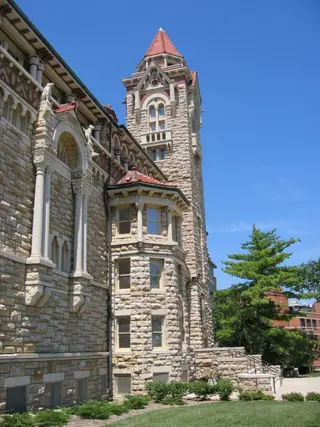
The legislature then funded a building for the Panorama and the scientific collections. Dyche Hall, named after Dyche and now listed on the National Register of Historic Places, was completed in 1903. A north wing for laboratories and offices followed in 1963, and about 30 years later a four-story wing for collections preserved in ethanol.
In 2003 the university combined the museum's research programs, scientists, graduate students and public outreach in the Biodiversity Institute. Its research collections hold about 11 million living and fossil plants and animals and more than 2 million archaeological artifacts. The public museum fills four floors of Dyche Hall with exhibits on past and present biodiversity, including Kansas wildlife, fossils, live snakes and the horse Comanche, a survivor of the Battle of the Little Bighorn.
Highlights
- The Panorama of North American wildlife, first shown in 1893
- The Bunker mosasaur, a 45-foot Tylosaurus found in Wallace County, Kansas, in 1911
- Comanche, the horse that survived the Battle of the Little Bighorn
- Live snakes and anoles
- A living Paleo Garden
- Historic Dyche Hall from 1903
Permanent exhibitions
- The Panorama – Lewis Lindsay Dyche's habitat display of North American mammals, created for the 1893 World's Columbian Exposition and expanded over the years.
- The Bunker Mosasaur – A 45-foot Tylosaurus from the Cretaceous sea that covered Kansas, viewable from the fourth and fifth floors.
- Comanche – The preserved horse that survived the Battle of the Little Bighorn, shown in a low-light room as a symbol of the conflict between the United States and the Plains nations.
- Founded
- 1864
- Operated by
- University of Kansas (Biodiversity Institute)
Admission & discounts
| Children & teens | –Suggested contribution $4 per child. |
|---|---|
| Students & apprentices | freeFree for KU students. |
| Groups | –Groups pay the same suggested contribution; self-guided group visits should be requested at least three weeks ahead. KU class groups are free. School programs and paid adult experiences are booked separately. |
Admission is by suggested contribution of $7 per adult and $4 per child; everyone is welcome regardless of payment. Members and KU students are free.
Booking: not required – tickets at the desk · Individual visitors need no reservation; groups should book three weeks ahead.
Accessibility
- Wheelchair accessible
- Elevator
- Accessible restroom: no information
- Accessible parking: no information
- Service dogs welcome
- Tactile models & exhibits: no information
- Sign language tours: no information
- Easy-to-read materials: no information
- Audio description: no information
The galleries are accessible. The accessible entrance is north of the historic entrance; take the elevator to the fourth (main) floor and check in at the Visitor Services Desk. A wheelchair can be reserved through Visitor Services. Service dogs are allowed; emotional support animals are not permitted in KU buildings.
Kids & families
Great for kids & families
- Family tours & workshops
- Activity booklet, scavenger hunt or kids’ audio guide
Adults must stay with children at all times. Discovery Guides help families explore the exhibits; scout programs for Girl Scouts, Cub Scouts and Scouts BSA.
Getting there & parking
By public transit
Kansas Memorial Union
Free KU and Lawrence Transit buses stop at the Kansas Memorial Union next to the museum.
By car
Paid parking
Mississippi Street Garage one block north of the museum (enter at 1261 Oread Avenue or from Mississippi Street): $2.25 for the first hour and $2 for each further hour, plus app fees; pay by HONK app, QR code or pay station. Free parking on weekends in Lot 16 across from the museum. Buses unload in front of the museum and park in Lot 300 at the Lied Center.
Bike rack in front of the museum. The museum is on the KU Lawrence campus next to the Kansas Union.
Get directionsAddress & contact
KU Natural History Museum1345 Jayhawk Boulevard
66045 Lawrence
Kansas, United States
Amenities & dining
- Café: not available
- Restaurant: not available
- Museum shop
Gift shop on the fourth floor near the front desk, with books, toys, plush animals and mosasaur-themed gear; open during museum hours. Food and drink are not allowed in the museum; dining options in the neighboring Kansas Union.
Events & venue rental
The museum hasn’t published any information on this.
Plan your visit
| Guided tours | yes |
|---|---|
| School programs | yes |
| Dogs | not allowed (assistance dogs excepted) · Only service dogs are allowed in KU buildings. |
| Good to know | K–12 school programs run Tuesday to Friday during the fall and spring semesters; registration for the coming school year opens on August 1. Scout programs, collection tours for KU classes and paid adult experiences (Tuesday–Friday) are also offered. Printable Discovery Guides are available. |
Visitor experiences
Loading experiences …