Wheelwright Museum of the American Indian
Museum on Santa Fe's Museum Hill for Native American art, in a 1937 building shaped like a Navajo hooghan, with a jewelry gallery.
Show individual sections
About the museum
The museum was founded by the Boston-born scholar Mary Cabot Wheelwright and the Diné (Navajo) singer and weaver Hastiin Klah. The two met in 1923 and spent more than a decade recording Navajo ceremonial chants, weavings and sandpaintings, hoping to preserve knowledge that faced suppression.
The building, designed by William Penhallow Henderson in consultation with Klah, follows the form of a Navajo hooghan. Its exterior was finished in 1937 and it opened quietly a year later; it is listed on the National Register of Historic Places. First called the Navajo House of Prayer and from 1939 the Museum of Navajo Ceremonial Art, it served mainly as a research institution while Wheelwright directed it until her death in 1958.
In the 1970s the museum changed course: in 1977 it voluntarily repatriated sensitive ceremonial items, which went to the Ned A. Hatathli Cultural Center Museum at Diné College in Tsaile, Arizona – one of the first museums in North America to take such a step – and took its present name. Today it shows historic and contemporary Native American art. In 2015 it opened the Jim and Lauris Phillips Center for the Study of Southwestern Jewelry, whose permanent gallery presents more than 700 works of Navajo and Pueblo jewelry. The Case Trading Post, opened in 1975 on the lower floor, sells work by Native artists.
Highlights
- Historic 1937 building modeled on a Navajo hooghan
- Permanent gallery of more than 700 pieces of Navajo and Pueblo jewelry
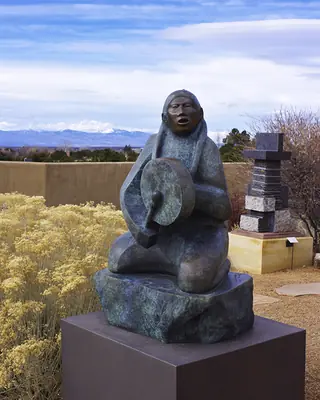
- Sculptures by Allan Houser and Melanie Yazzie on the grounds
- Mural by Eliza Naranjo Morse
- Case Trading Post with work by Native artists
Permanent exhibitions
- The Jim and Lauris Phillips Center for the Study of Southwestern Jewelry – The Martha Hopkins Struever Gallery traces Navajo and Pueblo jewelry from 1850 to today with more than 700 works from the collection.
- Making Our Way Every Day. Transformation. – Mural by Eliza Naranjo Morse (Santa Clara Pueblo) spanning the stairway between the two floors.
- Founded
- 1937
Admission & discounts
| Adults | $10 |
|---|---|
| Children & teens | freefree up to age 11 · Children under 12 free |
| Students & apprentices | freeFree with valid student ID |
Free admission: Open first Sundays of the month usually have free admission
Free for museum members, Native Americans (First Nations), veterans and active-duty military year-round. As a Blue Star Museum it also admits active-duty military with up to five family members free from Memorial Day to Labor Day.
Accessibility
- Wheelchair accessible
- Elevator: no information
- Accessible restroom: no information
- Accessible parking: no information
- Service dogs welcome
- Tactile models & exhibits: no information
- Sign language tours: no information
- Easy-to-read materials: no information
- Audio description: no information
Large print, Braille, ASL interpretation and assistive listening devices are available with two weeks' notice.
Kids & families
| Kids’ admission | free up to age 11 |
|---|
Children under 12 are admitted free.
Getting there & parking
The museum is on Museum Hill in Santa Fe; visitors enter the historic building through the east-facing door.
Get directionsAddress & contact
Wheelwright Museum of the American Indian704 Camino Lejo
87505 Santa Fe
New Mexico, United States
Amenities & dining
- Museum shop
The Case Trading Post on the ground floor sells vintage and contemporary Native American art; profits support the museum.
Events & venue rental
The museum hasn’t published any information on this.
Plan your visit
| Guided tours | yes |
|---|---|
| Photography | Photography for personal use is allowed in the galleries without flash; commercial photography needs approval from public relations. |
| Good to know | Docent tours are offered weekly, Tuesday and Wednesday 10:00–12:00 and Thursday to Saturday 10:00–14:00; groups can book a docent tour. Access to the collections and archives is by appointment with four weeks' notice. |
Visitor experiences
Loading experiences …