Workman and Temple Family Homestead Museum
Free guided tours of the 1870s Workman House and the 1920s mansion La Casa Nueva in City of Industry, on the history of greater Los Angeles.
Show individual sections
About the museum
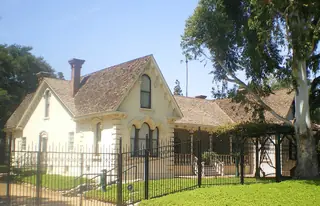
The Homestead Museum tells the history of the Los Angeles region from the era of the Mexican ranchos to the 1920s. William and Nicolasa Workman came from Taos, New Mexico, in 1841, when the area still belonged to Mexico, and settled on part of Rancho La Puente. They raised cattle and later grew wheat and grapes for wine. Their modest adobe house was remodeled twice; its present appearance dates from changes completed by 1870. A family-owned bank failed, and by around 1900 most of the family’s wealth and land were gone.
After oil was found on family land in the Montebello hills, the Workmans’ grandson Walter P. Temple and his wife Laura bought part of the Homestead in 1917 and built La Casa Nueva, a Spanish Colonial Revival mansion next to the Workman House. Temple founded the Town of Temple, today’s Temple City, in 1923, but failed oil and real estate ventures cost the family the property, which was lost to foreclosure in 1932. It later housed a military school for boys and a convalescent hospital.
The City of Industry bought the site in the 1960s and 1970s, restored it and opened the museum in May 1981. The city owns and funds the museum. Besides the two houses, visitors can see El Campo Santo, the family cemetery founded in the 1850s, with the Walter P. Temple Memorial Mausoleum, where Pío Pico, the last governor of Mexican California, is also buried. The collection holds more than 30,000 objects.
Highlights
- Workman House, an adobe remodeled by 1870
- La Casa Nueva, a Spanish Colonial Revival mansion of the 1920s
- El Campo Santo family cemetery with the Temple Memorial Mausoleum
- Grave of Pío Pico, last governor of Mexican California
- Free guided tours
Permanent exhibitions
- Workman House – Guided tour of the adobe home of William and Nicolasa Workman, remodeled with brick wings and a second story by 1870.
- La Casa Nueva – Guided tour of the Spanish Colonial Revival mansion built by Walter P. and Laura Temple in the 1920s.
- El Campo Santo – Family cemetery from the 1850s with the Walter P. Temple Memorial Mausoleum, open for self-guided visits.
- Founded
- 1981
- Operated by
- City of Industry (managed by Historical Resources, Inc.)
- Director
- Paul Spitzzeri
Admission & discounts
Admission is free.
| Groups (10+ people) | –Groups of 10 or more should schedule their tour in advance. |
|---|
Tours are free. Photo sessions with a professional photographer (weddings, quinceañeras, graduations) need a reservation and are charged.
Booking: not required – tickets at the desk · Tour places are limited and given on a first-come, first-served basis; no reservation needed for fewer than 10 people.
Accessibility
- Wheelchair accessible: no information
- Elevator: no information
- Accessible restroom: no information
- Accessible parking: no information
- Service dogs welcome: no information
- Tactile models & exhibits: no information
- Sign language tours: no information
- Easy-to-read materials: no information
- Audio description: no information
Group tours in American Sign Language (ASL interpretation) can be arranged by appointment.
Kids & families
Youth and school programs and curriculum materials are offered.
Getting there & parking
Turnbull Canyon Road is closed between Gale Avenue and Don Julian Road for overpass construction (from March 2025, for about two years); use Hacienda Boulevard to the east or 7th Avenue to the west to reach the museum via Don Julian Road.
Get directionsAddress & contact
Workman and Temple Family Homestead Museum15415 Don Julian Road
91745 City of Industry
California, United States
Amenities & dining
The museum hasn’t published any information on this.
Events & venue rental
The museum hasn’t published any information on this.
Plan your visit
| Guided tours | yes |
|---|---|
| School programs | yes |
| Photography | Professional photo sessions require a reservation and are allowed only in certain areas; fees apply. |
| Good to know | Group tours in English, some other languages and American Sign Language are available by appointment. Research visits to the collection by appointment with the museum director. |
Visitor experiences
Loading experiences …