Pflanzengarten und Heimatmuseum - Stadt Wehlen
Terraced botanic garden with around 600 species and a small local history museum on the town, castle, quarrying and beekeeping on the Elbe slope.
Få kun enkelte afsnit læst op
Om museet
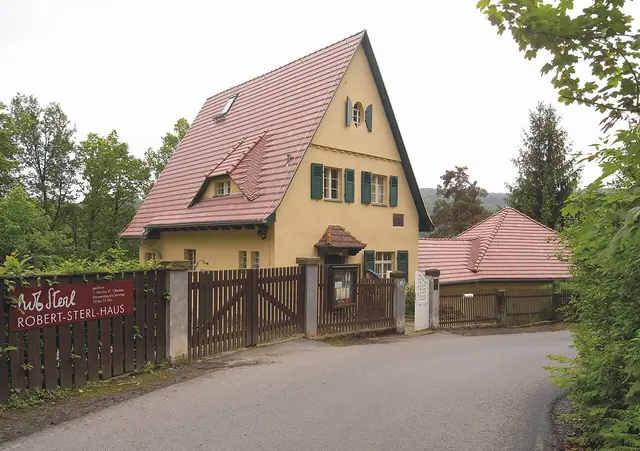
In 1923 the Saxon Mountaineers' Association (Sächsischer Bergsteigerbund) leased a rocky plot in Stadt Wehlen, had a hut fitted out there and in 1924 opened it as overnight accommodation for members. The stonemason and mountaineer Johannes Thumm laid out an alpine rock garden around the hut; he wanted to pass on knowledge of plants and thereby strengthen the emerging conservation movement. Over time, mountain plants from around the world were added from the travels of the climbing friends; they grew on sandstone terraces built by hand.
In 1939 the association gave up the hut and gave the garden and buildings to the town of Wehlen. By 1940 the local history museum, with its library, had moved into the former guesthouse; in July 1940 the site was opened to the public. In 1951 the state acquired the property, Erich Mädler became museum director, and in cooperation with botanists and academics from Dresden an educational center was established. The garden and museum became the first Landeskulturkabinett (regional nature and culture education center).
Today the garden of around 5,400 square meters shows about 600 plant species, including native mountain flora and plants from Asia and North America. The small local history museum over two floors presents the landscape, castle and town history, and trades such as stone breakers, boatmen, fishermen and Zeidler (traditional forest beekeepers). It has a room-high model of a sandstone quarry. An exhibition on honeybees and beekeeping complements the offering, along with a bee trail. In 2025 the botanic garden celebrated its 100th anniversary.
Højdepunkter
- Terraced botanic garden with around 600 species
- Viewing rock overlooking the castle and town of Wehlen
- Room-high model of a sandstone quarry
- Exhibition on honeybees, beekeeping and a bee trail
- Local history museum on town and castle history
Permanente udstillinger
- Heimatmuseum Stadt Wehlen – Over two floors: the landscape, castle and town, the trades of stone breakers, boatmen, fishermen and Zeidler, and beekeeping.
- Pflanzengarten – Terraced garden on the rock face with around 600 plant species, small ponds with water lilies, a viewing rock and a bee trail.
- Ejer
- Stadt Wehlen
Entrépriser & rabatter
| Voksne | 2 € |
|---|---|
| Nedsat pris | 1,50 €Guests with a guest card |
| Børn og unge | 1 €with guest card €0.50 |
| Adults with guest card | 1,50 € |
| Children with guest card | 0,50 € |
Admission covers the botanic garden and the local history museum.
Tilgængelighed
- Delvis kørestolsvenlig
- Elevator: ingen oplysninger
- Handicaptoilet: ingen oplysninger
- Handicapparkering: ingen oplysninger
- Servicehunde tilladt: ingen oplysninger
- Taktile tilbud: ingen oplysninger
- Rundvisninger på tegnsprog: ingen oplysninger
- Letlæste tilbud: ingen oplysninger
- Synstolkning: ingen oplysninger
The main areas of the garden and the lower floor of the museum are reachable step-free via a ramp at the northern entrance. The garden lies on a slope with narrow paths and sandstone steps; the viewing rock is reached by a wooden staircase.
Børn og familie
Museet har ikke offentliggjort oplysninger om dette.
Transport & parkering
Med offentlig transport
Heimatmuseum
Bus line 238 from the direction of Pirna to the Heimatmuseum stop; or S-Bahn to Bahnhof Stadt Wehlen, then by ferry to Stadt Wehlen and on foot from the Markt (steep climb via the Schreiberberg).
I bil
Parkering muligt
Two parking spaces near the main entrance are available to visitors during opening hours.
The garden lies on the south slope above the town; footpath from the Rathausbrunnen (town hall fountain) via Hauptstraße and Lohmener Straße.
Planlæg ruteService & spisesteder
Museet har ikke offentliggjort oplysninger om dette.
Arrangementer & udlejning
Museet har ikke offentliggjort oplysninger om dette.
Planlæg dit besøg
| Godt at vide | Visitor groups can sit down in the open-air lecture hall of the garden. There is seating in the garden and on the viewing rock. |
|---|