The show presents the brown alga Sargassum as a species-rich habitat and as an environmental problem when huge mats of algae reach Caribbean coasts. Originally planned until October 18, 2026, now extended until further notice.
Women scientists, lab technicians, benefactors and illustrators who helped shape Senckenberg are introduced through collection objects and AI-generated portraits by photographer Gesine Born.
Om museet
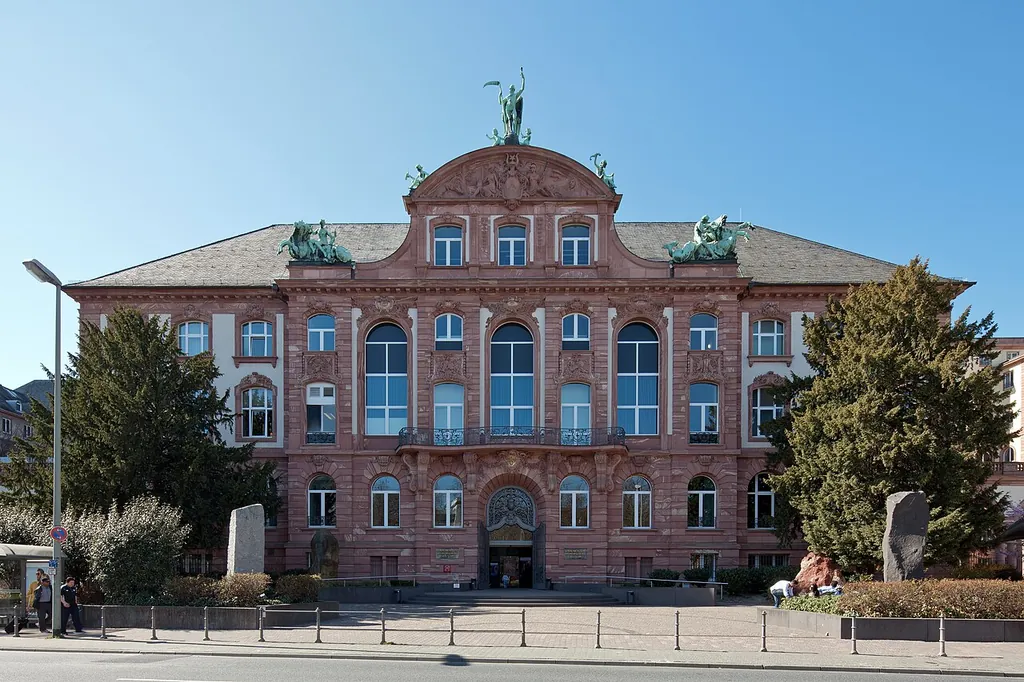
The museum traces its origins to the Senckenbergische Naturforschende Gesellschaft (Senckenberg Nature Research Society), founded by 32 Frankfurt citizens in November 1817 and named after the physician and benefactor Johann Christian Senckenberg. The trigger was a rare seal exhibited at the Frankfurt fair, whose carcass no one took care of after its death. The collection's core was formed by the mammals and birds of Johann Georg Neuburg; within a few years a first museum building was built at the Eschenheimer Turm. Prominent members such as Johann Wolfgang von Goethe and the expedition finds of Eduard Rüppell made the museum known early on.
When the premises became too small, a new museum building designed by Ludwig Neher was built from 1904 to 1907 on what is now Senckenberganlage; it opened on October 13, 1907. For the inauguration, the American Museum of Natural History donated a Diplodocus skeleton – the museum's first dinosaur skeleton. Since then the exhibition and the research institute have been organizationally separate but under joint management. Because the collections had been moved elsewhere for safekeeping, the bombs of March 1944 hit a largely empty building.
After reconstruction, the exhibitions were redesigned for a broad audience from the 1960s onward. Since the 1970s Senckenberg has been excavating at the Messel Pit, which became a UNESCO World Natural Heritage Site in 1995; its fossils shape both research and exhibitions. Today the museum welcomes more than 400,000 visitors a year. The project “Neues Senckenberg Naturmuseum Frankfurt” aims to modernize and expand the museum, research and collections in the coming years; an architectural competition for it was launched in 2026.
Højdepunkter
Diplodocus skeleton, donated by the American Museum of Natural History in 1907
Edmontosaurus mummy “Edmond” with preserved skin impressions
Fossils from the Messel Pit UNESCO World Heritage Site, including early horses
Archaeopteryx No. 11 from the Solnhofen limestone
Anaconda with its prey – a visitor favorite for almost 100 years
Cast of the hominin fossil “Lucy”
Permanente udstillinger
Dinosaurier – The dinosaur hall shows dinosaurs from the Triassic, Jurassic and Cretaceous – from Plateosaurus and Diplodocus to Tyrannosaurus and Triceratops.
EDMOND – Die letzten Tage der Dinosaurier – Centered on the Edmontosaurus mummy “Edmond”, the exhibition uses original fossils and a landscape model to reconstruct the world shortly before the mass extinction 66 million years ago.
Weltnaturerbe Grube Messel – Exceptionally well-preserved fossils from the oil shale near Darmstadt offer insight into a tropical habitat 48 million years ago, including early horses.
Grundlagt
1817
Ejer
Senckenberg Gesellschaft für Naturforschung
Ledelse
Dr. Eva Roßmanith (kommissarische Museumsleitung)
Besøgende pr. år
ca. 398.754 (2019)
Entrépriser & rabatter
Voksne
12 €
Nedsat pris
6 €Children and young people aged 6 to 17, school students, university students, people doing voluntary service (FSJ, BFD), and adults with a severe disability (degree of disability/GdB of 50 or more)
Børn og unge
6 €gratis til og med 5 år · Children up to 5 free, ages 6–17 €6. Children and young people up to and including age 15 must be accompanied by at least one adult.
Pensionister
–No senior discount mentioned.
Personer med handicap
6 €ledsager gratis · Reduced with a degree of disability (GdB) of 50 or more; children with severe disabilities free. Companion free if accompaniment is necessary because of the disability.
Studerende og elever
6 €Reduced for school and university students.
Grupper (fra 20 pers.)
10 € pr. personFor 20 or more people, per person aged 18 and over. Daycare centers, schools, children's and youth groups: €4.50 per child aged 6 and up (€3 with a booked guided tour), accompanying adults €5 (one free per 2 daycare children or per 5 school students; one accompanying adult free per booked tour). Group tickets at the ticket office on the day of the visit; no advance registration needed.
Familier
30 €2 adults with up to 3 children (ages 6–17). Mini family (1 adult, 2 children) €18; with the FamilienApp Hessen (2 adults and all their own children aged 6–18) €27.
Wednesday evening ticket from 17:00 for visitors aged 18 and over €6. Frankfurt Card €8, Frankfurt-Pass €6 (children €3), Kulturpass €1 (children €0.50). “Naturpass” annual pass €110 for ages 15 and up, or €50 for 6- to 14-year-olds and people with a GdB of 50 or more. MuseumsuferCard and MuseumsuferTicket valid. Free for, among others, ICOM and Senckenberg members, holders of the Ehrenamts-Card Hessen (volunteer card), journalists with a press card, and accompanied refugee groups. Loan device for the media guide €3 plus deposit.
Tilgængelighed
Delvis kørestolsvenlig
Elevator
Handicaptoilet
Handicapparkering
Servicehunde tilladt
Taktile tilbud
Rundvisninger på tegnsprog
Letlæste tilbud
Synstolkning: ingen oplysninger
About 90% of the exhibition space can be reached with a wheelchair or walking aid; the areas “Fossilien der Grube Messel” (Messel Pit fossils), “Mineralien” (minerals), “Edmontosaurus und Flugsaurier” (Edmontosaurus and pterosaurs), “Evolution des Menschen” (human evolution) and “Meeressaurier und Fische” (marine reptiles and fish) are not accessible. Due to technical problems with a lift, the museum currently cannot guarantee accessibility; from September 28 to approximately October 2, 2026, the platform lift to the 1st atrium is being replaced. A loan wheelchair is available. Three accessible parking spaces behind the museum (access via Gräfstraße). Touch exhibits with Braille in “Evolution des Menschen” and “Fossilisation”, further tactile models in almost all exhibitions, and two stations for visually impaired people in the Aha?! Forschungswerkstatt. Short guide in easy-to-read German (ticket office, €1, or free PDF); media guide with one tour each in German Sign Language and easy-to-read German. According to the Museumsufer portal, there is an accessible restroom. Assistance dogs allowed.
Børn og familie
Velegnet til børn og familier
Entré for børn
gratis til og med 5 år
Familiebillet
30 € · 2 adults with up to 3 children (ages 6–17). Mini family (1 adult, 2 children) €18; with the FamilienApp Hessen (2 adults and all their own children aged 6–18) €27.
Familieomvisninger & workshops
Opgavehæfte, skattejagt eller audioguide for børn
Interaktive stationer
Barnevognsvenlig
Børnefødselsdage
Family and children's tours (e.g., on dinosaurs, approx. 50 minutes), holiday programs and workshops, children's birthday parties, night tours for children aged 8 and up, a family tour in the media guide, and the hands-on exhibition “Aha?! Forschungswerkstatt”. Strollers are allowed but must not be left unattended. Children under 10 only when accompanied by a supervising person aged 16 or older.
Transport & parkering
Med offentlig transport
Bockenheimer Warte/Senckenbergmuseum
U4, U6, U7 and tram 16 to Bockenheimer Warte/Senckenbergmuseum; bus 75 to Senckenberg Naturmuseum; S3–S6 to Westbahnhof.
I bil
Museet har ingen egen parkeringsplads.
No visitor parking; only three accessible parking spaces behind the museum (access via Gräfstraße).
Bistro (Mon, Tue, Thu, Fri 10:00–16:45; Wed, Sat, Sun and public holidays 10:00–17:45) with coffee and cake. Museum shop run by the Walther König bookstore in the entrance hall. Eating and drinking only in the break room on the 1st floor. Free museum Wi-Fi.
Arrangementer & udlejning
Lokaler til leje
Firmaarrangementer
Op til 450 personer.
Atrium 1 “Dinosaurier” (approx. 570 m², up to 200 people) and Atrium 2 “Wale und Elefanten” (Whales and Elephants; approx. 580 m², up to 220 people, only together with Atrium 1) – combined up to 450 guests, e.g., “Dinner unter Dinos” (Dinner among Dinos); in the museum, evening events only on Mon, Tue, Thu and Fri. In the neighboring Jügelhaus, a historic banquet hall (up to 250 people) and cafeteria (up to 200 people), bookable daily and all day. Aimed mainly at corporate events; rental from €3,000.