Ole Rømer Observatoriet
Listed observatory from 1911 in the Kongelunden recreation area of Aarhus, with Denmark's largest working telescope, stargazing evenings and a science park.
Have only individual sections read aloud
About the museum
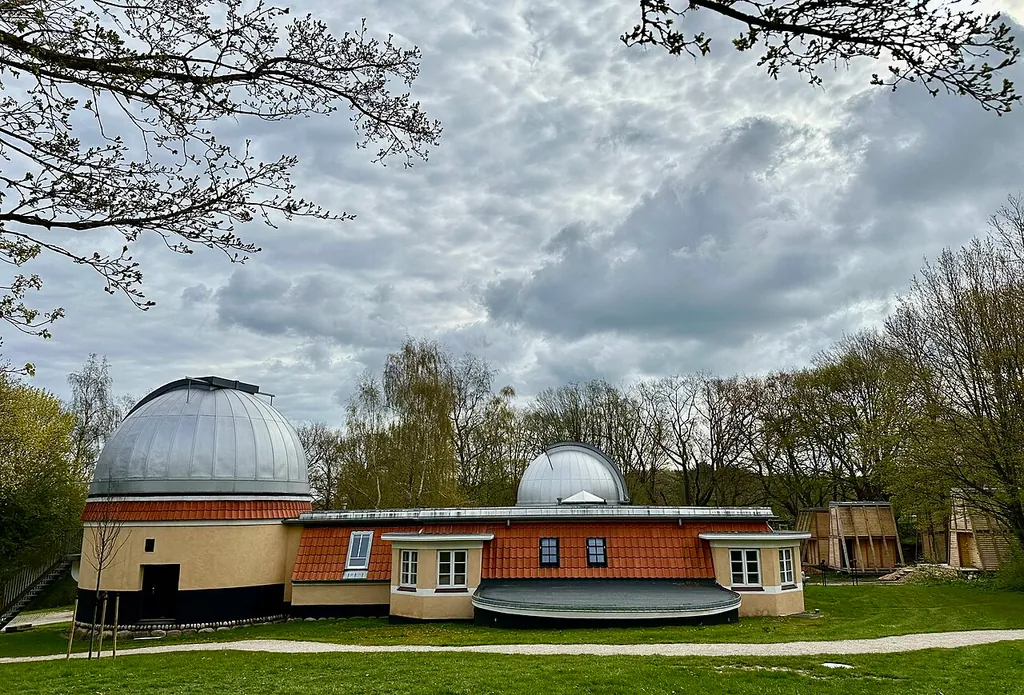
The impetus came from the German astronomer Friedrich Krüger from Altenburg in Thuringia, who offered the city of Aarhus his experience and his instruments if it would build an observatory. To designs by the architect Anton Rosen, the observatory and a director's villa were built from 1909 on the hill above Marselisborg Palace. The complex was inaugurated on 15 October 1911 and named after the Danish astronomer Ole Rømer. After Krüger's death in 1916, Ruben Andersen ran the observatory until 1955, and the following year Aarhus University took it over. The building has been listed since 2005.
After an extensive restoration funded by Realdania, several foundations, the municipality and the university, among others, the observatory reopened on 25 September 2023 – Ole Rømer's 379th birthday. Since then the foyer, the teaching room and the dome with the large telescope have been step-free. In November 2023 a crane lifted a reflecting telescope weighing around 800 kilograms, with a mirror 70 centimetres across, in through the dome; it replaced an instrument with a 28-centimetre mirror and, according to the observatory, is the largest working telescope in Denmark. A smaller telescope mounted on top shows its image on a screen so that all visitors can follow along. Today the observatory is run by Aarhus University's Science Museerne.
The building itself opens only for events, above all for stargazing evenings in the dark half of the year. The surrounding observatory garden with its science park, by contrast, is open at all times. There, seven points of light on steel poles form the Big Dipper only when seen from a marked spot, a lime tree acts as the pointer of a sundial for the solstices and equinoxes, and visitors sitting on a rotating model of the Earth can watch the phases of the Moon. A meteor camera watches the sky every night. The garden also contains the two-storey Sciencehytter with round windows, where groups spend the night during the "Nat på observatoriet" programme.
Highlights
- Reflecting telescope with a 70 cm mirror – according to the observatory, Denmark's largest working telescope
- Stargazing sessions of about 90 minutes on evenings in the dark half of the year, with a tour of the building and space images when it is cloudy
- Listed observatory by Anton Rosen (1911) with two domes
- Science park with a Big Dipper made of points of light, a lime-tree sundial, a model of the Moon's phases and a meteor camera
- Overnight stays in the Sciencehytter as part of the "Nat på observatoriet" programme
- Cultural history tours for groups to the telescopes in both domes
- Founded
- 1911
- Operated by
- Science Museerne, Aarhus Universitet
Admission & discounts
| Adults | DKK 95 |
|---|---|
| Children & teens | DKK 35Children and young people up to 18 |
| Visitors with disabilities | –companion free · Companions get free admission to all activities; please let the observatory know in advance by email or phone. |
| Groups | –Groups can book private stargazing sessions, cultural history tours and "Nat på observatoriet" at flat rates (see additional tickets). |
| Private stargazing session for school and children's groups (max. 25 people) | DKK 750Flat rate per group, 1½ hours; book at least two months in advance. |
| Private stargazing session for family and adult groups (max. 25 people) | DKK 2,000Flat rate per group, 1½ hours; book at least two months in advance. |
| Cultural history tour for groups (max. 25 people) | DKK 1,125Flat rate per group, 1½ hours, weekdays 9:00–16:00; book at least two weeks in advance. |
| Nat på observatoriet (group programme with overnight stay) | DKK 4,800Monday to Friday; Friday to Saturday DKK 5,000. Book at least two months in advance. |
Prices for a stargazing session of about 1½ hours, plus a booking fee. Tickets go on sale at 18:00 on the 1st of the preceding month, with a maximum of 25 places per session; tickets cannot be refunded or changed.
Accessibility
- Wheelchair accessible
- Elevator
- Accessible restroom
- Accessible parking
- Service dogs welcome
- Tactile models & exhibits: no information
- Sign language tours: no information
- Easy-to-read materials: no information
- Audio description: no information
A ramp leads into the foyer and the teaching room, and a lift gives access to the dome with the large telescope; accessible toilets are available. Disabled parking spaces right by the observatory, only with a valid permit. Guide and assistance dogs are welcome.
Kids & families
Great for kids & families
| Time needed | approx. 1.5 hrs |
|---|
- Family tours & workshops
- Hands-on stations
- Kids’ birthday parties: not available
Children pay DKK 35 for stargazing sessions. In spring and summer "Nat på observatoriet" is also offered to families, who can book a single hut (sold out for 2026, returning in 2027). In the observatory garden, the rotating model of the Moon's phases, information boxes and bird and bat boxes invite exploration.
Getting there & parking
By public transit
Bus route 17 stops on Carl Nielsens Vej below Observatorievejen.
By car
Parking available
Large car park belonging to the Jydsk Væddeløbsbane trotting track on the left of Observatorievejen, just after turning into the road; the spaces right by the observatory are reserved for disabled parking.
- Accessible parking
The observatory is located in the Kongelunden recreation area near the trotting track and Marselisborg Palace. Bicycle racks by the building.
Get directionsAmenities & dining
- Café: not available
- Restaurant: not available
Coffee, tea and cocoa from a vending machine; food may not be brought along.
Events & venue rental
- Private parties: not available
- Weddings / ceremonies: not available
Private celebrations such as christenings, birthdays, confirmations or weddings cannot be held at the observatory.
Plan your visit
| Guided tours | yes · approx. 1.5 hrs |
|---|---|
| School programs | yes |
| Photography | Filming and photography for private use are permitted; please follow staff instructions. |
| Good to know | Stargazing sessions are in Danish only. On clear evenings visitors observe through the telescope, for example the craters of the Moon, Saturn's rings or distant galaxies; when it is cloudy the session explores the building with stories about astronomy and images from the great space telescopes. Warm clothing is advisable, as it quickly gets cold when the dome is open. Cultural history tours are currently for groups only; book on +45 87 15 54 15 (Tue–Fri 10:00–14:00) or at sm@au.dk. |