Underground archaeological museum on the Fourvière hill, next to the Roman theatres of Lugdunum, with one of the richest Gallo-Roman collections in France.
Photographs by Jean-Claude Martinez and testimonies gathered by journalist Régis Guillet show how a neighbourhood steeped in history shapes the lives of its residents and visitors, around the archaeological sites of Fourvière hill.
A look behind the scenes of reconstructing Roman antiquity, between science and creation, with previously unseen watercolours by Jean-Claude Golvin of ancient Lyon and reconstructions drawn from pop culture. The exhibition also examines the limits of reconstruction in the age of AI.
About the museum
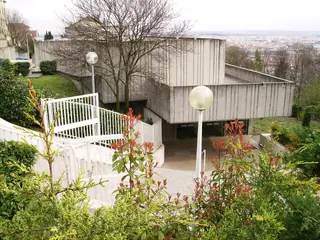
The museum and the Roman theatres occupy the slopes of the Fourvière hill, where the Roman city of Lugdunum was founded in 43 BC. The idea of a museum bringing together objects from the Roman city dates back to the 1930s, but the project only took shape in the early 1960s. It was entrusted to the architect Bernard Zehrfuss, who chose to bury the building so that it would be integrated into the archaeological site without dominating it. Construction began in 1972, and the museum opened on November 15, 1975.
The building is almost invisible from outside. Its raw concrete structure disappears beneath vegetation, and only two large openings, known as “canons à lumière” (light cannons), open the galleries onto the theatres. Inside, large open spaces follow a broad helical ramp. The neighbouring theatre and odeon, two major monuments of the Roman city, are part of the UNESCO World Heritage perimeter. They had almost disappeared after being used as quarries at the end of antiquity, and were uncovered and partly reconstructed during the first half of the 20th century.
Across some 4,000 m², the museum presents the public and private life of a capital of the Roman Empire: town planning, administration, the army, coinage, religion, circus games and trade. Among the major works are the Table claudienne, which reproduces a speech by the Emperor Claudius, a Gaulish calendar and the swastika mosaic. The museum is now run by the Métropole de Lyon and also offers temporary exhibitions, workshops and events on the theatres.
Highlights
Bronze Table claudienne, bearing a speech by Emperor Claudius
Gaulish calendar, one of the longest known texts in the Celtic language
Swastika mosaic, which visitors can walk on
Roman theatre and odeon, within the UNESCO World Heritage perimeter
Bernard Zehrfuss’s concrete architecture, integrated into the hill
Family area and tactile trail
Permanent exhibitions
Parcours permanent du musée – Across 4,000 m², the collections show the public and private life of Lugdunum, from everyday routines to beliefs, with inscriptions, mosaics and objects of Roman daily life.
Théâtres romains – The Roman theatre and odeon, side by side on the hill, can be seen all year round and host concerts, festivals and tours.
Explore Lyon antique – This self-guided route links the sites of ancient Lyon through a free web app with augmented reality and podcasts.
Founded
1975
Operated by
Métropole de Lyon
Visitors per year
approx. 169,238 (2024)
Admission & discounts
Adults
€4
Reduced
€2.50Students aged 26 and over, people aged 19 to 25, groups of at least ten people, families or holders of the large family card, holders of the culture or museum cards of the City of Lyon
Children & teens
freefree up to age 18 · Free admission up to the 18th birthday.
Seniors
freeFree from age 65.
Visitors with disabilities
freecompanion free · Free for visitors with disabilities and two companions.
Students & apprentices
freeFree for students aged 18 to 25 and for people on civic service (service civique).
Groups (10+ people)
€2.50 per personReduced rate from ten people; school groups and groups from social or educational organisations are free.
Families
€2.50Reduced rate for families (up to two adults with at least one child under 18) and holders of the large family card.
Admission ticket during a temporary exhibition
€7Reduced rate: €4.50
Annual pass
€14
Guided tour
€4
Workshop
€5Free for a parent accompanying children under 5 in a dedicated activity
Free admission:The first Sunday of every month; free admission also on some national free-entry events
Also free, on proof, for job seekers, RSA recipients, teachers and students preparing a visit, journalists, museum and tourism professionals, holders of the Lyon City Card or the ICOM or ICOMOS card, and holders of the annual pass. Prices are set by resolution of the Métropole de Lyon.
Access ramp to the entrance, two lifts with raised buttons and an audible signal, induction loops at the reception desks and in the lecture hall, a bone-conduction headset lent free of charge, a tactile trail with labels in braille, tactile floor guides and objects to touch. An easy-read and easy-to-understand leaflet is available at reception. Activities are translated into French Sign Language; activities with a mediator must be booked in advance.
Kids & families
Great for kids & families
Kids’ admission
free up to age 18
Family ticket
€2.50 · Reduced rate for families (up to two adults with at least one child under 18) and holders of the large family card.
Family tours & workshops
Activity booklet, scavenger hunt or kids’ audio guide
Hands-on stations
Playground / play area
A family area lets visitors dress like Romans, discover ancient games, deities and Roman cuisine. At the theatre site, a playful area and tactile models complement the visit. Workshops and tours for families are offered; a parent accompanying children under 5 in a dedicated activity gets free entry.
Getting there & parking
By public transit
Fourvière
Vieux Lyon station, then funicular F2 towards Fourvière; or funicular F1 towards Saint-Just, Minimes stop.
By car
Parking available
A car park is signposted on Rue Roger Radisson. Bike parking at 14 Rue Roger Radisson and Vélo’v stations 5051 (Rue Roger Radisson) and 5052 (Fourvière).
Second access to the Roman theatres at 6 Rue de l’Antiquaille. Upper entrance to the museum at 17 Rue Cléberg.
The museum rents its spaces to companies for public relations events, in cocktail format only; no catering during public opening hours. Contact: privatisation.lugdunum@grandlyon.com.
Guided tours and paid workshops, by reservation only. A free smartphone web app, accessible via QR codes on the signs, offers a virtual augmented-reality tour, podcasts and quizzes in French, English, Spanish, Italian and French Sign Language. A visitor guide to the permanent circuit can be downloaded.