May 21, 2027 – September 5, 2027
Ann Veronica Janssens
A sensory work of light, colour and transparency that reveals the instability of perception; in the Patio, a monumental installation encloses a dense fog within translucent architecture.

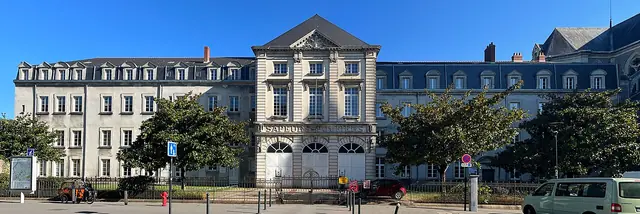
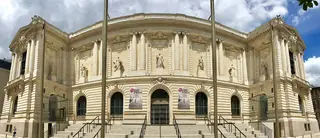
Large fine arts museum covering the 13th century to the present day, housed in a palace from 1900 and extended by the Cube and the Chapelle de l’Oratoire.
May 21, 2027 – September 5, 2027
A sensory work of light, colour and transparency that reveals the instability of perception; in the Patio, a monumental installation encloses a dense fog within translucent architecture.
February 5, 2027 – May 23, 2027
Works from the seventeenth to the twenty-first century depicting Black people, centred on Chassériau’s study after the model Joseph, with a critical view of the relationship between racism and invisibility.
February 5, 2027 – January 2, 2028
The brothers explore painting under a common signature, between optical effects, abstraction and superimposed forms; a work conceived for the display case extends into the museum.
November 20, 2026 – March 21, 2027
Women artists linked to Surrealism, from the 1920s to the 1960s, and contemporary creations, in four sections, with a carte blanche to Hélène Delprat and a place for the Nantes-born Claude Cahun.
November 20, 2026 – March 21, 2027
A 2011 video projected in the Chapelle de l’Oratoire: a black-and-white film that turns the lecture into an erudite and burlesque collage, in which the artist plays several roles.
January 30, 2026 – January 3, 2027
A small group of works brought out of storage, moved or loaned, presented in room 21 to offer a fresh look at the museum’s collections.
January 30, 2026 – January 3, 2027
An installation of fluid, non-figurative forms and translucent textiles, first in the Parvis display case and then, for the first time, in the permanent collections, in dialogue with seventeenth-century works.
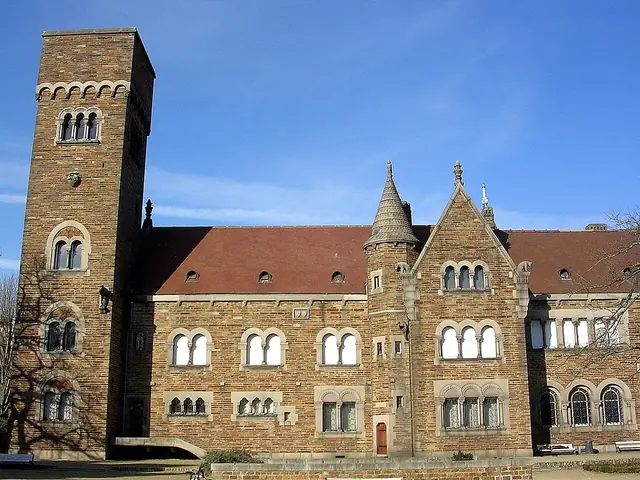
The museum was established by a consular decree of September 1, 1801, together with fourteen other provincial museums. Its collections grew considerably in 1810, when the city bought the collection assembled by the Cacault brothers. It opened to the public in 1830 in the Halle aux toiles and took the name Musée Clarke de Feltre after a bequest in 1852.
By the late 19th century the building was too small. The architect Clément Josso won the competition for a new palace, which opened as the Palais des Arts on January 19, 1900; after budget overruns, Léon-Félix Lenoir completed the site. The facades and the grand staircase have been listed as historic monuments since 1975.
The museum closed in December 2011 for a major extension and reopened on June 23, 2017. The project by the British firm Stanton Williams added the Cube, a building for contemporary art, and linked the palace to the Chapelle de l’Oratoire. The collections today span the 13th century to contemporary art and include paintings by Georges de La Tour, works by Kandinsky from 1922 to 1933, and Ingres’s Portrait of Madame de Senonnes, from 1814.
| Adults | €9 |
|---|---|
| Reduced | €4Especially young people aged 18 to 25 |
| Children & teens | freefree up to age 17 · Free admission for children under 18. |
| Visitors with disabilities | freecompanion free · Free visit for people with disabilities and their companion. |
| Families | –Every Sunday afternoon (except July and August), reduced rate for one or two adults accompanying a child under 18. |
| Pass musées (unlimited access for one year to four museums in the metropolitan area) | €15 |
| Activity for children under 18, full price | €6 |
| Activity for children living in the Nantes metropolitan area | €4 |
| Activity for children with the Carte blanche | €2.50 |
Free admission: Every Thursday from 19:00 to 21:00; the first Sunday of the month (except July and August); during certain events such as the European Heritage Days
Free admission for job seekers. Guided tours are booked through the online ticket shop; the price for people with disabilities is €4 or €2.50, and it is free for adapted groups.
The museum is entirely step-free; the main entrance is reached by an outdoor lift on the forecourt on rue Georges-Clemenceau, and lifts connect all levels. Manual wheelchairs, seat canes and push canes are lent at reception. Tactile, raised-relief and Braille maps. Sign-language tours led by deaf mediators, induction loops at reception and in the workshops, free remote interpreting. The “Ma visite” app offers content in easy-to-read French, in sign language and with audio description. Reserved parking spaces: rue Georges-Clemenceau (1), place de l’Oratoire (1) and rue Stanislas-Baudry (2).
Great for kids & families
| Time needed | approx. 2 hrs |
|---|---|
| Kids’ admission | free up to age 17 |
Workshops and guided tours for families from age 2 on Wednesdays, at weekends and during the school holidays; family Sunday with tours and board games; shows for young audiences. Activity booklets and sketchbooks at reception, family route in the “Ma visite” app. Changing tables on level -1. Free admission for children under 18.
Foch-Cathédrale · 4-min walk
Tram line 1, “Duchesse-Anne” stop (about 6 minutes on foot); tram line 2, “St-Mihiel” stop (about 10 minutes on foot); buses C1, C6, 11, 12 and Busway 4, “Foch-Cathédrale” stop (about 4 minutes on foot).
Paid parking
Covered Cathédrale car park (rue Sully), less than 5 minutes on foot; paid on-street parking and the Oratoire car park.
Coach drop-off (Dépose-minute) on Place Maréchal-Foch. Bike racks nearby; Bicloo stations no. 32 “Foch” and no. 63 “Jardin des Plantes”. The SNCF Nantes Nord station is nearby.
Get directionsThe Café du musée is a café-restaurant run by chef Éric Guérin; bookshop-boutique on site. According to the museum's official app, a Wi-Fi network is available to visitors to help them find their way around the galleries. Lockers accept items up to 55 x 35 x 20 cm.
The museum hasn’t published any information on this.
| Guided tours | yes |
|---|---|
| Audio guide | yes (FR, EN, ES) |
| School programs | yes |
| Photography | Photography is permitted without flash. |
| Good to know | Allow 1.5 to 2 hours for a quick or targeted visit and about 4 hours to see the whole museum. A tablet audio guide is handed out against an ID; the free “Ma visite” app is also available. Guided tours, workshops and events are scheduled each quarter and booked online, not by phone. |
Loading experiences …