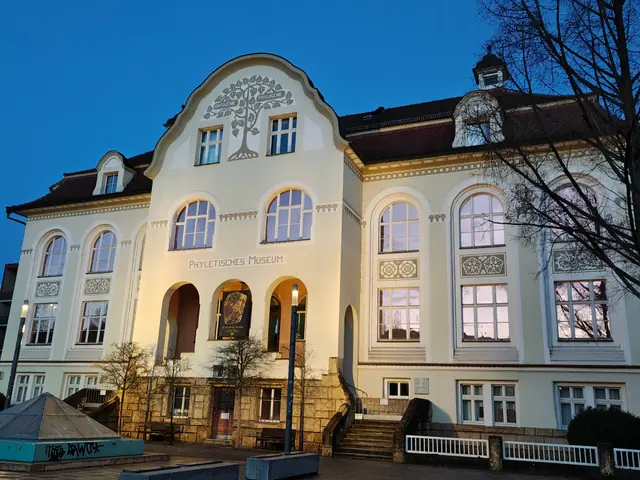
Anatomische Sammlung Jena
Public exhibition on human anatomy in the Collegium Jenense, with anatomical specimens, models and preparations made by Goethe. Admission free.
Have only individual sections read aloud
About the museum
The Anatomical Collection of the University of Jena goes back to a ducal collection from the early 19th century; its founding is attributed to the physician Justus Christian Loder. First displayed in Jena Castle, it moved in 1858 to its present location at Teichgraben 7.
The exhibition is aimed at a lay audience and is located in the Collegium Jenense, the oldest rooms of the university. In the Rolfinck Hall, the basics of anatomy are presented by organ systems, along with the arts of preparation and modeling and the origin of the bodies on display. The Goethe Hall is devoted to the historical holdings and the history of the collection. It also displays preparations that Goethe himself made, and a historical model collection.
Today the collection is mainly of scientific and cultural-historical significance. It continues to serve the training of students in human and dental medicine and is available to the medical professional public. Organizationally, it belongs to the Institute of Anatomy I of the University Hospital Jena.
Highlights
- Rolfinck Hall on organ systems and the art of preparation
- Goethe Hall with historical holdings
- Preparations made by Goethe himself
- Historical model collection
- Exhibition in the oldest rooms of the university
- Free admission
Permanent exhibition
- Anatomische Sammlung Jena – Exhibition on human anatomy with the Rolfinck Hall (organ systems, arts of preparation and modeling) and the Goethe Hall (historical holdings, Goethe's preparations, model collection).
- Operated by
- Universitätsklinikum Jena, Institut für Anatomie I
Admission & discounts
Admission is free.
Admission and guided tours are free. A donation (by bank transfer only) is requested.
Accessibility
- Wheelchair accessible
- Elevator: no information
- Accessible restroom: not available
- Accessible parking: no information
- Service dogs welcome: no information
- Tactile models & exhibits: no information
- Sign language tours: not available
- Easy-to-read materials: no information
- Audio description: no information
Ground-level access, passage widths at least 110 cm. The threshold of just over 2 cm to the first room can be bridged with a mobile ramp; the display cases cannot be driven under. Benches in the foyer, chairs in the Rolfinck Hall. Rollators, wheelchairs and strollers can be parked in the foyer or the Rolfinck Hall. Large-print texts are available, and object labels are also in English. There are no public toilets in the building; low-barrier free toilets are in the Goethe-Galerie and the Neue Mitte shopping center.
Kids & families
Children under 12 may only visit the exhibition accompanied by adults. The exhibition displays body parts of deceased people, including children, which may be unsuitable for some visitors.
Getting there & parking
By public transit
Stadtzentrum, Teichgraben · 40 m
Bus stop Stadtzentrum, Teichgraben; bus and tram stop Stadtzentrum, Holzmarkt; stops Löbdergraben. The Jena Paradies and Jena West railway stations are within walking distance.
By car
Parking available · 150 m to the entrance
Public parking nearby: underground car park Neue Mitte (about 150 m), Goethe Galerie parking garage, City Carree car park and Holzmarkt parking garage (about 200 m each), Eichplatz car park (about 250 m). Parking for tour buses can be arranged through the Jena Tourist Information.
Bicycle parking directly at the main entrance. Jena Paradies station is about 450 m away, Jena West station about 750 m.
Get directionsAmenities & dining
The museum hasn’t published any information on this.
Events & venue rental
The museum hasn’t published any information on this.
Plan your visit
| Guided tours | yes · approx. 1.5 hrs |
|---|---|
| Audio guide | no |
| School programs | yes |
| Good to know | Guided tours for registered school classes and groups of up to 30 people, led by student tutors (about 1.5 hours, free of charge). Only outside opening hours and not on Sundays or public holidays; also possible in English. A visit to the preparation room is not possible. There are no audio or video stations; English brochures with the exhibition texts are available. |