Photographs by press photographer Mickey Bohnacker in the dormitory show how postwar Frankfurt, under American influence, transformed from a field of rubble into a modern city.
About the museum
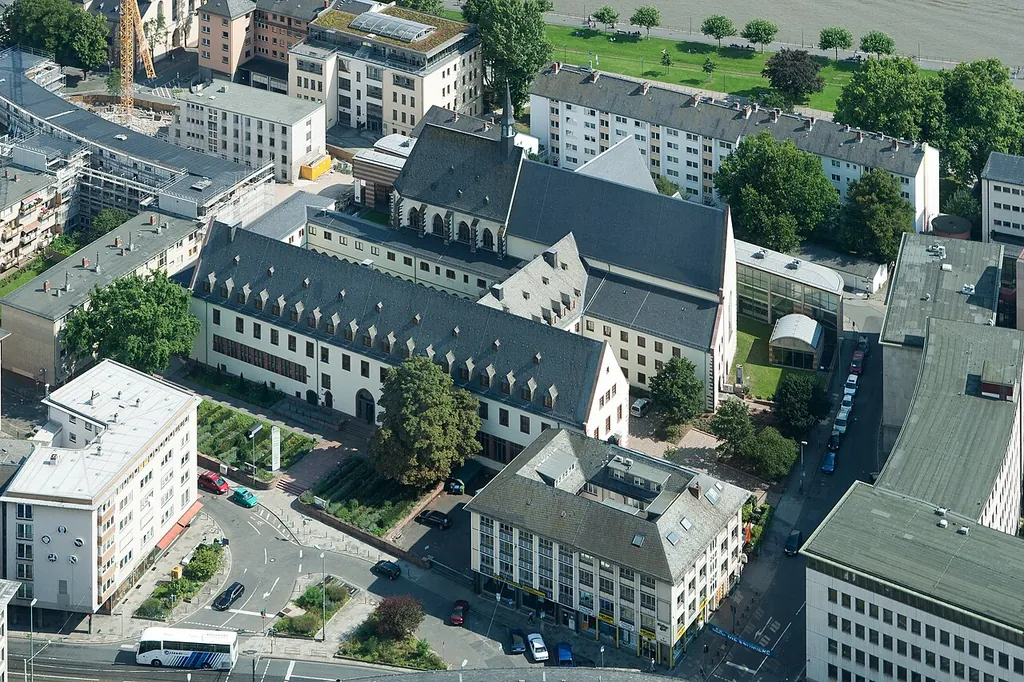
In the mid-13th century, monks of the Carmelite order settled in Frankfurt. From modest lodgings, a complete monastery complex with church, cloister, refectory and residential wings had grown by around 1500, financed mainly by endowments from Frankfurt patrician families, who in return secured burial places and masses. Between 1514 and 1521 the Swabian painter Jörg Ratgeb, a contemporary of Dürer and Grünewald, decorated the cloister and refectory with large murals depicting the history of salvation and the history of the order.
With secularization in 1803, the monastery passed to the city and was put to other uses, including as barracks; much of the painting was lost in the process. After World War I, friends of the old town campaigned for its preservation; in World War II the complex was badly damaged. Reconstruction began in 1951, and the city archive moved in in 1959. In the 1980s a team from Warsaw restored the surviving Ratgeb paintings, and the ruined church was converted into exhibition space for what is now the Archäologisches Museum.
Since 1998 the Institut für Stadtgeschichte (Institute for City History) – the city's memory, with holdings from the early Middle Ages to the present – has also used the cloister, refectory and dormitory; following a renovation completed in 2010, these rooms are open to the public. Alongside the permanent exhibition on Ratgeb's murals, the institute presents changing exhibitions on Frankfurt's history and retrospectives of Frankfurt artists in the dormitory, with free admission.
Highlights
Jörg Ratgeb's murals (1514–1521) in the cloister and refectory
28-meter-long refectory painting on the history of the Carmelite order
Tranquil cloister garden in the heart of downtown
Changing exhibitions by the Institut für Stadtgeschichte in the dormitory
Thomas Werner's "WandBild (für Jerg)" in the foyer
Permanent exhibitions
Jörg Ratgeb (um 1480–1526): Die Wandbilder im Karmeliterkloster – The partly reconstructed murals in the cloister and refectory tell the history of salvation and the history of the Carmelite order; explanations help decode the visual language of the early 16th century.
Thomas Werner: WandBild (für Jerg) – A large nine-part work by the Frankfurt painter in the foyer, combining motifs from Ratgeb's murals with Werner's own imagery.
Operated by
Institut für Stadtgeschichte Frankfurt am Main (Stadt Frankfurt am Main)
Admission & discounts
Admission is free.
Groups
–Group tours (approx. 60–90 minutes) for up to 25 people €100, on weekdays 9:00–18:00; request at least 14 days in advance via the online form or by phone at 069 212-33955.
Public guided tour of the special exhibition
€8Reduced €4; no reservation needed.
Free admission to all exhibitions. The guided tours of the Ratgeb murals on the third Sunday of the month are also open to the public.
Accessibility
Wheelchair accessible
Elevator: no information
Accessible restroom: no information
Accessible parking: no information
Service dogs welcome: no information
Tactile models & exhibits: no information
Sign language tours: no information
Easy-to-read materials: no information
Audio description: no information
According to the institute, the exhibitions are wheelchair-accessible.
Kids & families
The museum hasn’t published any information on this – please ask the museum directly.
Getting there & parking
By public transit
Karmeliterkloster
U1–U5 and U8 to Willy-Brandt-Platz; tram 11, 12 and 14 to Karmeliterkloster.
By car
No on-site parking at the museum.
No on-site parking; the Kaiserplatz (Bethmannstraße), Hauptwache (Kornmarkt) and Römer parking garages are close by.
The museum hasn’t published any information on this – please ask the museum directly.
Events & venue rental
Spaces for rent
Private parties
Corporate events
Up to 240 guests.
Spaces available for rent include the refectory (up to 240 people), the cloister (up to 200), the cloister garden (up to 180, e.g. for concerts and receptions), the dormitory (up to 120), the parlatorium (seminar room for up to 35) and the foyers, also in combination. The monastery church can be booked through the Archäologisches Museum.
Public guided tours of the Ratgeb murals every third Sunday of the month at 15:00; tours of special exhibitions as listed in the calendar. An audio guide and multimedia guides to the murals run in the web browser on your own smartphone. The archive's education team offers programs for middle and high school classes.