Museum der Stadt Füssen
Municipal museum in the Baroque state rooms of the monastery of St. Mang with the Füssen Dance of Death and a collection on lute and violin making.
About the museum
The museum's roots go back to 1913: a newly founded museum society then set up a district museum of local history in the library hall of the former Benedictine monastery of St. Mang, which the town had acquired shortly before. After closures due to both world wars, it reopened in 1924 and again in the early 1950s. In 1989 it was completely redesigned and received its present name.
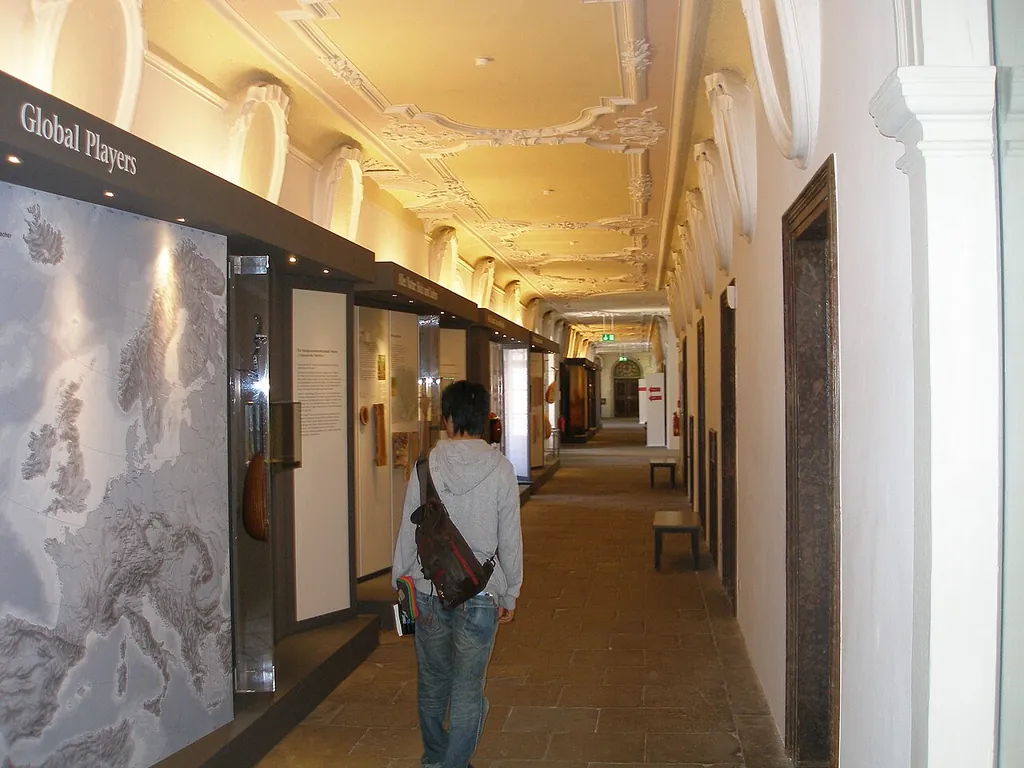
The museum occupies the southern part of the monastery complex, which goes back to the work of Saint Magnus around 750 and is thus one of the oldest monasteries north of the Alps. The present symmetrical Baroque complex was designed around 1700 by the local master builder Johann Jakob Herkomer. On view are the magnificent state rooms, above all the festival hall laid out as an imperial hall (Kaisersaal), the oval library building, and the refectory beneath it.
One focus is instrument making: Füssen is considered the cradle of commercial lute making in Europe, and the continent's first lute makers' guild was founded here in 1562. Among the oldest pieces is a lute from the Füssen workshop of Wolf from the mid-16th century. In the Annakapelle (St. Anne's Chapel), the Füssen Dance of Death can be seen, the oldest surviving Dance of Death in Bavaria. Further sections are devoted to the rope factory at the Lechgries, with which industrialization began for Füssen from the 1860s, as well as Füssen nativity scenes.
Highlights
- Kaisersaal and Baroque state rooms of the monastery of St. Mang
- Oval library hall with a view down into the refectory
- Füssen Dance of Death in the Annakapelle – the oldest surviving Dance of Death in Bavaria
- Lute from the Füssen workshop of Wolf, mid-16th century
- Large nativity scene by the wood sculptor Edmund Sprenzel
Permanent exhibitions
- Barocke Prunkräume des Klosters St. Mang – The Kaisersaal, oval library hall, and refectory show the Baroque monastery complex by Johann Jakob Herkomer as a total work of art.
- Füssener Lauten- und Geigenbau – Instruments and workshop history tell how Füssen became the cradle of European lute making.
- Füssener Totentanz – The Dance of Death in the Annakapelle shows twenty estates in a round dance with Death and is considered the oldest surviving one in Bavaria.
- Founded
- 1913
- Operated by
- Stadt Füssen
- Director
- Isabelle Schwarz
- Visitors per year
- approx. 17,000 (2018)
Admission & discounts
| Adults | €6 |
|---|---|
| Reduced | €5Holders of the FüssenCard, groups of 10 or more, seniors, people with severe disabilities |
| Children & teens | freefree up to age 17 · Children and teenagers under 18 as well as school classes have free admission. |
| Seniors | €5 |
| Visitors with disabilities | €5 |
| Groups (10+ people) | €5 per person |
| Combination ticket museums (Museum der Stadt Füssen and Galerien im Hohen Schloss) | €9 |
| Annual pass (Museum der Stadt Füssen and Hohes Schloss) | €20 |
School classes have free admission.
Accessibility
- Partially wheelchair accessible
- Elevator
- Accessible restroom
- Accessible parking
- Service dogs welcome
- Tactile models & exhibits: not available
- Sign language tours: no information
- Easy-to-read materials: not available
- Audio description: no information
"Reisen für Alle" (Travel for All) certificate: partially accessible for people with walking and visual impairments (valid until December 2028). Most rooms are on one level or reachable by ramp or elevator; two steps lead to the chapter house. Information is also conveyed by audio.
Kids & families
Great for kids & families
| Kids’ admission | free up to age 17 |
|---|
- Family tours & workshops
- Activity booklet, scavenger hunt or kids’ audio guide
With the children's booklet "Mit dem Kleinen Mang durch das Barockkloster" (With Little Mang through the Baroque Monastery; €3 at the ticket desk), children explore eleven stations with puzzles on monastic life, lute making, and the town coat of arms. Throughout the year, the museum education department offers workshops, family tours, and holiday programs.
Getting there & parking
By public transit
Tiroler Straße · 300 m
Füssen train station (trains from Munich, Augsburg, and Ulm, among others), about a 10-minute walk from there; nearest bus stop Tiroler Straße.
By car
Parking available · 25 m to the entrance
General parking lot about 25 m from the entrance; parking in the monastery courtyard only by prior arrangement.
- Accessible parking
By car via the A7 and the B310, B16, and B17 to Füssen.
Get directionsAmenities & dining
The museum hasn’t published any information on this – please ask the museum directly.
Events & venue rental
The museum hasn’t published any information on this – please ask the museum directly.
Plan your visit
| Guided tours | yes |
|---|---|
| Good to know | On selected dates, town tours with a museum visit are offered. The archive of the Deutsche Lautengesellschaft (German Lute Society) in the museum can be visited by arrangement with the society. |