Limited operations (expected until 2026-10-09). The first section of the permanent exhibition is being remodeled for the 30th anniversary; the tour therefore starts at a different point, and the highlights are temporarily on view elsewhere in the exhibition. For wheelchair users this means a longer detour. The redesigned areas open on October 10, 2026.
Revised new edition of the 2017 show: using four major migrations – from the departure from Africa to the steppe nomads around 5,000 years ago – it presents migration as a fundamental feature of human history.
Anniversary exhibition with a PLAYMOBIL diorama about ten meters long on the history of the valley from the Ice Age into the future, a large play area and a section with memories of people from the Neandertal.
About the museum
It all began with a chance find: in 1856, quarry workers in the Kleine Feldhofer Grotte in the Düssel valley came across bones that the Elberfeld teacher Johann Carl Fuhlrott recognized as the remains of a prehistoric human. The skeleton “Neanderthal 1” gave its name to an entire form of human and is considered the beginning of paleoanthropology. The grotto itself disappeared through limestone quarrying; its original location was only rediscovered in 1997.
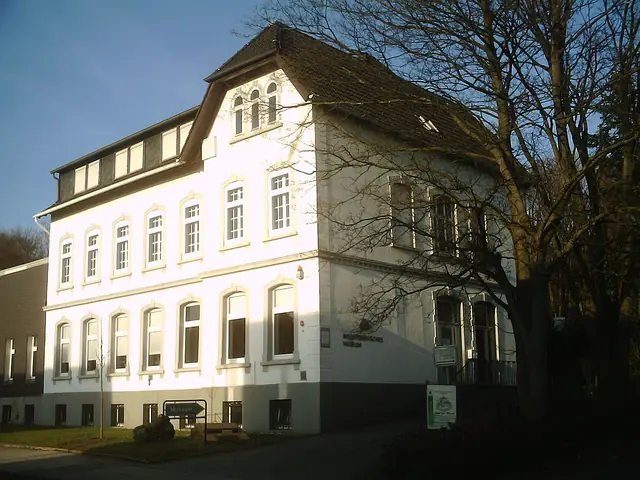
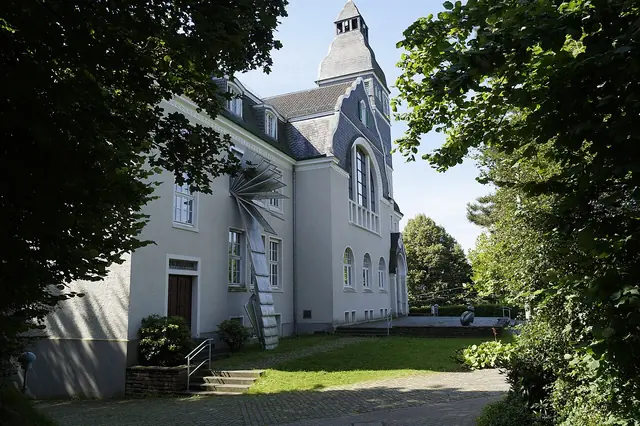
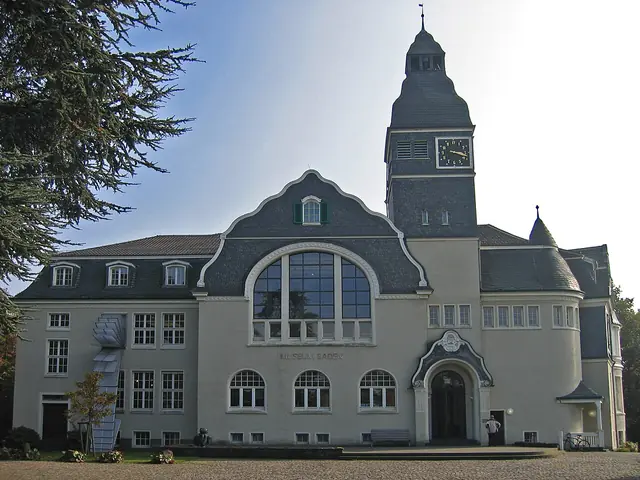
A first small prehistoric museum opened in the Neandertal as early as March 1938 and was redesigned as the Neandertal-Museum in 1962. Plans from the 1970s for a larger new building initially came to nothing; the old building in the woods now serves as the Steinzeitwerkstatt (Stone Age workshop).
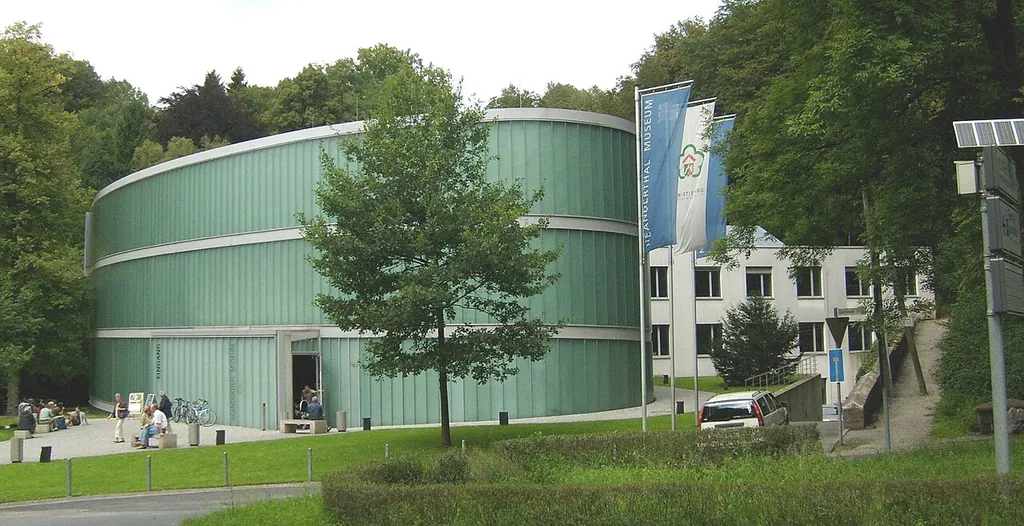
The present museum opened in 1996, run by the Stiftung Neanderthal Museum. The oval building was designed by Günter Zamp Kelp, Julius Krauss and Arno Brandlhuber; inside, a step-free circular path spirals upward, and in 1997 it received the Architekturpreis Beton (concrete architecture award). Since 2019 the museum, which received the German Archaeology Prize in 2009, has been directed by Bärbel Auffermann.
With life-size reconstructions, the permanent exhibition leads through seven million years of human history and was nominated for the European Museum of the Year Award in 2024. The museum also includes the find site with the Höhlenblick tower, the Stone Age workshop, and programs around the neighboring Eiszeitliches Wildgehege (Ice Age wildlife enclosure). For its 30th anniversary in 2026, three exhibition areas are being redesigned.
Highlights
Reconstruction “Mr. N”, based on the skeleton Neanderthal 1 discovered in 1856
Life-size reconstructions of early humans and human ancestors along a spiral path
Original find site with the accessible Höhlenblick tower
Oval museum building with a step-free ramp (Architekturpreis Beton 1997)
Free audio guide with TV presenter Ralph Caspers
Stone Age workshop, Stone Age playground and Ice Age wildlife enclosure nearby
Permanent exhibitions
Zeitreise erleben – Interactive tour through seven million years of human history with life-size reconstructions and many hands-on stations. From October 10, 2026, three areas will be redesigned, including a new presentation of the 1856 find.
Fundstelle des Neanderthalers mit Erlebnisturm Höhlenblick – The grounds at the former location of the Kleine Feldhofer Grotte let visitors experience the find site. From the wheelchair-accessible tower, you look out at the height of the vanished grotto.
Founded
1996
Operated by
Stiftung Neanderthal Museum
Director
Bärbel Auffermann
Visitors per year
approx. 160,956 (2025)
Admission & discounts
Adults
€14
Reduced
€11University students and people with disabilities (proof required)
Children & teens
€8free up to age 3 · Children aged 4 to 5 (“Minis”) €8, children aged 6 to 16 €9.50; children up to 3 free.
Seniors
–No senior discount listed.
Visitors with disabilities
€11companion free · Discount with a disability ID online and at the ticket desk; children up to 16 with ID €5.95. Companion admitted free with the “B” marker (museum and find site).
Students & apprentices
€11University students with proof.
Groups (15+ people)
€13 per personGroup discount from 15 people: adult group €13, school class €7, kindergarten group €6 per person. Groups of 10 or more are asked to register in advance (museum@neanderthal.de, 02104 9797-15).
Families
–Family rate from 1 adult and 1 child with 15% off: adults €11.90, children (6–16) €8.08, Minis (4–5) €6.80.
The ticket is valid for the permanent and special exhibitions as well as the find site and the Höhlenblick tower. Tower only: adults €4.50, children €3.10, Minis €2.60, reduced €3.60 (families 15% off). Combined ticket with the Visiodrom Wuppertal (about 23% cheaper, redeemable for three years) and annual pass (365 days from first visit). Free admission for members of the Neanderthaler Gesellschaft and with the Art:card; free once with the RUHR.TOPCARD; €1 off with a public transport ticket. Tickets online or at the ticket desk; guided tours, workshops and holiday programs can only be booked online. SteinzeitActionPack for children €2.95.
Accessibility
Wheelchair accessible
Elevator
Accessible restroom
Accessible parking
Service dogs welcome
Tactile models & exhibits
Sign language tours
Easy-to-read materials
Audio description: no information
Certified under “Reisen für Alle” (Travel for All) (including accessible for people with walking and visual impairments and for blind people, partially accessible for wheelchair users). The exhibition, café, shop and Höhlenblick tower are step-free via ramps; the wheelchair-accessible toilet can be reached by elevator. During remodeling until October 9, 2026, there is a detour: take the elevator to the top level, then go down the ramp. Tactile floor guidance system, tactile objects, text readers in 16 languages and in Easy Language (Leichte Sprache), “Touchpoint” workshop for blind and visually impaired people, sign language tours on request. Loaner wheelchairs and folding seats free of charge; free accessible parking spaces in P1.
Kids & families
Great for kids & familiesRecommended for ages 4+
Time needed
approx. 3 hrs
Kids’ admission
free up to age 3
Family tours & workshops
Hands-on stations
Stroller-friendly
Playground / play area
Kids’ birthday parties
According to the museum, suitable for children from about four to five years; many hands-on stations in the exhibition. Public family tour on Sundays, interactive tours for children, Stone Age birthday parties (from age 5), holiday programs and a Stone Age playground in the outdoor adventure area. Strollers may be taken into the exhibition.
Getting there & parking
By public transit
Neanderthal/Museum
Bus 741 (Mettmann–Hilden) and 743 (Mettmann–Erkrath) to Neanderthal/Museum directly in front of the building; Regiobahn S 28 to Neanderthal (approx. 800 m walk); S 8 to Hochdahl (approx. 25-min. walk via the street Thekhaus).
By car
Parking available
Paid parking lot P1 opposite the museum (€1.50/hr., with accessible parking spaces, which are free); free P+R parking lot P2 at Neanderthal station (approx. 5–10-min. walk); additional overflow lots P4 (approx. 25 min.) and Erkrath-Hochdahl S-Bahn station (approx. 20 min.). Four free bus parking bays about 200 m away.
Accessible parking
Free shuttle from the Erwepa parking lot (Sat 13:00–18:00, Sun and public holidays 11:00–18:00). On foot, do not take the street Feldhof, but go via Thekhaus.
Museum café with rooftop terrace at the end of the exhibition (Tue–Sun 10:00–17:30, run by the neighboring Ristorante Gavi); the Neanderthal Kiosk is opposite. Free cloakroom, lockers €0.50, free Wi-Fi “neanderthal-wifi”. Dogs only on DoggyDay (first Friday of the month, 14:00–18:00) and as assistance dogs.
Events & venue rental
Spaces for rent
Private parties
Corporate events
Weddings / ceremonies
Up to 500 guests.
Entire museum (up to 500 people, only in the evening from 18:00 or on Mondays), auditorium (up to 100), barbecue area (up to 150, only with a guided tour, workshop or activity program), museum café (50 seats plus 25 on the rooftop terrace), conference room (up to 40) and the Wildhüterhaus (gamekeeper's house) in the Stone Age workshop (up to 30). Civil wedding ceremonies on the Höhlenblick tower for up to 30 guests (€300 plus VAT, through the Erkrath registry office).