The exhibition is devoted to five hybrid creatures of ancient mythology – Medusa, the Chimera, the Minotaur, centaurs and the Sphinx – using objects from Munich's Antikensammlungen.
About the museum
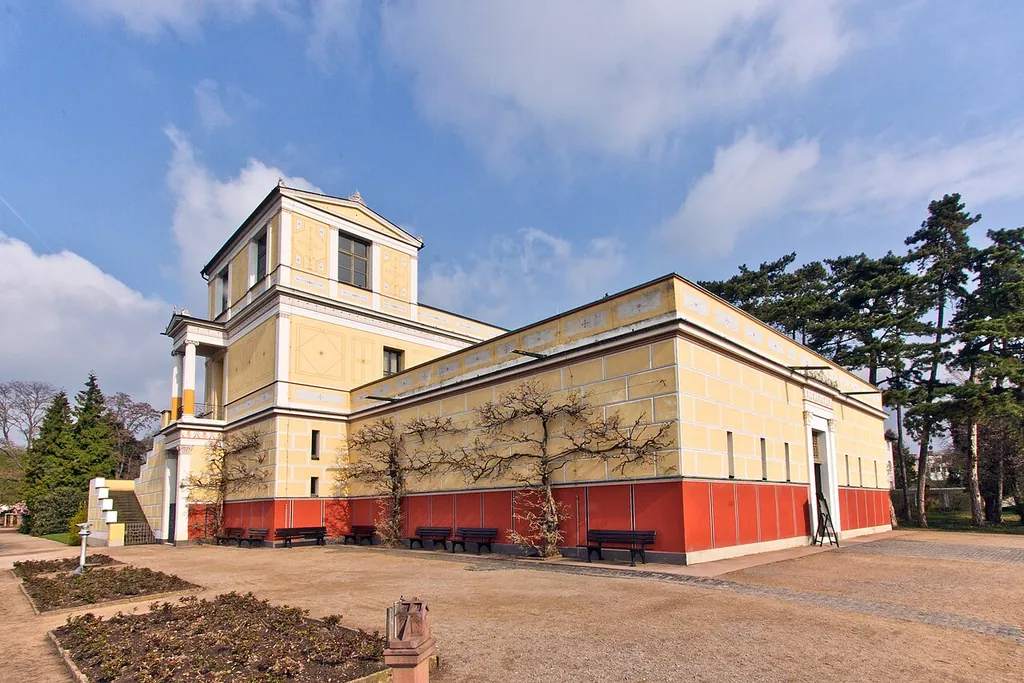
After his travels in Italy, King Ludwig I of Bavaria decided to have a full-size replica of a Pompeian house built north of the Alps. Friedrich von Gärtner erected the building between 1840 and 1848 on the high bank of the Main River in the palace gardens of Aschaffenburg. The house was conceived as a walk-through model to give art lovers and students a vivid impression of how people lived in antiquity.
The rooms are arranged around two courtyards: the atrium with its water basin and the viridarium, a planted garden. Wall paintings and mosaic floors were executed after Pompeian models, as was the design of the dining rooms, bedrooms and living rooms.
The building was badly damaged in World War II and was gradually restored starting in 1960. Since 1994 the Pompejanum has served as a branch museum of the Staatliche Antikensammlungen und Glyptothek München.
On display are original Roman marble sculptures, bronzes, glassware and everyday objects, including two ancient marble thrones. The house is managed by the Bayerische Schlösserverwaltung (Bavarian Palace Administration); during the season, special exhibitions with loans from Munich complement the presentation.
Highlights
Walk-through, full-scale replica of a Roman villa
Atrium with water basin and viridarium
Wall paintings and mosaic floors based on Pompeian models
Original Roman sculptures, bronzes and glassware
Two ancient marble thrones
Permanent exhibitions
Römisches Wohnhaus und antike Originale – A tour through the reconstructed living quarters with wall paintings and mosaics, along with Roman sculptures, bronzes and glassware from Munich.
Founded
1848
Operated by
Bayerische Schlösserverwaltung (Schloss- und Gartenverwaltung Aschaffenburg); Ausstellung der Staatlichen Antikensammlungen und Glyptothek München
Admission & discounts
Adults
€7
Reduced
€6Seniors 65 and over, people with severe disabilities, groups of 15 or more paying visitors, students of art/art history, volunteer service participants, members of artists' associations
Children & teens
freefree up to age 17 · Children and teens under 18 free; school students also free over 18
Seniors
€6Ages 65 and over with ID
Visitors with disabilities
€6companion free · With severe disability ID (Schwerbehindertenausweis); companion free with “B” marker
Students & apprentices
–Reduced rate (€6) only for students of art, art history and art studies; school students free even over 18
Groups (15+ people)
€6 per personReduced rate for groups of 15 or more paying visitors; one tour leader free per 25 people
Families
–No separate family rate; children under 18 are free
2026 prices; special exhibition included in admission. Card payment not accepted at the ticket desk.
Accessibility
Partially wheelchair accessible
Elevator: not available
Accessible restroom: not available
Accessible parking: not available
Service dogs welcome: no information
Tactile models & exhibits: no information
Sign language tours: no information
Easy-to-read materials: no information
Audio description: no information
Entrance via a step about 15 cm high; on request, staff will set up a portable ramp (advance notice at 06021 218012 recommended). First floor step-free, second floor by stairs only. No accessible restroom. Nearest accessible parking spaces at Kapuzinerplatz opposite St. Elisabeth.
Kids & families
Great for kids & families
Kids’ admission
free up to age 17
Family tours & workshops
Activity booklet, scavenger hunt or kids’ audio guide
Free children's tour via smartphone (through museum.de) and a downloadable explorer worksheet; occasional family tours, e.g. “Lucius Pfiffikus lernt lesen” (approx. 90 min.).
Getting there & parking
By public transit
Stadthalle
Bus to the “Stadthalle” stop.
By car
Parking available
No parking directly at the house; parking garages in the city center as well as parking lots including at Schloßplatz and on Suicardusstraße.