Around 100 exhibits tell of more than five decades of queer protest in West Germany, East Germany and reunified Germany. Created as a touring exhibition with the Goethe-Institut and the bpb (Federal Agency for Civic Education).
The exhibition sheds light on the American intellectual Susan Sontag as a thinker on photography, film and camp – and as a much-photographed icon herself.
A staged journey through villages and small towns shows queer life, activism and communities away from the big city from the 1920s to the present.
About the museum
The impetus came in 1984 with the exhibition “Eldorado” about gay women and men in Berlin, which drew tens of thousands of visitors to what was then the Berlin Museum. Its initiators – student gallery attendants around Andreas Sternweiler, Wolfgang Theis and Manfred Baumgardt – wanted to continue this work permanently and founded a supporting association on December 6, 1985. The first exhibition of its own, about the gay press, followed in 1986 in rooms of the Allgemeine Homosexuelle Arbeitsgemeinschaft (General Homosexual Working Group).
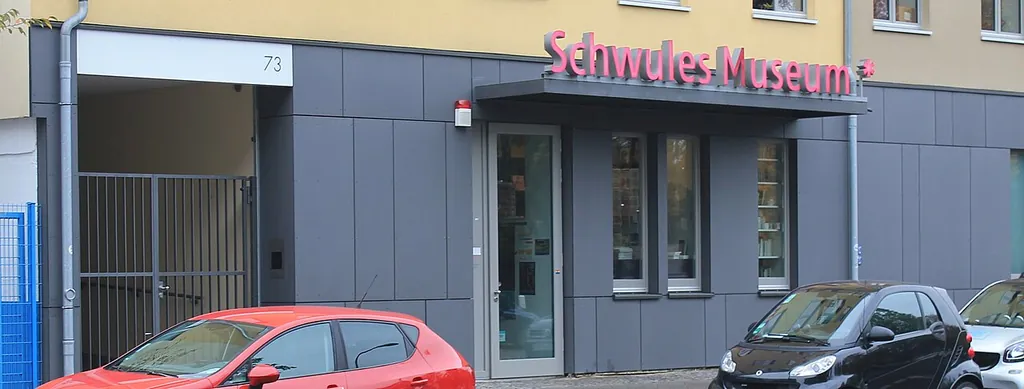
From 1988 the museum was based on Mehringdamm in Kreuzberg, where well over a hundred exhibitions were created up to 2013 – on Oscar Wilde, Marlene Dietrich and the persecution of gay men under National Socialism, for example. In May 2013 it moved to the building on Lützowstraße in Tiergarten, which offers space for several exhibition rooms, a café, a library and a climate-controlled archive.
Since 2008 the museum has broadened its focus to include lesbian, trans*, inter* and other queer lives; the asterisk in its name stands for this expansion. In 2015, together with the Deutsches Historisches Museum, it presented the major exhibition “Homosexualität_en”.
Today several changing exhibitions usually run at the same time. The collection – with magazines dating back to 1896, photos, films, posters, artworks and personal papers – is among the most extensive of its kind in the world and is used by researchers from many countries.
Highlights
Several concurrent changing exhibitions on queer history, art and culture
Archive with magazines dating back to 1896, personal papers, photos, posters and films
Reference library with around 19,000 titles, usable without registration
Free public guided tours on Thursdays, Saturdays and Sundays
Café on the ground floor
Founded
1985
Operated by
Verein der Freundinnen und Freunde des Schwulen Museums in Berlin e. V.
Admission & discounts
Adults
€10
Reduced
€5The unemployed, pensioners, school and university students, trainees, people doing federal voluntary service, people with severe disabilities, holders of the Jugendleiter-Card (youth leader card), members of Vorspiel SSL Berlin e. V.
Children & teens
freefree up to age 17 · Children and teens under 18 free
Seniors
€5Reduced with a pension ID
Visitors with disabilities
€5companion free · Reduced with a severe disability ID (Schwerbehindertenausweis)
Students & apprentices
€5
Groups (10+ people)
€6 per personGroup members eligible for reduced admission €3; private group tour (1 hour) €80 plus admission, max. 25 people
Families
–No family ticket; under-18s are admitted free
Solidarity ticket
€15Voluntary supporter price
Berlin WelcomeCard
€6
get2Card / joycard (2 people)
€9Price for two people
Free admission:Every first Sunday of the month (Museumssonntag Berlin)
Also free for members of the museum association, the press and holders of ICOM and DMB (German Museums Association) cards. Public guided tours are free. According to the German price list, the group rate applies to 10 or more paying visitors.
Accessibility
Wheelchair accessible
Elevator
Accessible restroom
Accessible parking: not available
Service dogs welcome
Tactile models & exhibits: not available
Sign language tours
Easy-to-read materials
Audio description: no information
Main entrance with three steps, step-free access via the courtyard (ring the bell at the gate). Two wheelchair-accessible all-gender restrooms, elevator to the library. Exhibition information as German Sign Language (DGS) videos; DGS tours or interpreting can be booked at no extra charge; Phonak hearing amplifiers (also with telecoil) available on request for guided tours. No Braille information; plain language only for some exhibitions.
Kids & families
The museum hasn’t published any information on this – please ask the museum directly.
Getting there & parking
By public transit
Lützowstraße/Potsdamer Straße · 500 m
Bus M48, M85 to Lützowstraße/Potsdamer Straße (about 500 m); bus 100, 106, 187, M29 to Lützowplatz (about 500 m); U1, U3 to Kurfürstenstraße (about 750 m, with elevator); U1–U4 to Nollendorfplatz (about 900 m, with elevator).
By car
Paid parking
No dedicated parking; only a few paid parking spaces in the immediate vicinity, none of them accessible.
Café on the ground floor at the courtyard entrance.
Events & venue rental
The museum hasn’t published any information on this – please ask the museum directly.
Plan your visit
Guided tours
yes · approx. 60 min
Audio guide
yes
School programs
yes
Good to know
Public guided tours Thu 18:00, Sat and Sun 16:00, no registration, max. 25 people. Group tours (German/English/DGS) and school classes via fuehrungen@schwulesmuseum.de. Audio guide only for some exhibitions.