On view as prints for the first time: photographs by the Scottish ethnographer Denis Galloway, who traveled through the Spreewald between 1908 and 1914. The images show field work, markets, weddings and a rare variety of Wendish traditional costumes.
About the museum
Sorbian/Wendish culture has a long museum tradition in Cottbus: the municipal museum, opened in 1908, already had a “Wendish Room”, later followed by a dedicated department and a Wendish farmhouse parlor in the local history museum. After almost all municipal collections were lost in the Second World War, the city museum – from 1961 the district museum – again showed exhibitions on the culture of the Lower Lusatian Sorbs at Schloss Branitz.
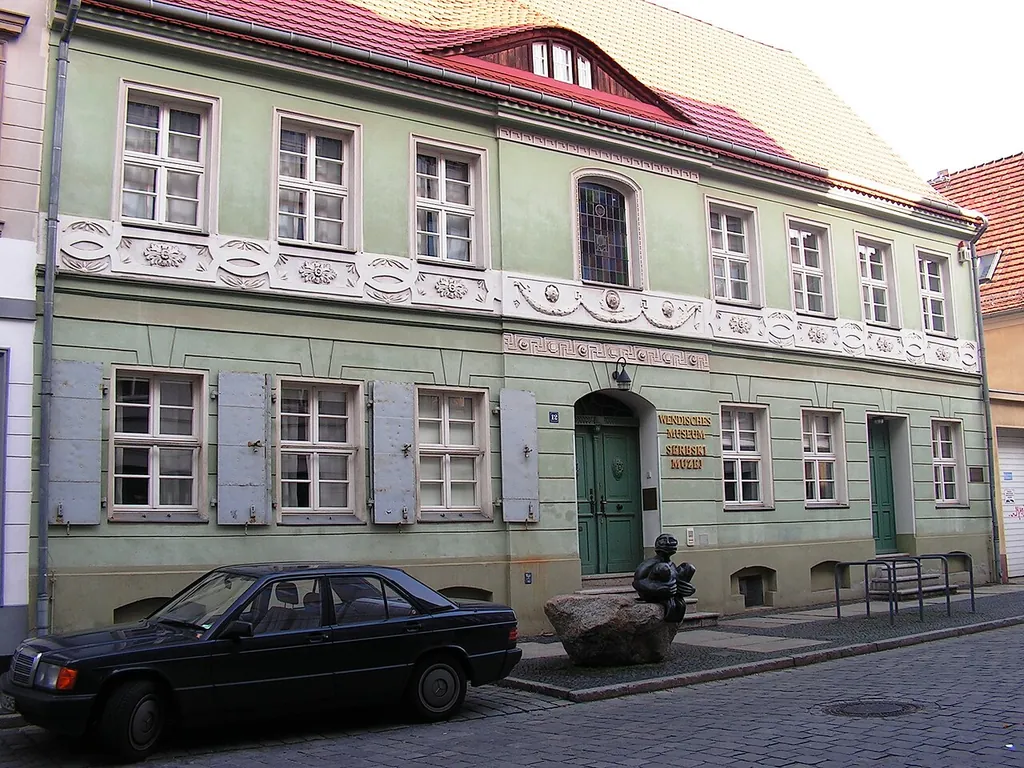
In the mid-1980s, the district museum set up a “Wendisches Museum” department, which expanded its collections to include traditional costumes, fine art, folk art, music and everyday culture. In 1986 the city purchased the town house at Mühlenstraße 12 near the Altmarkt; the plot is first mentioned in 1544, and the house belonged to a family of leather merchants for over a century. After conversion with funding from the state of Brandenburg, the Stiftung für das sorbische Volk (Foundation for the Sorbian People) and the city, the Wendisches Museum opened as an independent museum on June 3, 1994, with the first permanent exhibition on Lower Sorbian history and culture.
By 2015 the museum had produced almost 100 special exhibitions. From 2016 to 2020 the building was renovated and the permanent exhibition completely redesigned. Since the 2020 reopening, it has led through themed rooms on faith, language and literature, customs over the course of the year and of life, traditional costumes and music, as well as industrialization, emigration and the loss of homeland caused by the transformation of the Lusatian landscape. The museum is an institution of the city of Cottbus/Chóśebuz and is supported by the Stiftung für das sorbische Volk.
Highlights
Church door from Werben/Wjerbno, more than 600 years old
Facsimile of the oldest known written Lower Sorbian source, from 1510
Variety of regional Lower Sorbian/Wendish traditional costumes
Model and original pews of the Wendish Church in Cottbus
Parts of the Jordan Library, probably the largest private Sorbian book collection in Lower Lusatia
Collection of around 900 decorated Easter eggs (on display at Easter)
Permanent exhibitions
Daś Serbstwo wobstawa! – Kulturgeschichte der Sorben/Wenden in der Niederlausitz – Opened in 2020, the permanent exhibition uses originals, replicas and media to explore faith, language, customs, traditional dress and music, as well as industrialization and the loss of homeland in Lusatia.
Founded
1994
Operated by
Stadt Cottbus/Chóśebuz (Städtische Sammlungen)
Director
Robert Büschel (Leiter der Städtischen Sammlungen Cottbus)
Admission & discounts
Adults
€5
Reduced
€4School students, apprentices, university students, volunteer-service participants, people with severe disabilities and recipients of benefits under SGB II/XII, the Asylum Seekers’ Benefits Act and housing benefit (each with proof)
Children & teens
freefree up to age 17 · Children and young people free until their 18th birthday.
Seniors
–No senior discount in the fee schedule.
Visitors with disabilities
€4companion free · Reduced for people with severe disabilities; companions free with a “B”, “G” or “H” marker.
Students & apprentices
€4Reduced for university students, school students and apprentices.
Groups (10+ people)
€4 per personFrom 10 people. Guided tours for adults €2 per person plus admission (minimum €50 including admission). Educational programs for daycare centers and schools from €1 per child; one accompanying adult free per 10 children.
Families
–No family ticket; children and young people under 18 get free admission.
Combined ticket for the Wendisches Museum and the Stadtmuseum Cottbus €8 (valid for one week), joint annual pass €25. Ehrenamtskarte (volunteer card) Berlin/Brandenburg: 50% discount. Free for the press and for members of ICOM, the Deutscher Museumsbund, the Museumsverband Brandenburg and the Wendisches Museum friends’ association. Based on the fee schedule of November 1, 2025.
Accessibility
Partially wheelchair accessible
Elevator
Accessible restroom
Accessible parking: not available
Service dogs welcome: no information
Tactile models & exhibits: no information
Sign language tours: no information
Easy-to-read materials: no information
Audio description: no information
According to an assessment by the Museumsverband Brandenburg (2023), accessible to people with limited mobility: the main entrance has four steps, and the step-free side entrance is opened by staff by arrangement. Ramps in the exhibition and an elevator to the upper floor; one step on the upper floor requires a detour. Accessible restroom with grab bars, but with little lateral maneuvering space. No accessible parking space at the building; nearest parking approx. 300 m away. The website itself contains no information on accessibility on site.
Kids & families
Great for kids & families
Kids’ admission
free up to age 17
Family tours & workshops
Activity booklet, scavenger hunt or kids’ audio guide
Hands-on stations
Museum explorer case with puzzles and tasks for each room of the permanent exhibition (including opening a treasure chest and trying out a weaving frame) and a children’s audio guide featuring the character “Nikola der Nyks” (Nikola the Nix); occasional family days with legends and handicrafts (ages 4 and up). Free admission up to age 18.
Getting there & parking
By car
According to Reiseland Brandenburg, there is no dedicated visitor parking; the museum itself provides no information on parking.
Accessible parking: not available
Mühlenstraße 12 in the old town, near the Altmarkt.