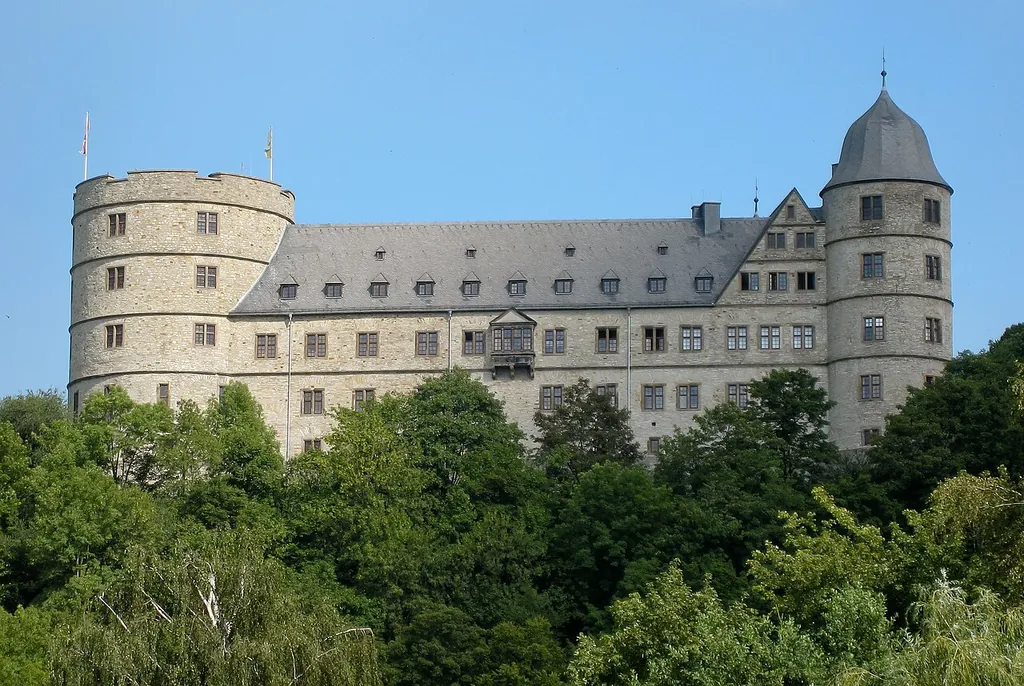
District museum in the triangular Wewelsburg castle: the history of the Prince-Bishopric of Paderborn and a memorial with the exhibition “Ideologie und Terror der SS” (Ideology and Terror of the SS).
Opening hoursAdmission from €3 Partially accessible Restaurant
Intervention in the Historical Museum on the domestic life of the nobility, the middle classes and the rural population in the Paderborn region; included in museum admission.
Exhibition by memorial sites in North Rhine-Westphalia on the German colonial period in Rwanda, the 1994 genocide against the Tutsi and how it has been confronted since; free admission.
About the museum
Wewelsburg, high above the Alme valley, was built between 1603 and 1609 as a secondary residence for Dietrich von Fürstenberg, Prince-Bishop of Paderborn – a closed triangular complex in the Weser Renaissance style, on the site of a medieval castle. Rebuilt after damage in the Thirty Years' War, it passed to Prussia in 1802. In 1924/25 the district of Büren acquired the property, set up a youth hostel and opened the district local history museum on May 31, 1925.
After a visit by Heinrich Himmler in 1933, the SS leased the castle in 1934 and planned to turn it into an ideological center. Prisoners from the Niederhagen concentration camp, set up specifically for this purpose, were forced to work on the conversion; at least 1,285 of them lost their lives. After the SS attempted to blow it up, the castle burned out in 1945; once rebuilt, it reopened in 1950 as a museum and youth hostel.
In 1982 a first documentation of the Nazi era was set up in the former SS guardhouse, and in 1996 the Historical Museum of the Prince-Bishopric of Paderborn opened in the castle, telling the story of the prince-bishopric from prehistory to 1802. In 2010 the Wewelsburg 1933–1945 Remembrance and Memorial Site opened with the permanent exhibition “Ideologie und Terror der SS”, which presents a comprehensive history of the SS and commemorates its victims.
Since 2024 the GeDenkOrt in the former prisoners' kitchen of the Niederhagen concentration camp has added to what the site offers. The district museum belongs to the district of Paderborn and celebrated its 100th anniversary in 2025.
Highlights
Weser Renaissance castle that has kept its closed triangular shape to this day
Permanent exhibition “Ideologie und Terror der SS” in the former SS guardhouse
North Tower with the former SS rooms, accessible as part of the memorial tour
The so-called witches' cellar, the original setting of witch interrogations in 1631
The original Balkenhol smithy with demonstrations in the Historical Museum
GeDenkOrt in the former prisoners' kitchen of the Niederhagen concentration camp
Permanent exhibitions
Ideologie und Terror der SS – Covering 850 m², the memorial's permanent exhibition presents the history of the SS and the Niederhagen concentration camp and commemorates the victims; exhibits include prisoner clothing and a pocket diary belonging to Himmler.
Historisches Museum des Hochstifts Paderborn – A tour through the history of the Prince-Bishopric of Paderborn from the Stone Age to 1802, covering the history of the castle, everyday life in town and country, the witch hunts and the natural history of the region.
GeDenkOrt – Exhibition in the side wing of the former prisoners' kitchen of the Niederhagen concentration camp about the camp grounds and forced migration in the 20th century; open to individual visitors every third Saturday of the month.
Founded
1925
Operated by
Kreis Paderborn
Director
Kirsten John-Stucke
Visitors per year
approx. 108,215 (2025)
Admission & discounts
Adults
€3
Reduced
€1.50School and university students up to age 27, people doing voluntary service, recipients of benefits under SGB II or XII (German social security codes), and people with a disability rating of 80% or more
Children & teens
–No separate children's category is listed; school students pay the reduced price of €1.50 at the Historical Museum. The memorial is free for everyone; young people aged 14 and over may visit it on their own.
Seniors
–No senior discount listed.
Visitors with disabilities
€1.50companion free · Reduced admission with a disability rating of 80% or more; a companion with ID is admitted free.
Students & apprentices
€1.50Up to age 27. Students of Paderborn University with the AStA culture ticket are admitted free.
Groups (10+ people)
€2 per personAdult groups of 10 or more €2 per person (minimum €20), children's and school groups €1 per person (minimum €10). Guided tours by advance booking only: €40 (in English €50), with a village walk €60, day seminars €80.
Families
€6Up to two adults with children under 18.
Prices apply to the Historical Museum of the Prince-Bishopric of Paderborn; the permanent exhibition “Ideologie und Terror der SS” at the memorial, the GeDenkOrt and the special exhibitions in the special exhibition room are free. Public guided tours €3 per person, tours for families with children aged 6 and over €2 (no additional admission in either case). 50% off with the family passes of surrounding municipalities and the Paderborn Karte, “2 for 1” with some guest and spa cards; guests of the Wewelsburg youth hostel pay €1. Free admission including for members of the friends' association, holders of the Ehrenamtskarte NRW (volunteer card) and ICOM and Museumsbund members. Your ticket gets you a one-time 20% discount at Kloster Dalheim (and vice versa). Payment in cash, by EC (German debit) card or credit card.
Accessibility
Partially wheelchair accessible
Elevator
Accessible restroom
Accessible parking
Service dogs welcome
Tactile models & exhibits
Sign language tours
Easy-to-read materials
Audio description: no information
With help from museum staff, both exhibitions are largely accessible; not reachable are the dungeon and the cellar room in the southeast wing of the Historical Museum and the crypt at the memorial. Both entrances have ramps (at the Historical Museum the ramp is put out on request); very large power wheelchairs may find things tight. Accessible parking space on the square in front of the castle. Multisensory tours with tactile models for blind and visually impaired visitors, tours in German Sign Language every six months, and audio guides also in Easy Language (Leichte Sprache). Guide dogs allowed, other animals not.
Kids & families
Great for kids & families
Time needed
approx. 3 hrs
Family ticket
€6 · Up to two adults with children under 18.
Family tours & workshops
Activity booklet, scavenger hunt or kids’ audio guide
Hands-on stations
Kids’ birthday parties
In the Historical Museum, the mascot Falko (a kestrel) accompanies children with hands-on stations to try out and explore; discovery tour and discovery bag for families with children aged 6 and over, public family tour (ages 6 and up), holiday programs, children's birthday parties and programs for daycare centers. Children may visit the memorial on their own only from age 14; younger children only accompanied by a parent or guardian. The Historical Museum has no age restriction.
Getting there & parking
By public transit
Kreismuseum
Express bus S61 from Paderborn Hauptbahnhof (toward the airport) to the “Kreismuseum” or “Wewelsburg-Schule” stop; lines Sk1 and 461 also stop in Wewelsburg.
By car
Free parking
Free visitor parking level with the castle garden, signposted in the village; accessible parking space on the castle forecourt. On weekends and public holidays there is often not enough space: overflow parking at the Dorfhalle (Niederhagen 3, about 10 min on foot) and at Bäckerei Grundmann (Schafsberg 2).
Burgcafé serving hearty home-style food, coffee and cake in the former guardhouse on the castle forecourt (Tue–Thu and Sun 11:30–21:00, Fri/Sat until 22:00, closed Mon). Museum shops in both sections plus an online shop. Free cloakroom and lockers, loan umbrellas when it rains.
Events & venue rental
Spaces for rent
Corporate events
Weddings / ceremonies: not available
Up to 200 guests.
The accessible Burgsaal (200 m², up to 200 people) on the ground floor of the castle is available for conferences, workshops and events, with a concert grand piano, technical equipment and Wi-Fi; catering via the Burgcafé or the youth hostel. Weddings, wakes and dance events are not possible.