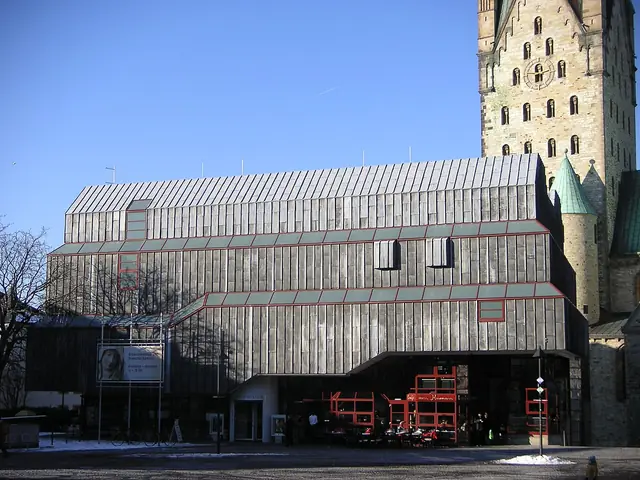
Foyer exhibition on the recently discovered Roman marching camp in Paderborn: finds from Roman camps in eastern Westphalia and models show the everyday life of legionaries. At hands-on stations you can carry marching gear and grind grain.
About the museum
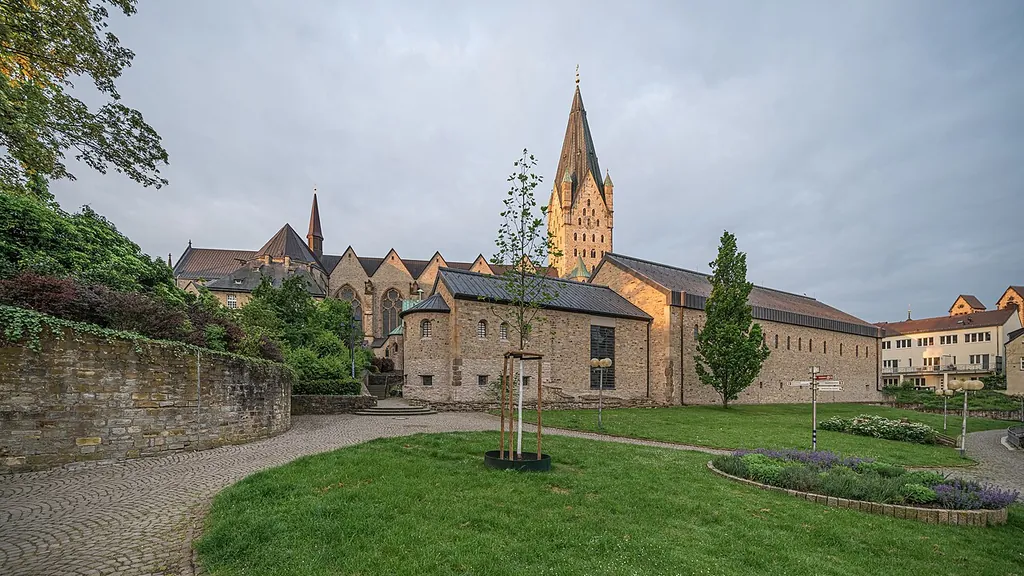
Written sources revealed that Charlemagne had a palace (Pfalz) in Paderborn, but its exact location long remained unknown. When the cathedral chapter wanted to redevelop the area north of the cathedral in the early 1960s, archaeologists from the Landschaftsverband Westfalen-Lippe under Wilhelm Winkelmann first uncovered the walls of the palace that Bishop Meinwerk had built for King Henry II in the early 11th century. Beneath it, in 1964, the remains of the much smaller Carolingian complex from the late 8th century came to light.
The Ottonian-Salian palace was so well preserved that it could be rebuilt incorporating the original walls; next to it, the outline of the Carolingian palace is traced in the open air. The building has served as a museum since 1978. It is owned by the Metropolitan Chapter and run by the Landschaftsverband Westfalen-Lippe as part of LWL-Archäologie für Westfalen; Paderborn's municipal archaeology department is also associated with the museum.
The permanent exhibition presents finds from Paderborn and Westphalia from the 6th to the 12th century – fragments of colorful wall paintings, capitals and window glass from the Carolingian palace, as well as jewelry, weapons and grave goods that tell of the shift from paganism to Christianity. Major special exhibitions, such as those on the Carolingian era in 1999 and on the Walk to Canossa in 2006, brought the museum national attention. Today, annual special and foyer exhibitions complement the collection; thanks to newly installed elevators, all floors are now accessible.
Highlights
Rebuilt palace of Henry II with a great hall on original masonry
Fragments of Carolingian wall paintings and elaborate capitals
Early medieval grave finds with jewelry and weapons from Westphalia
Spring cellar above one of the Pader springs
Traced foundation walls of Charlemagne's palace in the outdoor area
Carolingian garden with plants based on the Capitulare de villis
Permanent exhibitions
Von Kaisern und königlicher Pracht – Set within the historic masonry, the permanent exhibition explains how the traveling rulers lived in Paderborn and presents early medieval Westphalia from the Saxon period to the town's emergence under Bishop Meinwerk.
Fenster in die Vergangenheit – Section of the municipal archaeology department with finds from excavations in Paderborn's city center that show urban everyday life beyond the 12th century.
Founded
1978
Operated by
Landschaftsverband Westfalen-Lippe (LWL)
Director
Martin Kroker
Admission & discounts
Adults
€5
Reduced
€2.50Students up to age 30, apprentices, volunteer service participants, people with a disability rating (GdB) of 50 or more, recipients of benefits under SGB II and XII (German social welfare codes), holders of the Ehrenamtskarte NRW (volunteer card)
Children & teens
freefree up to age 17 · Children and young people under 18 are admitted free.
Seniors
–No senior discount listed.
Visitors with disabilities
€2.50companion free · Reduced admission with a disability rating of 50 or more.
Students & apprentices
€2.50Students up to age 30 with valid ID.
Groups (16+ people)
€4.50 per personAdults in groups of 16 or more; booked guided tour €40 per hour plus admission.
Families
–No family ticket listed; children and young people under 18 are free.
Public guided tour (plus admission)
€2.50Sundays at 13:30 and 15:00
Archaeological city walk (first Wednesday of the month, 17:00)
€4.50Approx. 1.5 hours, free for under-18s; tickets online or in cash at the start of the tour
Free admission with the LWL/LVR-MuseumsCard. The free admission days in 2026 (February 21, June 21, August 29, September 13) have already passed. Payment at the ticket desk in cash or by card; tickets also available in the online shop.
Accessibility
Wheelchair accessible
Elevator
Accessible restroom: no information
Accessible parking: not available
Service dogs welcome
Tactile models & exhibits
Sign language tours: no information
Easy-to-read materials
Audio description: no information
All floors can be reached via new elevators. The museum is on a cobblestone street with restricted vehicle access; there is no museum parking. Booklet in Easy Language, museum app also in German Sign Language, tactile tours for blind and sighted visitors (e.g., “Römer begreifbar”). Assistance animals with proof of status are allowed.
Kids & families
Great for kids & families
Kids’ admission
free up to age 17
Family tours & workshops
Kids’ birthday parties
Free admission up to age 18. Bookable family tours (approx. 1.5 hours, some from age 8) and children's birthday programs with registration; a birthday cake you bring yourself can be eaten during the break by arrangement.
Getting there & parking
By public transit
From Paderborn Hauptbahnhof, bus lines 2, 4, 8, and 9 toward Innenstadt/Rathaus/Dom; about a 25-minute walk from the main station (partly cobblestones).
By car
Parking available
No parking directly at the building (street with through-traffic restrictions); nearest parking at Maspernplatz and Domplatz, underground garages Volksbank/Theater and Königsplatz.
Accessible parking: not available
By car via the A33, exit Paderborn-Zentrum. The museum is on the Kaiserroute, Römer-Lippe-Route, Wellness-Route, and Alme-Radweg.
The museum hasn’t published any information on this – please ask the museum directly.
Plan your visit
Guided tours
yes
Audio guide
yes (DE, EN)
School programs
yes
Good to know
Free museum app with a one-hour tour (German, English, German Sign Language). Public guided tours on Sundays at 13:30 and 15:00 (up to 20 people). Booked tours for max. 15–20 people, starting no earlier than 10:15; booking confirmation within 2–3 working days. Programs for school classes, families, children's birthday parties and workshops by registration. Animals other than assistance animals are not allowed.