Acropolis of Athens
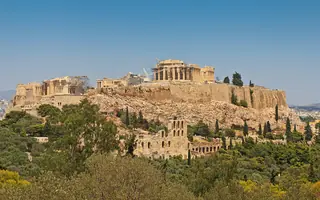
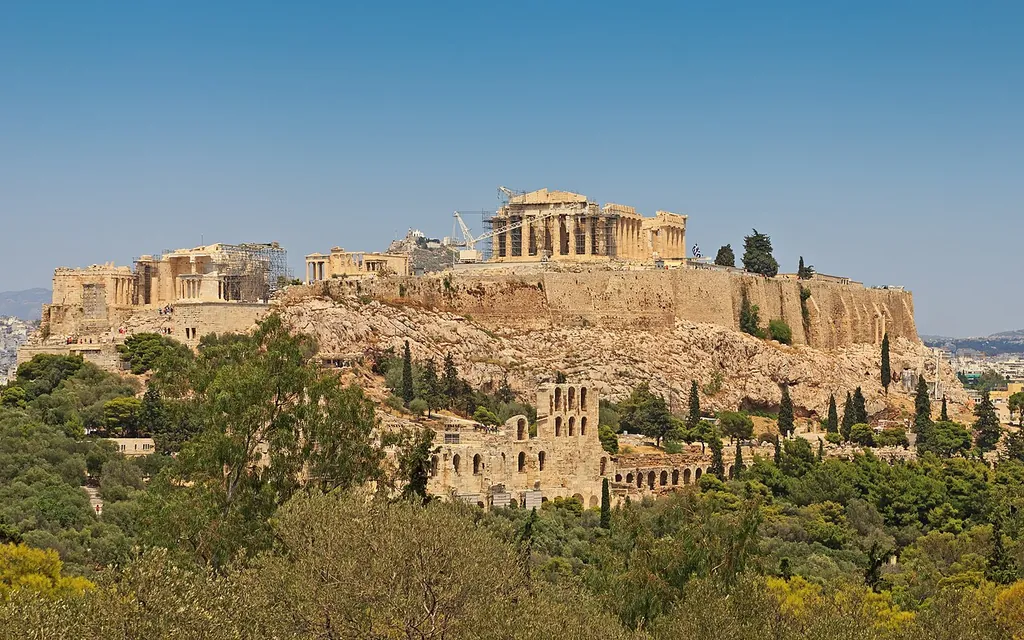
The sacred rock of the Acropolis with the Parthenon, the Propylaia, the Erechtheion and the Temple of Athena Nike, the most important monumental ensemble of ancient Athens.
Have only individual sections read aloud
About the museum
The Acropolis rock rises about 156 metres above the sea and is steep on all sides except the west. It was inhabited as early as the 3rd millennium BC, thanks to its natural defensibility and the springs on its slopes. In the Mycenaean period it became a centre of power, and from the 8th century BC it took on an exclusively religious character with the worship of Athena Polias. In the mid-6th century BC Peisistratos built an early temple, and after the victory at Marathon in 490 BC construction began on a larger temple, the Older Parthenon.
In 480 BC the Persians invaded Attica, looted the Acropolis and set fire to its monuments. From the mid-5th century BC Pericles launched an ambitious building programme that lasted almost half a century and produced the monuments we know today: the Parthenon, the Propylaia, the Erechtheion and the Temple of Athena Nike.
The Parthenon was designed by Iktinos in collaboration with Kallikrates, and Pheidias was responsible for its sculptural decoration. Inside the temple stood the gold and ivory statue of Athena. The Erechtheion is known for its porch of the Maidens, later called the Caryatids, and it was there that the Panathenaic procession, the city’s great festival, ended.
Highlights
- The Parthenon, temple of Athena
- Propylaia, the monumental entrance to the rock
- Erechtheion with the porch of the Caryatids
- Temple of Athena Nike
- View over all of Athens from the sacred rock
Permanent exhibition
- Ιερός Βράχος της Ακρόπολης – A walk past the monuments on the rock: the Propylaia, the Temple of Athena Nike, the Erechtheion and the Parthenon.
- Operated by
- Εφορεία Αρχαιοτήτων Πόλης Αθηνών
Admission & discounts
| Adults | €30 |
|---|---|
| Reduced | €15 |
Free admission: 6 March, 18 April, 18 May, the last weekend of September, 28 October, as well as every first and third Sunday of the month from 1 November to 31 March.
Tickets are also available from the online shop at tickets.hh.gr.
Accessibility
- Partially wheelchair accessible
- Elevator
- Accessible restroom
- Accessible parking: no information
- Service dogs welcome: no information
- Tactile models & exhibits: no information
- Sign language tours: no information
- Easy-to-read materials: no information
- Audio description: no information
On the north side of the rock a lift serves visitors with mobility difficulties and parents accompanying two or more infants; it is about 300 metres from the exit area. Visitors using a wheelchair enter accompanied, either through the special entrance and exit on the western slope, north of the main entrance, or through the main entrance on the southern slope. At the end of the route between the Parthenon and the Erechtheion there is an accessible WC.
Kids & families
The museum hasn’t published any information on this.
Getting there & parking
By public transit
Ακρόπολη · 12-min walk
Metro Line 2, Akropoli station; Lines 1 and 3, Monastiraki station; bus 230, Akropoli stop.
By car the site is about 10 minutes from Syntagma Square.
Get directionsAmenities & dining
- Café
- Museum shop
- Wi-Fi
On site there are a café/restaurant, a shop (Hellenic Heritage Museum Shop at the entrance), toilets and WiFi.
Events & venue rental
The museum hasn’t published any information on this.
Plan your visit
| Good to know | The main entrance is on Dionysiou Areopagitou and Thrasyllou streets, on the southern slope of the rock. |
|---|