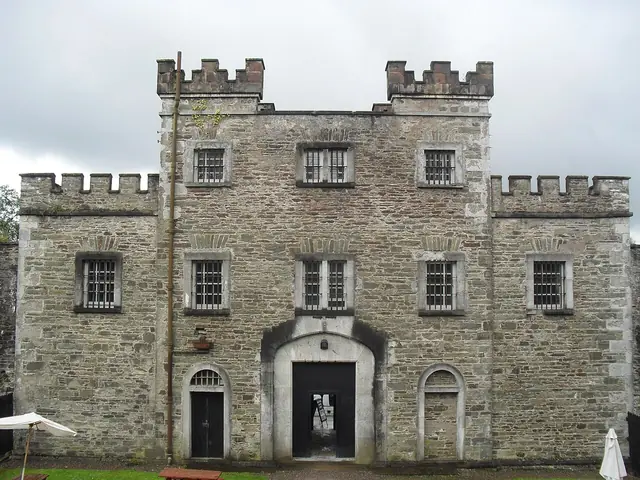
Elizabeth Fort
Seventeenth-century star-shaped fort above Cork city with free entry, wall walks, guided tours and an audio guide.
Have only individual sections read aloud
About the museum
Elizabeth Fort was first built in 1601 as an earth, stone and timber fort on the orders of Sir George Carew, President of Munster, in response to events at Kinsale. It was attacked in 1603 when the death of Queen Elizabeth sparked a revolt in Cork, and was rebuilt in stone between 1624 and 1626 in its present star shape, much of which survives.
The fort was strengthened again around 1649 and 1650 and withstood the Siege of Cork in 1690, until it was surrendered after the city wall was breached. Army barracks were built inside in 1719, and from 1817 to 1837 it was a depot where up to 250 convicts at a time waited for ships to Australia. During the Great Famine it served as a food depot, one of ten in the city that together fed up to 20,000 people a day.
In the twentieth century it was a base for auxiliary forces in the War of Independence, was held by anti-Treaty forces in the Civil War, and had a new Garda station built within its walls in 1929; the Garda station closed in 2013. Cork City Council now runs the fort as a free attraction. Visitors can walk the walls with views over the city, join a guided tour, or use an audio guide.
Highlights
- Star-shaped fort from the 1620s with walkable walls and city views
- Free general admission
- Daily guided tours telling 400 years of history
- Audio guide in seven languages
- Former Garda station and air-raid shelter within the walls
Permanent exhibition
- Elizabeth Fort walls and guided history tour – A walk on the star-shaped fort’s walls and through its buildings, telling its use as barracks, convict depot, famine food depot and Garda station.
- Operated by
- Cork City Council
Admission & discounts
Admission is free.
| Guided tour (per person) | €5Tuesday to Saturday at 11:00, 13:00 and 15:00; Sunday at 13:00 and 15:00. Can be booked online. |
|---|---|
| Audio guide (per person) | €3Available in English, French, German, Irish, Italian, Portuguese and Spanish. |
General admission is free of charge. Guided tours and the audio guide are optional paid extras.
Accessibility
- Partially wheelchair accessible
- Elevator: no information
- Accessible restroom
- Accessible parking: no information
- Service dogs welcome: no information
- Tactile models & exhibits: no information
- Sign language tours: no information
- Easy-to-read materials: no information
- Audio description: no information
Disability access is restricted. The courtyard is wheelchair accessible, but the walls can only be reached by a small, steep stone staircase. An accessible toilet is on site.
Kids & families
Great for kids & families
The council describes the fort as a great attraction for young and old.
Getting there & parking
By car
No on-site parking at the museum.
There is no parking at the fort. Visitors are advised to use a city centre car park such as Park It Here or Grand Parade and walk up Barrack Street.
The fort is on Barrack Street, just outside the line of the medieval city walls.
Get directionsAmenities & dining
The museum hasn’t published any information on this.
Events & venue rental
The museum hasn’t published any information on this.
Plan your visit
| Guided tours | yes |
|---|---|
| Audio guide | yes (EN, FR, DE, GA, IT, PT, ES) |
| Good to know | Guided tours are recommended for a deeper understanding of the fort and can be booked online. Guided group tours are available on request; pre-booking by phone or email is advised, especially for large groups. |