Fort Dunree
Military museum in a coastal fort above Lough Swilly on the Inishowen peninsula, with underground bunkers, artillery and a café.
Have only individual sections read aloud
About the museum
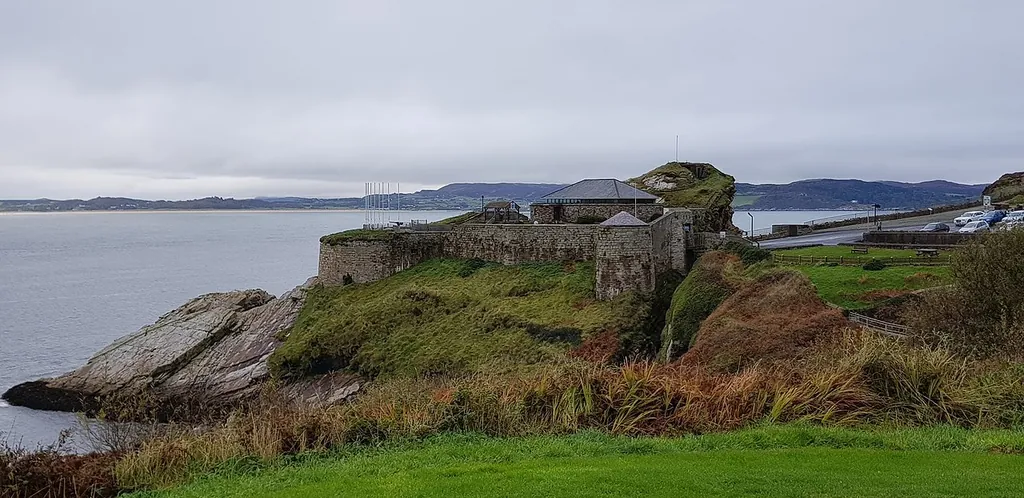
Fort Dunree stands on the western shore of Lough Swilly on the Inishowen peninsula, a sea inlet that has been important for centuries: the Flight of the Earls left from nearby Rathmullan in 1607, and Wolfe Tone was brought ashore at Buncrana as a prisoner in 1798. A small fort was built close to that spot to guard against a possible return of a French invasion fleet.
In the late nineteenth century the fort was modernised and extended with the Top Fort on Dunree Hill. During the First World War it guarded the Grand Fleet, which sheltered in the lough before the Battle of Jutland. After the Irish Free State was founded in 1922, Britain kept control of three strategic ports under the Anglo-Irish Treaty, so the Royal Navy remained at Dunree until the site was handed over to Ireland on 3 October 1938.
The fort opened to the public as a military museum in 1986. A video presentation in the audio-visual theatre introduces the history, and displays explain coastal defence, Irish neutrality and the artillery used here. Underground bunkers hold artefacts showing everyday life at the fort. The Saldanha Suite houses the Rockhill Collection of Defence Forces memorabilia and military equipment from international missions, and a remembrance garden commemorates those from Inishowen and Ireland who died in the First World War and later wars.
Highlights
- Coastal artillery and underground bunkers
- Audio-visual presentation on the history of the fort
- Rockhill Collection of Defence Forces memorabilia in the Saldanha Suite
- Remembrance garden of the Inishowen Friends of Messines
- Views over Lough Swilly, walking trails and café
Permanent exhibitions
- Fort Dunree Military Museum – Displays on the fort’s role in coastal defence and neutrality protection, with coastal artillery, a video presentation and underground bunkers holding everyday artefacts.
- The Saldanha Suite – Rockhill Collection – A collection of Defence Forces memorabilia, uniforms, rank insignia and equipment, including items from soldiers of other nations who served alongside Irish troops on UN, EU and NATO-led missions.
- Founded
- 1986
Admission & discounts
| Adults | €10 |
|---|---|
| Reduced | €7Seniors |
| Children & teens | €5 |
| Seniors | €7 |
| Groups (10+ people) | €5 per personPer person, for groups of 10. |
| Families | €25 |
Schools receive a special group rate, and supervising teachers or assistants are admitted free of charge. Euro, sterling and major cards are accepted.
Accessibility
- Partially wheelchair accessible
- Elevator: no information
- Accessible restroom
- Accessible parking: no information
- Service dogs welcome: no information
- Tactile models & exhibits: no information
- Sign language tours: no information
- Easy-to-read materials: no information
- Audio description: no information
Wheelchair and pushchair access is only partial and some areas are not accessible. An accessible toilet is available.
Kids & families
| Time needed | approx. 60 min |
|---|---|
| Family ticket | €25 |
Getting there & parking
By car
Parking available
On-site parking; visitors are asked not to block roads, driveways or rights of way.
By car the fort is about 26 miles (45 minutes) from City of Derry Airport, 32 miles (50 minutes) from Letterkenny and 68 miles (1 hour 45 minutes) from Donegal Airport. It is signposted from about five miles away.
Get directionsAmenities & dining
- Café
The fort has a coffee shop with views over the lough, open the same hours as the museum.
Events & venue rental
- Spaces for rent
The fort lists a venue hire option; details are given on its website.
Inquiries & detailsPlan your visit
| School programs | yes |
|---|---|
| Good to know | The museum visit takes about an hour; including the walks and the rest of the site, a visit can last up to three hours. A video presentation is shown in the audio-visual theatre. School tours are welcome. |