Special exhibition
Ik zie wat jij niet ziet
Temporary exhibition (since summer 2025) on artistic depictions of outer space and on how telescope data are turned into images; no end date has been given.
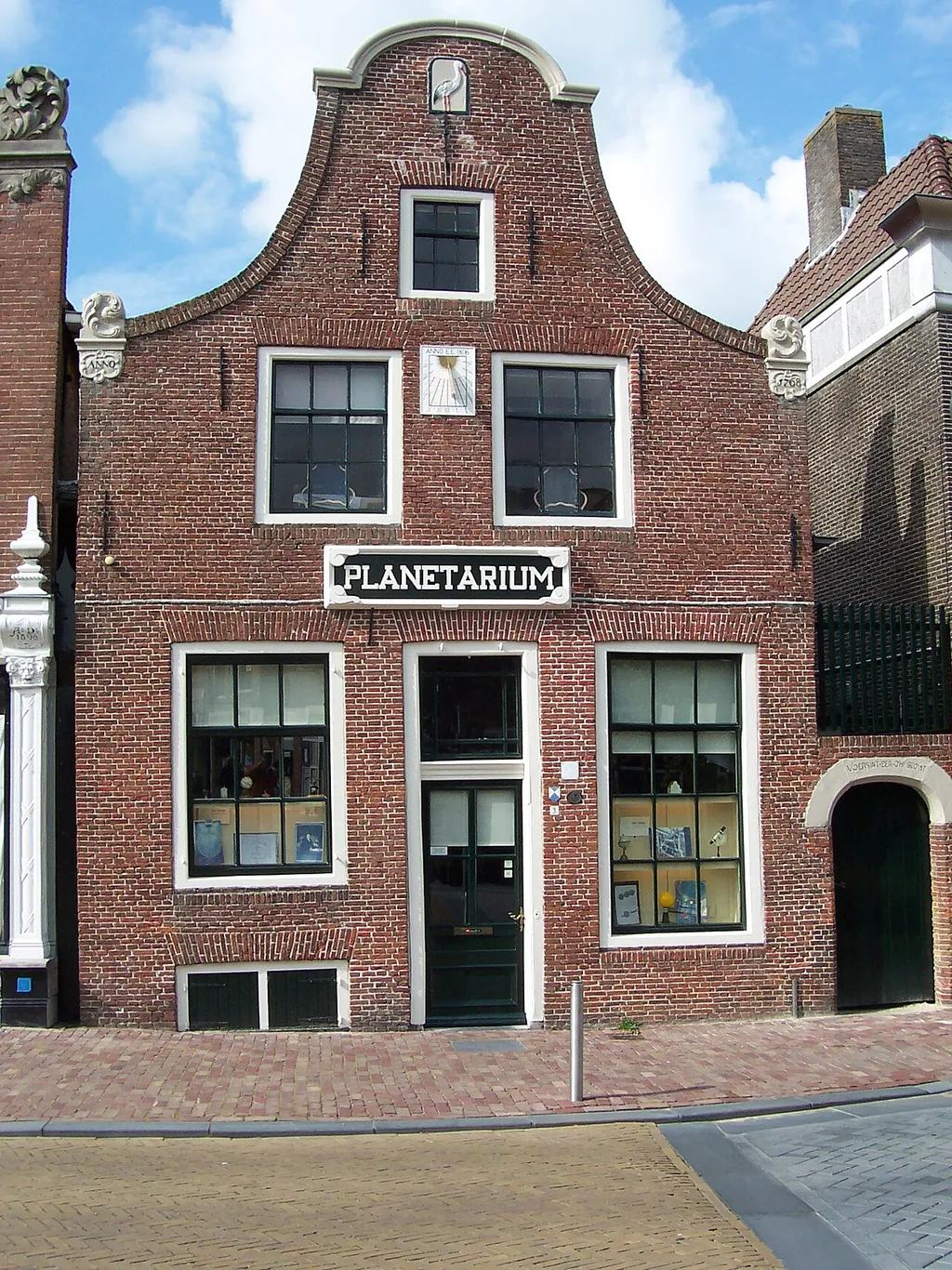
The world's oldest still-functioning planetarium: Eise Eisinga's ceiling model of the solar system in Franeker, a UNESCO World Heritage Site since 2023.
Special exhibition
Temporary exhibition (since summer 2025) on artistic depictions of outer space and on how telescope data are turned into images; no end date has been given.
Eise Eisinga (1744–1828), a wool comber from Dronrijp with a great passion for mathematics and astronomy, settled in Franeker with his business in 1768. Alongside his work, between 1774 and 1781 he built a moving model of the solar system into the ceiling of his living room. It used to be said that he wanted to dispel fears about a predicted planetary conjunction; more recent research instead points to his wish to spare himself laborious calculations and to be able to read the positions of the planets at any time.
The model shows the sun, moon, earth and the five planets known at the time on a scale of one millimeter to one million kilometers. The entire mechanism of wooden hoops, disks and iron nails is driven by a single pendulum clock, and it still runs today. Eisinga built it together with his father and brother; it is especially precise in its data on the moon.
Since the late 18th century, the house has welcomed visitors, who have its workings explained to them in the planetarium room. Today the museum is run by the Koninklijk Eise Eisinga Planetarium foundation, established in 2001. The tour also includes Eisinga's home and former wool-combing workshop, a collection of historic astronomical instruments, a screening room and, since 2016, the interactive exhibition “De Ruimte” on modern astronomy. The neighboring Art Nouveau building of the former Van Balen coffee roastery now houses a brasserie.
On September 19, 2023, UNESCO inscribed the planetarium on the World Heritage List as the thirteenth World Heritage Site of the Kingdom of the Netherlands.
| Adults | €6.50 |
|---|---|
| Reduced | €5CJP pass holders |
| Children & teens | €5free up to age 3 · Children ages 4 through 13: €5. |
| Seniors | –No senior discount mentioned. |
| Groups (20+ people) | €5 per personGroups of 20 or more on request via form; payment by invoice. Schools €3.75 per student, one accompanying adult free for every four students. |
| Combination ticket with Museum Martena or Kaatsmuseum (adults) | €10Valid for one year; visits need not be on the same day |
| Combination ticket with Museum Martena or Kaatsmuseum (children) | €7.50Valid for one year |
| School classes (per student) | €3.75One accompanying adult free for every four students |
The Museumkaart is not valid at the planetarium. Reserving online in advance is recommended to be sure of entry.
The building is largely wheelchair-accessible; an elevator goes up to the second floor. The mechanism can only be reached via a steep staircase; on the first floor, screens show a film and animation about it. Pets are not allowed; assistance dogs are welcome.
Great for kids & families
| Kids’ admission | free up to age 3 |
|---|
In the interactive exhibition “De Ruimte,” children can set the earth in motion themselves, make the mechanism turn and solve questions about telescopes or eclipses. The current temporary exhibition has a hands-on wall where children can add their own artwork to a solar system. For school classes there are scavenger hunts and coloring pages.
No dedicated parking. Franeker is divided into parking zones; according to the museum, the free zone is within walking distance of the planetarium.
The planetarium is located in Franeker's historic city center.
Get directionsBrasserie De Stadstuin in the former Art Nouveau Van Balen coffee roastery next door (coffee, cake, lunch; operated separately). Museum shop with books about Eisinga, among other items.
No rentals by the museum mentioned; the neighboring Brasserie De Stadstuin offers rooms for conferences and meetings.
| Guided tours | yes · approx. 15 min |
|---|---|
| School programs | yes |
| Good to know | Every visitor receives an explanation of about 15 minutes in the planetarium room; the rest of the museum is explored independently; full guided tours are not offered. Groups can specify the language of the explanation when making their request. School visits usually last about 1.5 hours (explanation plus scavenger hunt). |
Cookies help you use this website. We only load the map and statistics with your consent.