Lived-in local heritage museum in a Toggenburg farmhouse from 1752 with furniture, farmhouse painting and house organs, plus a cultural venue in the extension.
Show individual sections
Highlights
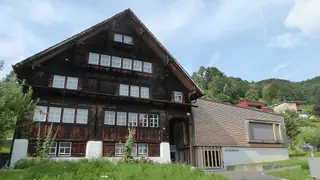
Toggenburg farmhouse from 1752 as a lived-in local heritage museum
Painted furniture, Alpine dairy-farming ornaments and farmhouse painting
House organs and neck zithers from the Toggenburg
Collection of the teacher and painter Albert Edelmann
Cultural venue with concert hall in the modern extension
The 2026 special exhibition shows a collection of photographs of Toggenburg houses from around 1910 to 1920, which a farmer found with a Munich dealer. Open Sundays 13 to 17 Uhr until 8 November 2026 (summer break 6 July to 30 August).
About the museum
The house that now accommodates the museum was built in 1752 as a stately Toggenburg farmhouse on the Füberg near Oberhelfenschwil. Later it served as a poorhouse and was due to be demolished in 1949. The teacher, painter and collector Albert Edelmann (1886–1963) recognised its value, had it carefully dismantled and rebuilt in 1951/52 in Ebnat-Kappel at its present location "im Acker".
Edelmann furnished the building as a lived-in local heritage museum and gave his collection a home there: furniture, musical instruments, rural art and everyday objects that reflect life in the Toggenburg over four centuries. After his death, his long-time housekeeper Ida Bleiker continued to run the museum in his spirit together with the Albert-Edelmann-Stiftung. The foundation owns the house and the collection.
Since 2015 a modern extension has complemented the Baroque log-frame house; it serves as a cultural venue with a concert hall. The Kulturverein Ackerhus was founded in the same year and today looks after the museum, mostly on a voluntary basis. The tour leads through the parlour, the parlour chamber and other rooms with painted furniture, Alpine dairy-farming ornaments, house organs and neck zithers.
Permanent exhibition
Toggenburger Hauskultur – Domestic culture spanning four centuries with painted Toggenburg furniture, house organs and neck zithers, farmhouse painting and decorated everyday objects.
According to the website, the museum is wheelchair accessible and the sanitary facilities are accessible; the hall in the extension has barrier-free access.
Kids & families
The museum hasn’t published any information on this.
Getting there & parking
By public transit
Ebnat-Kappel Acker · 3-min walk · 200 m
Bus to the stop "Ebnat-Kappel Acker"; from Ebnat-Kappel station it is about 800 metres (roughly a 10-minute walk).
Museum shop with regional crafts, textiles, woodwork and publications on Toggenburg culture.
Events & venue rental
Spaces for rent
Private parties
Corporate events
Weddings / ceremonies
Up to 100 guests.
Hall in the extension for 80–100 people with concert seating or about 60 at a banquet, with projector and screen; the historic house has a wedding room for civil ceremonies and smaller celebrations.