The exhibition examines Richard Wagner's antisemitism from a Jewish perspective and presents Jewish positions on this ambivalent subject from almost 200 years. Curated together with the Richard-Wagner-Stätten Graupa.
About the museum
The museum is housed in the country house in which Richard Wagner lived as a tenant from 1866 to 1872. The roots of the listed building on the shore of Lake Lucerne go back to the 15th century; its present appearance with the regular rows of windows dates from around 1800. In the 18th century the Lucerne patrician family Am Rhyn acquired the estate as a summer house; Wagner's landlord was Colonel Walter Am Rhyn.
After Wagner moved to Bayreuth, the house stood empty for a long time or served as holiday accommodation. In 1931 the City of Lucerne bought the property together with about 30,000 square metres of parkland in order to make it accessible to the public; two years later, in 1933, the museum was founded. From 1943 to 2009 the upper floor displayed Heinrich Schumacher's collection of historical musical instruments, which can now be seen in the Haus der Instrumente in Kriens.
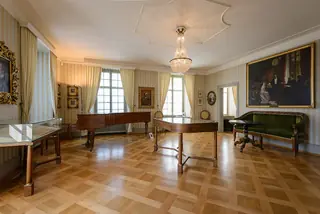
The permanent exhibition on the ground floor was redesigned between November 2022 and April 2023. Instead of display cases, an audio guide now leads through the former living rooms, which are furnished with restored and original furniture. The showpiece is Wagner's Érard grand piano from Paris, dating from 1858, which is still playable today and is used for concerts during public tours. The upper floor is used for changing exhibitions about Wagner.
Permanent exhibition
Dauerausstellung zu Leben und Werk Richard Wagners – In the former living rooms on the ground floor, an audio guide leads through Wagner's Lucerne years; on display are original and restored furniture as well as the Érard grand piano of 1858.
Founded
1933
Operated by
Stadt Luzern
Director
Monika Sigrist
Admission & discounts
Adults
CHF 12
Reduced
CHF 10AHV (old-age pension) and guest card
Children & teens
CHF 5Children and young people aged 10 to 16 pay CHF 5; children up to 10 years have free admission.
Seniors
CHF 10AHV recipients.
Students & apprentices
CHF 5Pupils and students.
Groups (10+ people)
CHF 10 per personGroup rate for 10 or more people; tours for an additional fee (see visitor information).
According to the museum, holders of the Swiss Museum Pass, the Lucerne Museum Pass, the Raiffeisen card, the Swiss Travel Pass and the KulturLegi have free admission. The audio guide is included in the admission price.
The historic building is only partly accessible: nine steps with a handrail lead to the entrance, and the forecourt has a gravel surface. The permanent exhibition on the ground floor is wheelchair accessible; the rooms on the first floor can only be reached by stairs. A wheelchair-accessible outdoor toilet is available; there is seating in the exhibition rooms.
Kids & families
Only partly suitable for kids
Children up to 10 years have free admission; a school programme for lower and upper secondary levels is in development.
Getting there & parking
By public transit
Wartegg
From Lucerne station by bus 6, 7 or 8 to "Wartegg", then 5 to 10 minutes on foot towards the lake; by boat from Lucerne Schiffsquai KKL in about 10 minutes to the "Tribschen" stop.
By car
Parking available
Parking at the end of Warteggstrasse; from there a footpath leads to the museum in a few minutes.
On foot from the station in about 25 minutes along the lake, with a short steep stretch at the end. By car from Bundesplatz take Tribschenstrasse out of town, and after Sankt Anton church turn left into Warteggstrasse.
The audio guide (about 45 minutes, 22 stations) is downloaded to your own smartphone; please bring your own headphones. Private tours in five languages (CHF 160 for 6 to 25 people, CHF 180 for up to 5 people, plus admission). Public tours and themed tours according to the events calendar.