Canons Ashby
Tudor and early Georgian manor house of the Dryden family in Northamptonshire, with painted rooms, terraced gardens and a priory church.
Have only individual sections read aloud
About the museum
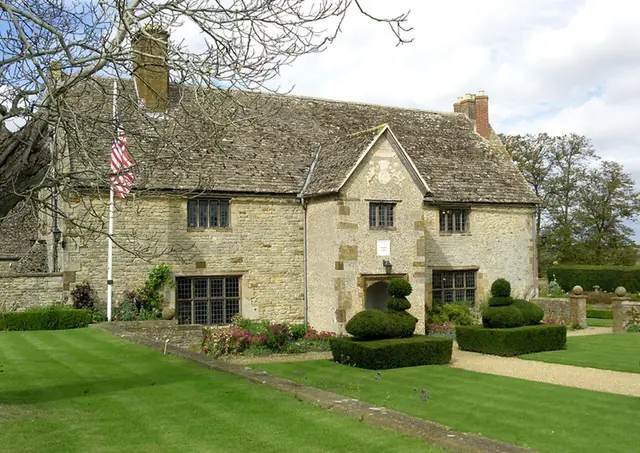
Canons Ashby began as an Augustinian priory founded in the middle of the 12th century. The name means the canons' farmstead. After the priory was dissolved under Henry VIII, the land passed through a few owners until the Dryden family took it over in the 1550s. They lived here for about four hundred years, and the courtyard house grew in stages, with major extensions in the late 16th century.
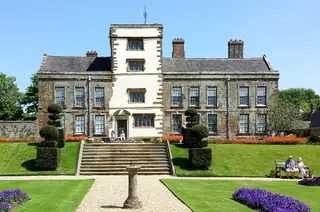
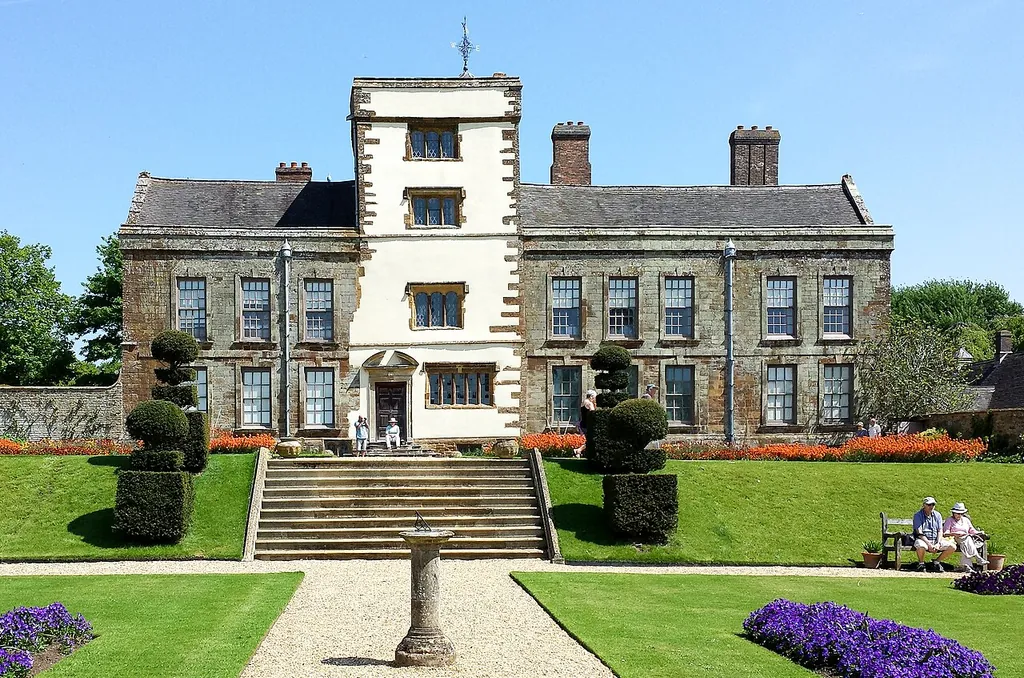
The next big change came in the early 18th century, when Edward Dryden, a London grocer who had inherited the estate, modernised the house, refaced the south front and laid out a formal terraced garden. His cousin Elizabeth Creed painted the trompe l'oeil decoration in the Painted Parlour. Later generations changed the house very little, which is why it has kept so much of its early 1700s character, including rare furniture of that date.
Today the house is run by the National Trust. Visitors see panelled and plastered rooms, tapestries and the old kitchen and servants' areas. Outside are Edward's Garden, a paddock and parkland, and St Mary's Church, the only surviving part of the priory.
Highlights
- Painted Parlour with trompe l'oeil decoration by Elizabeth Creed
- Tapestry Room and Jacobean plasterwork
- Tudor wall painting of the story of Jeroboam in Spenser's Room
- Terraced Edward's Garden, paddock and parkland
- St Mary's Church, the remnant of the medieval priory
Permanent exhibitions
- The house – Panelled and plastered rooms with tapestries and early 18th-century furniture, including the Painted Parlour, the Drawing Room and the old kitchen.
- Edward's Garden and parkland – An 18th-century terraced garden with flowers, fruit and vegetables, a paddock and surrounding parkland with traces of medieval farming.
- Operated by
- National Trust
Admission & discounts
| Adults | £15 |
|---|---|
| Children & teens | £7.50free up to age 4 · Children aged 5 to 17; under 5s are free. |
| Groups | £14.25 per personGroup adult price; the group child price is £7.13. |
| Families | £37.50Two adults and up to three children. |
| Family ticket, one adult and up to three children | £22.50 |
Prices are standard admission without Gift Aid; the price with Gift Aid is £16.50 for adults, £8.30 for children and £41.30 for a family. Entry is free for National Trust members. Some family trails and craft activities cost extra.
Accessibility
- Partially wheelchair accessible
- Elevator: not available
- Accessible restroom
- Accessible parking
- Service dogs welcome
- Tactile models & exhibits
- Sign language tours: no information
- Easy-to-read materials: no information
- Audio description: no information
This is a historic building with steps and stairs; there is no lift, and step-free access in the house is only to the Great Kitchen, where a video tour is available. A driver-assisted buggy runs between the car park and the house, tea-room and shop. In the garden only the Sundial Terrace is level, with steps and gravel paths elsewhere. Hearing loops are in reception, the shop and tea-room, with a portable loop in the house. Braille and large print guides, ear defenders and a quiet space are available, and some items in the rooms can be handled. Assistance dogs are welcome everywhere.
Kids & families
Great for kids & families
| Kids’ admission | free up to age 4 |
|---|---|
| Family ticket | £37.50 · Two adults and up to three children. |
- Family tours & workshops
- Activity booklet, scavenger hunt or kids’ audio guide
- Hands-on stations
- Baby changing facilities
- Playground / play area
Family trails are available at reception, with seasonal trails and craft activities during school holidays, and there is a wild play corner. Baby changing is next to the accessible toilet and the ladies toilet, and high chairs are available. Pushchairs can be left in the courtyard; the garden has loose gravel and steps, and the parkland can be boggy, so it may be hard going with a pushchair.
Getting there & parking
By public transit
Woodford Halse (bus)
There is no direct public transport. The nearest railway stations are Banbury (12 miles) and Buckby (12.7 miles); buses between Daventry and Banbury stop at Woodford Halse, 4 miles away.
By car
Parking available
Small car park about 200 yards from the house, with mobility parking and four electric vehicle charging bays; the car park is locked at 17:00. Cycle racks are next to reception.
- Accessible parking
Sat nav postcode NN11 3SD. From the M40 take the A422 towards Northampton and then the B4525; from the M1 take the A45 and A5 towards Towcester and follow the brown signs. HS2 construction work has caused road closures nearby, so allow extra time. The site is on the Macmillan Way footpath and National Cycle Network route 50.
Get directionsAmenities & dining
- Café
- Museum shop
Tea-room in the former stables serving hot meals, sandwiches and snacks, a shop in the Victorian Coach House and a second-hand bookshop in the old brewhouse. Picnic tables in the Paddock.
Events & venue rental
The museum hasn’t published any information on this.
Plan your visit
| Good to know | Room guides in the house answer questions and offer objects to handle. Group visits can be booked in advance, and occasional extra tours and events are listed on the property page. If you want to see a particular room or object, contact the property beforehand because not everything is on display at once. |
|---|