Museum of Witchcraft and Magic
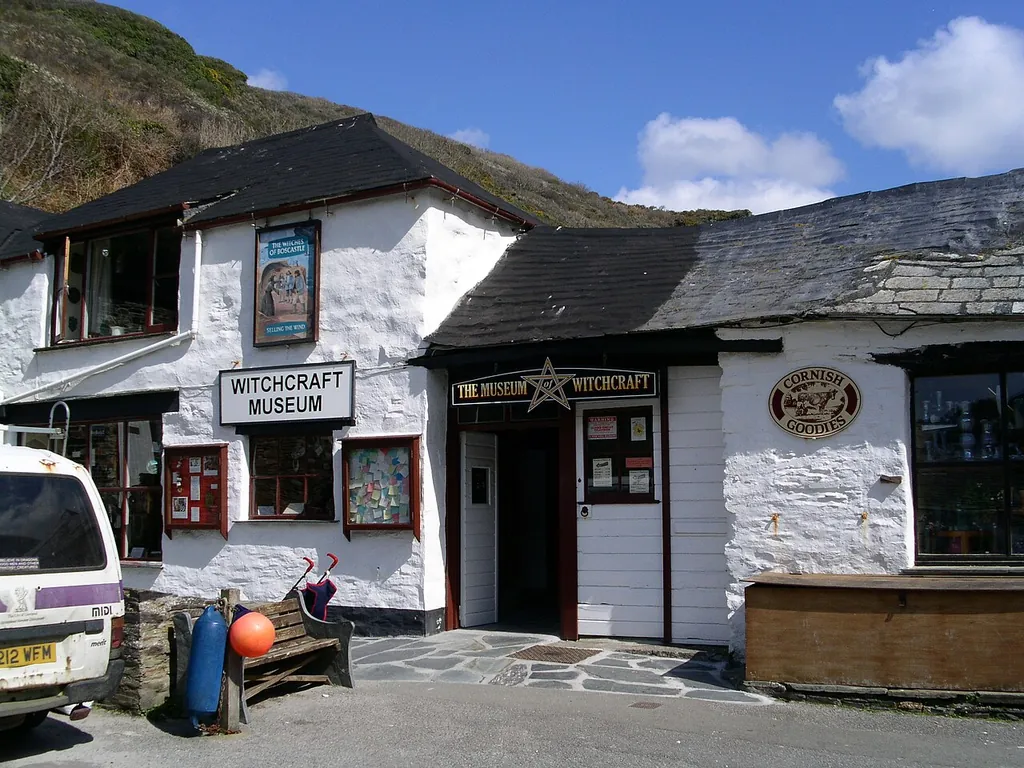
Independent museum in a harbourside building at Boscastle with a collection of over 3,000 objects on witchcraft, folk magic and ritual magic in Britain.
Have only individual sections read aloud
About the museum
The museum was created by Cecil Williamson, who had been interested in witchcraft and magic since childhood. He first opened a Museum of Witchcraft in Stratford-upon-Avon, moved to the Isle of Man after local opposition and opened a folklore centre there in 1951, then set up several more museums on the mainland. He settled in the Cornish village of Boscastle and opened the Museum of Witchcraft there in 1960, using his skills as a filmmaker to create theatrical displays around a growing collection of magical objects, many of them linked to everyday folk magic.
In 1996 Williamson sold the museum to Graham King, who developed it into a successful independent museum with an international reputation, expanded the collection to include more ritual and comparative magic, and arranged a major redisplay. In August 2004 a devastating flood swept through Boscastle; most of the objects were protected, and the museum reopened with new exhibition spaces. In 2013 King gave the museum and its contents to Simon Costin, director of the Museum of British Folklore, and in 2015 it was renamed the Museum of Witchcraft and Magic to reflect its wider interests.
Today the collection has grown to over 3,000 objects and more than 7,000 books. The museum is independent of the National Trust, receives no public funding and occupies a historic stone building in the harbour area, spread over a compact ground floor and an upper floor.
Highlights
- More than 3,000 objects of witchcraft, folk magic and ritual magic
- Library of over 7,000 books
- Displays on magical practice in Britain from ancient times to the present
- Joan's Cottage display with sound as part of the interpretation
- Historic harbourside building in Boscastle
Permanent exhibition
- Permanent collection – Displays of magical objects, many connected with the everyday folk magic of ordinary people, show the history of magical practice in Britain from ancient times to the present.
- Founded
- 1954
- Operated by
- Museum of Witchcraft and Magic
Admission & discounts
| Adults | £8 |
|---|---|
| Children & teens | £5free up to age 4 · Child ticket for ages 6 to 17. Children under 5 enter free. |
| Seniors | –There is no concessions scheme. |
| Visitors with disabilities | –Wheelchair users who cannot visit the upper floor independently are not charged. Carers pay the normal adult or child price. |
The museum receives no public funding and has no concessions.
Accessibility
- Partially wheelchair accessible
- Elevator: not available
- Accessible restroom: not available
- Accessible parking: not available
- Service dogs welcome
- Tactile models & exhibits: no information
- Sign language tours: no information
- Easy-to-read materials: no information
- Audio description: no information
The museum is in a historic stone building in a conservation area with narrow doorways, and it is not an accessible building. The entrance is step-free, and some manual wheelchair users can reach the compact ground floor on their own if the chair is no larger than a standard UK reference wheelchair. The two staircases (13 steps each) have no stairlift, because the old one was removed, so the upper floor cannot be reached by wheelchair. A folding manual wheelchair can be borrowed on the ground floor (subject to availability; no staff assistance). Small class 1 scooters are usually allowed in the shop area, but larger scooters must stay outside. Six disabled parking bays are in the village car park, 250 metres away, and there is a disabled drop-off at the museum but no parking. Assistance dogs are welcome and water is provided. A large-print guide, ear defenders, torches and illuminated magnifying glasses can be borrowed at the booth. A BSL video was being prepared for summer 2026. The museum has no toilets; the nearest are in the village car park. Light levels are low in some rooms.
Kids & families
Only partly suitable for kids
| Kids’ admission | free up to age 4 |
|---|
- Stroller-friendly: not available
Children visit at the discretion of accompanying adults. Buggies and pushchairs are allowed, but parents must be able to carry them up and down the stairs, and there is no buggy storage; they can be folded and left outside at the owner's risk.
Getting there & parking
By car
No on-site parking at the museum.
There is no parking at the museum, and the harbour area is largely pedestrianised with permit parking for local businesses only. Visitors park at the Cobweb Car Park in the village (run by Cornwall Council), a flat 5-minute walk away, where public toilets and six disabled bays are located.
- Accessible parking: not available
The museum stands by the harbour in Boscastle on the north Cornish coast between Tintagel and Bude, on the same side of the harbour as the National Trust building. Drop-off for disabled visitors is possible at the museum.
Get directionsAmenities & dining
- Café: not available
- Restaurant: not available
- Museum shop
- Coat check
There is a museum shop and a booth selling guidebooks, including foreign-language guides. There is no café, but two cafés and an ice-cream stall are in the harbour area, and food and drink may not be taken into the museum. Backpacks must be removed, and limited bag storage is available at the owner's risk.
Events & venue rental
As far as we know, the museum does not rent out spaces for external events.
The museum does not host events or workshops and has no space to offer for them.
Plan your visit
| Photography | Still photography is welcome, but video and flash photography are not allowed. |
|---|---|
| Good to know | Dogs are not allowed except assistance dogs. Children visit at the discretion of their accompanying adults. The museum can be crowded and noisy, and the quietest time is usually between 16:00 and 17:00; in busy periods visitors may have to queue outside. The library and archive are open by appointment for research. |