Stott Park Bobbin Mill
Victorian bobbin mill in the Lake District, presented as in the 1870s and shown on guided tours with working machinery.
Have only individual sections read aloud
About the museum
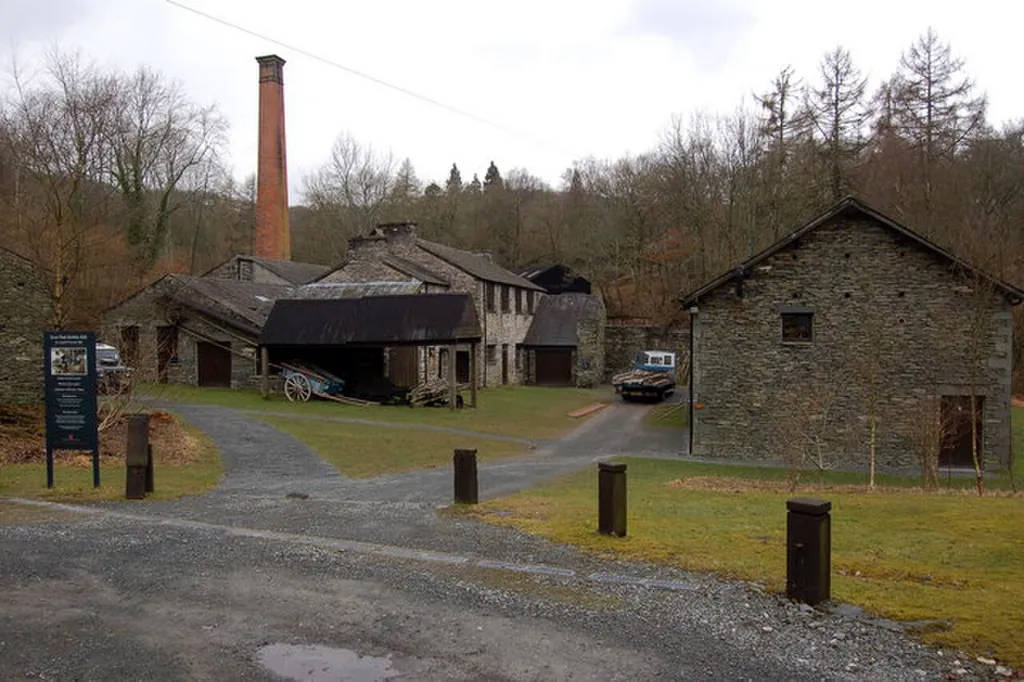
Stott Park Bobbin Mill was built in 1835 by the local landowner John Harrison as a speculative venture. It is the last survivor of around a hundred Lake District mills that turned coppiced timber into wooden bobbins for the Lancashire cotton industry. Bobbin masters leased the mill for short periods, and the Coward family ran it from 1864 and bought it in 1921.
A waterwheel powered the machinery until 1858, when a water turbine replaced it. A new lathe shop was built in 1876 for heavier machines driven by leather belts from line shafting, and a steam engine was added in the early 1880s to supplement the turbine. Water stayed the main source of power until an electric motor arrived in 1941. The mill kept this older set-up rather than changing to fully automatic machines, which helped it to make other products such as toggles and tool handles.
Boys as young as eight worked at the mill before the Factory and Workshop Act of 1878; afterwards the minimum age was ten, with half-time work until fourteen. The mill closed in 1971 after more than a century of largely unchanged production. The Department of the Environment opened it to the public as a working mill in 1983, and English Heritage took over its care in 1984. Today it is presented as it was in the 1870s.
Highlights
- Belt-driven bobbin-making machinery in working order
- Steam engine, run on selected days
- Guided tour showing how timber became bobbins
- Drying Barn exhibition on bobbin making and child labour
- Four acres of woodland with bluebells in spring
Permanent exhibition
- Bobbin-making exhibition and mill tour – Guided tour of the working belt-driven machinery as in the 1870s, and an exhibition in the Drying Barn on bobbin makers and child labour.
- Founded
- 1983
- Operated by
- English Heritage
Admission & discounts
| Adults | £10.79 |
|---|---|
| Reduced | £10.03Concession tickets |
| Children & teens | £5.35Child ticket |
| Groups | –Group visits are bookable via the English Heritage group visits page. |
| Families | £27.03Family ticket; the composition of the family ticket is not stated on the booking page. |
| Family ticket, one adult | £16.15 |
Prices shown are the online advance prices for peak days (a 10% online discount is included) and exclude the optional donation. Tickets bought on the day at the site cost more: adult £12.70, child £6.30, concession £11.80, family £31.80. Prices change by season and day; the booking calendar shows what applies. Tickets can be bought online until 08:45 on the day of the visit, otherwise on arrival subject to availability. English Heritage members enter free (bring the membership card); membership allows free entry for up to six children with a member adult.
Accessibility
- Partially wheelchair accessible
- Elevator: not available
- Accessible restroom
- Accessible parking
- Service dogs welcome
- Tactile models & exhibits
- Sign language tours: not available
- Easy-to-read materials: no information
- Audio description: not available
Wheelchair access is to the ground floor of the mill only; the upper floor is reached by steep wooden stairs and there is no lift. The site is sloped and uneven with trip and slip hazards, especially when wet. Three disabled parking spaces are in the lower car park, about 50 metres from the mill entrance. Cut timber and turned bobbins at every stage of manufacture can be handled, and braille guides and signage are available. Induction loops are available on request. Audio tours, large print and BSL tours are not available.
Kids & families
Great for kids & families
| Family ticket | £27.03 · Family ticket; the composition of the family ticket is not stated on the booking page. |
|---|
- Activity booklet, scavenger hunt or kids’ audio guide
- Hands-on stations
- Playground / play area
A resident bobbin turner leads an interactive family trail through the mill, where children find clues and can win a sticker. The exhibition looks at the experience of the child workers, and there is a small play area by the picnic tables. Push chairs are allowed on site, but the ground is sloped and uneven.
Getting there & parking
By public transit
Lakeside station (Lakeside & Haverthwaite Railway)
Bus Lecks 538 passes the site on Thursdays only. Otherwise take Stagecoach X6, Lecks 518 or the summer Blueworks X32 to Newby Bridge and walk about 1½ miles. Grange-over-Sands station is about 8 miles away. Lakeside station on the Lakeside & Haverthwaite Railway is about ¾ mile on foot, and Windermere Lake Cruises run from Ambleside or Bowness to Lakeside, then a ¾-mile walk.
By car
Paid parking · 200 m to the entrance
The top car park has 15 spaces and room for up to three coaches, about 200 metres from reception. The lower car park has seven spaces, including three disabled bays, about 50 metres from reception. Parking is free for members and charged for non-members.
- Accessible parking
The mill is 1½ miles north of Newby Bridge, off the A590. Sat nav postcode LA12 8AX.
Get directionsAmenities & dining
- Museum shop
Small gift shop selling bobbins made in the mill and a second-hand bookshop during guided tours. Toilets (including an accessible toilet) are available during tours. Picnic tables and benches in the grounds.
Events & venue rental
The museum hasn’t published any information on this.
Plan your visit
| Guided tours | yes |
|---|---|
| Audio guide | no |
| School programs | yes |
| Photography | Photographers whose main reason for visiting is photography should call ahead, as some areas may be restricted. Drones are not permitted except by approved contractors or partners. |
| Good to know | The mill can be visited only on a guided tour, with demonstrations of the working machinery. Dogs are not allowed on the tour inside the mill, but dogs on short leads are welcome in the grounds. Smoking, vaping, barbecues and naked flames are not permitted. |