MIT List Visual Arts Center
MIT’s free contemporary art museum in the I. M. Pei-designed Wiesner Building, with changing exhibitions and the campus-wide Public Art Collection.
Show individual sections
About the museum
Contemporary art has been shown on the MIT campus since 1950, when the Hayden Gallery opened as the first contemporary visual arts space at the Institute. A gift of works from Standard Oil in 1951 started the permanent collection, and Alexander Calder’s large stabile La Grande Voile was installed on campus in 1965. In 1968 MIT created a Percent-for-Art program that still funds new commissions for major buildings.
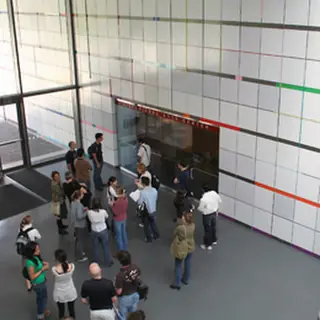
In the late 1970s MIT president Jerome Wiesner and the collectors Albert and Vera List began planning a new gallery, and the architect I. M. Pei designed a building to house both the gallery and the future Media Lab. The Wiesner Building opened in October 1985, and the gallery was formally established as the List Visual Arts Center, with artworks by Scott Burton, Richard Fleischner and Kenneth Noland built into the architecture.
The List presents changing exhibitions of contemporary art, including the List Projects series for emerging artists, and has organized the United States pavilion at the Venice Biennale. It also cares for MIT’s Public Art Collection of sculptures and installations across the campus and runs the Student Lending Art Program, which lends original works to students each year.
Highlights
- Alexander Calder’s La Grande Voile (The Big Sail), 1965
- Public Art Collection with works by Anish Kapoor, Sol LeWitt and Cai Guo-Qiang
- Wiesner Building by I. M. Pei with artist-designed courtyard and benches
- Changing exhibitions of contemporary art and the List Projects series
- Student Lending Art Program
Permanent exhibition
- MIT Public Art Collection – Sculptures, murals and installations placed across the MIT campus, from Alexander Calder’s La Grande Voile to recent commissions under the Percent-for-Art program; a public art map and digital guide help visitors find them.
- Founded
- 1985
- Operated by
- Massachusetts Institute of Technology
Admission & discounts
Admission is free.
Admission is free for everyone.
Accessibility
- Wheelchair accessible
- Elevator
- Accessible restroom: no information
- Accessible parking
- Service dogs welcome
- Tactile models & exhibits: no information
- Sign language tours: no information
- Easy-to-read materials: no information
- Audio description: no information
Ramp from Ames Street and power doors at the first-floor entrance; the galleries are wheelchair accessible and an elevator leads to the Bartos Theater on the lower level, which has wheelchair seating. Accessible parking at Ames Street and Amherst Street. Folding stools, large-print wall texts and labels, transcripts for works with sound, and an iPad on loan at the front desk. CART live captioning for most talks in the Bartos Theater; recorded programs have closed captions. ASL interpretation for tours and programs on request with three weeks’ notice. Some public artworks across campus are harder to reach; MIT publishes an accessibility map.
Kids & families
The museum hasn’t published any information on this.
Getting there & parking
By public transit
Kendall/MIT
MBTA Red Line to Kendall/MIT, then follow Main Street west to Ames Street and walk about one block south to the main entrance.
By car
Limited metered street parking in Kendall Square; garage parking at 90 Broadway. MIT campus parking is open to visitors after business hours and on weekends.
- Accessible parking
Access through the MIT Health Building is closed because of construction.
Get directionsAddress & contact
MIT List Visual Arts Center20 Ames Street, Bldg. E15
02139 Cambridge
Massachusetts, United States
Amenities & dining
- Coat check: not available
Coat and bag check is currently closed; bags must be no larger than 11 x 14 inches, self-check is available.
Events & venue rental
The museum hasn’t published any information on this.
Plan your visit
| Guided tours | yes · approx. 30 min |
|---|---|
| Audio guide | yes |
| Photography | Noncommercial photography and video are allowed for most works; no flash, tripods or large equipment. |
| Good to know | Free digital guide on the Bloomberg Connects app. 30-minute exhibition tours and 60-minute public art tours for groups of 5–20, to be booked at least two weeks ahead; scheduled public art tours are listed in the events calendar. Phone calls are not allowed in the galleries, and only pencils may be used. |
Visitor experiences
Loading experiences …