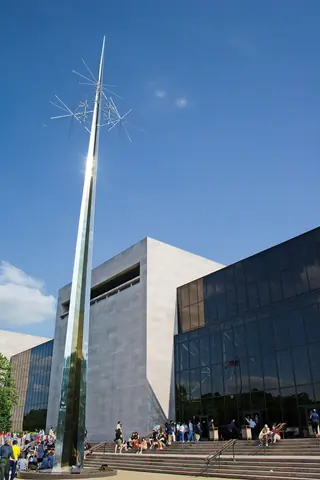
National Air and Space Museum
Smithsonian museum of aviation and spaceflight on the National Mall with the Wright Flyer, Apollo 11 Columbia and the Spirit of St. Louis; free timed passes.
Show individual sections
About the museum
The museum was created by Congress in 1946 as the National Air Museum. For decades its aircraft, rockets and engines were spread across the Arts and Industries Building, a temporary metal hangar behind the Smithsonian Castle and an outdoor rocket display, while much of the collection stayed in storage. Some objects reach back to kites given to the Smithsonian after the 1876 Centennial Exposition in Philadelphia.
The space race brought a new name, National Air and Space Museum, and the funding for a purpose-built hall on the National Mall. The building, with large glass-walled halls for hanging aircraft, opened on July 1, 1976, during the Bicentennial, under director Michael Collins, the Apollo 11 command module pilot. It quickly became one of the most visited museums in the world.
Almost all aircraft and spacecraft on display are original flown craft or backups rather than replicas. In 2003 the museum opened a second site, the Steven F. Udvar-Hazy Center near Dulles Airport in Virginia, for its largest objects. In 2018 a multi-year renovation of the Mall building began; galleries reopened in phases, and the transformation of all 20 galleries is now complete.
Highlights
- 1903 Wright Flyer
- Apollo 11 Command Module Columbia
- Charles Lindbergh’s Spirit of St. Louis
- John Glenn’s Mercury capsule Friendship 7
- Amelia Earhart’s Lockheed Vega 5B
- Lockheed Martin IMAX Theater and Northrop Grumman Planetarium
Permanent exhibitions
- Modern Military Aviation – Gallery on military aviation from the beginning of the Cold War to the present and its effect on power, politics and technology.
- At Home in Space – Gallery on more than 50 years of learning how people can live and work in space and travel beyond Earth orbit.
- TEXTRON How Things Fly – Interactive gallery with more than 45 stations that explain the science of flight.
- Founded
- 1946
- Operated by
- Smithsonian Institution
Admission & discounts
Admission is free.
| Lockheed Martin IMAX Theater | –Tickets at the on-site box office. |
|---|---|
| Northrop Grumman Planetarium | –Tickets at the on-site box office. |
Admission is free, but every visitor, regardless of age, needs a free timed-entry pass. Up to nine passes per reservation; groups of 10 or more reserve group passes. Planetarium shows and IMAX films are ticketed separately.
Booking: visits by advance booking only · timed-entry tickets · Free timed-entry passes are required for all visitors; they are released online on the first of each month at 12:00 ET for the month after next. Entry is possible any time after the time on the pass, and there is no limit on visit length.
Accessibility
- Wheelchair accessible
- Elevator
- Accessible restroom
- Accessible parking
- Service dogs welcome
- Tactile models & exhibits
- Sign language tours: no information
- Easy-to-read materials: no information
- Audio description
Ramps on both sides of the Jefferson Drive entrance vestibule; several elevators; all restrooms, stores and dining areas are accessible. Standard and bariatric wheelchairs on loan at the Security Desk, first come, first served. Accessible drop-off on Jefferson Drive SW; a few accessible parking spaces on Jefferson Drive, and vehicles with disability tags can park free at meters on Independence Avenue SW. Hearing loop (induction loops) at some media pieces, marked with a blue and white sign; other pieces use ListenTech assistive listening. All multimedia has captions. ASL interpretation is provided for some programs and can be requested for others (two weeks’ notice appreciated); CART live captioning on request; Aira ASL free on visitors’ own devices. Sighted-guide descriptive tours of 45–60 minutes and tactile Discovery Stations on request; Aira Explorer for blind and low-vision visitors. Sensory-friendly hours (Mornings at the Museum before weekend opening), sensory bags with noise-reducing headphones at the Welcome Center and a social narrative for preparation.
Kids & families
Great for kids & families
- Family tours & workshops
- Hands-on stations
- Stroller-friendly
Hands-on activities for the youngest visitors in Barron Hilton Pioneers of Flight and more than 45 interactives on the science of flight in TEXTRON How Things Fly; family days and other events. Children also need a timed-entry pass. Strollers are allowed; lactation room available.
Getting there & parking
By public transit
L’Enfant Plaza (Exit A) · 10-min walk
Metrorail L’Enfant Plaza (Blue, Orange, Silver, Green and Yellow lines), use Exit A; more than ten Metrobus stops within a block. VRE commuter trains at L’Enfant Plaza; MARC and Amtrak at Union Station.
By car
No on-site parking at the museum.
The museum has no parking for cars or buses. Limited metered street parking and paid commercial lots nearby; spaces can be reserved through ParkWhiz. Curb lanes on Independence Avenue and Jefferson Drive are for drop-off only.
- Accessible parking
For taxis and rideshares, use 601 Independence Ave SW. Bike racks at the Jefferson Drive entrance. No shuttle to the Udvar-Hazy Center in Chantilly, Virginia.
Get directionsAddress & contact
National Air and Space Museum650 Jefferson Drive SW
20560 Washington
Washington, D.C., United States
Amenities & dining
- Café
- Museum shop
Mars Café on the lower level, open daily 11:00–17:00, with salads, sandwiches and an espresso bar. Museum store on the first floor and lower level. Food must stay sealed and may not be eaten in the galleries; bottle fillers at most water fountains. Security screening at the entrance.
Events & venue rental
The museum hasn’t published any information on this.
Plan your visit
| Guided tours | yes |
|---|---|
| School programs | yes |
| Photography | Personal photography is allowed; selfie sticks, tripods and monopods are not. |
| Dogs | not allowed (assistance dogs excepted) · Pets are not allowed; service animals are welcome. |
| Good to know | Free highlights tours by volunteer docents; times at the Welcome Center. Hands-on Discovery Stations and science demonstrations around the museum. All visitors enter on Jefferson Drive SW; plan for an average wait of about 25 minutes for pass scanning and security. Re-entry on the same day needs a new pass. |
Visitor experiences
Loading experiences …
Museums nearby
All 64 museums in Washington All museums in Washington, D.C.