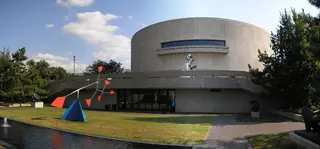
Hirshhorn Museum and Sculpture Garden
Free Smithsonian museum of modern and contemporary art in Gordon Bunshaft’s cylindrical building on the National Mall, with a sunken sculpture garden.
Show individual sections
About the museum
The Hirshhorn goes back to the collection of Joseph H. Hirshhorn, an immigrant who made a fortune in uranium mining and built a large collection ranging from French Impressionism and American modernism to contemporary painting and sculpture. After a 1962 exhibition in New York drew wide attention, several cities competed for the collection. President Lyndon B. Johnson and Smithsonian Secretary S. Dillon Ripley won it for Washington, and an act of Congress established the museum in 1966.
Architect Gordon Bunshaft designed a hollow concrete cylinder raised on four massive piers around a courtyard with a fountain, with a sunken sculpture garden on the Mall side. Under founding director Abram Lerner, more than 6,000 works were brought to Washington, and the museum opened in 1974; about one million people saw the inaugural exhibition in its first six months.
As the Smithsonian’s museum of modern and contemporary art, the Hirshhorn now focuses on art since World War II. Its program includes large long-term installations such as Mark Bradford’s Pickett’s Charge and Barbara Kruger’s Belief + Doubt. The sculpture garden, earlier remodeled by landscape architect Lester Collins, was redesigned by artist and architect Hiroshi Sugimoto and reopened in 2026 with nearly sixty sculptures; Sugimoto also designed the lobby coffee bar.
Highlights
- Gordon Bunshaft’s cylindrical building with central fountain plaza
- Sculpture Garden redesigned by Hiroshi Sugimoto, with nearly sixty sculptures
- Mark Bradford’s Pickett’s Charge, a cyclorama of eight abstract paintings
- Barbara Kruger’s immersive installation Belief + Doubt
- Laurie Anderson’s wall paintings Four Talks
Permanent exhibitions
- Sculpture Garden – Hiroshi Sugimoto’s redesigned sunken garden with nearly sixty sculptures among almost 30,000 new trees and plants.
- Mark Bradford: Pickett’s Charge – A circular, cyclorama-like installation of eight large abstract paintings based on historic images of the Battle of Gettysburg.
- Barbara Kruger: Belief + Doubt – A walk-in, site-specific text installation on democracy, doubt and belief.
- Founded
- 1966
- Operated by
- Smithsonian Institution
Admission & discounts
Admission is free.
Admission is free; no passes are needed.
Booking: not required – tickets at the desk · No passes or tickets needed.
Accessibility
- Wheelchair accessible: no information
- Elevator: no information
- Accessible restroom: no information
- Accessible parking: no information
- Service dogs welcome
- Tactile models & exhibits: no information
- Sign language tours: no information
- Easy-to-read materials: no information
- Audio description: no information
MetroAccess address: 700 Independence Ave. SW. Nearest accessible Metrorail entrance: L’Enfant Plaza, southwest corner of the Department of Transportation courtyard. A few accessible metered parking spaces near the National Mall. Manual and motorized mobility devices are permitted in all Smithsonian museums. Disability access requests: HirshhornExperience@si.edu.
Kids & families
The museum hasn’t published any information on this.
Getting there & parking
By public transit
L’Enfant Plaza
Metrorail L’Enfant Plaza station (Smithsonian Museums exit); Metrobus.
By car
No on-site parking at the museum.
No public parking facility for Smithsonian museums on the National Mall. A limited number of city-operated metered spaces, including some accessible spaces; parking can be reserved in advance through ParkWhiz.
Address & contact
Hirshhorn Museum and Sculpture Garden700 Independence Avenue SW
20560 Washington
Washington, D.C., United States
Amenities & dining
- Café
- Restaurant: not available
- Museum shop
Lobby coffee bar designed by Hiroshi Sugimoto with gelato, espresso drinks and pastries from a local roaster (10:00–17:00, Mondays from 12:00). The Museum Shop sells art supplies, housewares, accessories and books. Security screening at the entrance.
Events & venue rental
The museum hasn’t published any information on this.
Plan your visit
| Photography | Noncommercial still and video photography is allowed unless posted otherwise; tripods, monopods and selfie sticks are not permitted in Smithsonian museums and gardens. |
|---|---|
| Dogs | not allowed (assistance dogs excepted) · Dogs and other animals are not allowed, except service animals. |
Visitor experiences
Loading experiences …
Museums nearby
All 64 museums in Washington All museums in Washington, D.C.